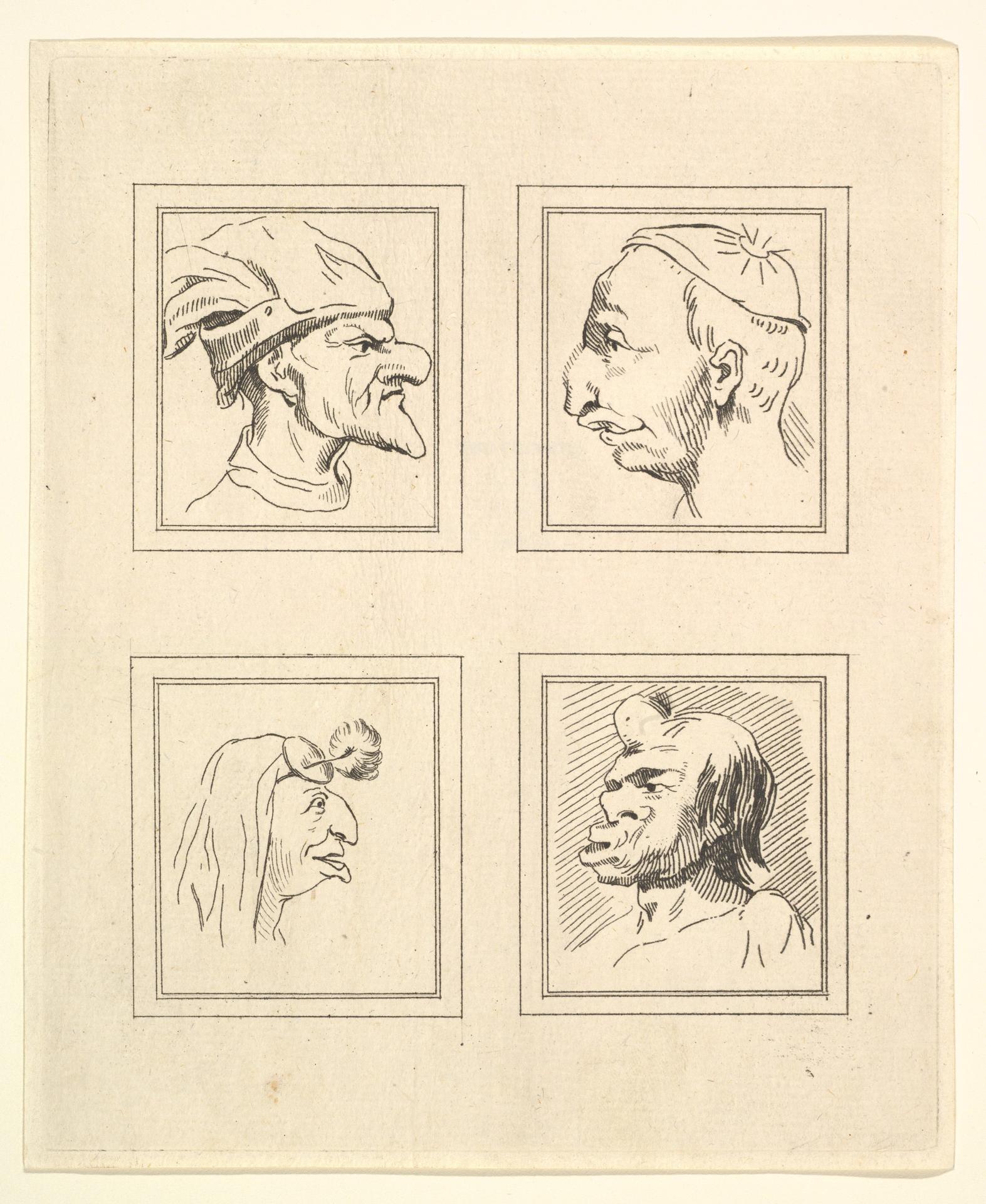
Four Heads (from Characaturas by Leonardo da Vinci, from Drawings by Wenceslaus Hollar, out of the Portland Museum)
Original title: Four Heads (from Characaturas by Leonardo da Vinci, from Drawings by Wenceslaus Hollar, out of the Portland Museum)
kurzbeschreibung
Four heads in profile, each set within its own square, make up Wenceslaus Hollar's etching Vier Köpfe from 1786. The prints show different hairstyles and expressions, ranging from serious to a slight smile. The portrait-format sheet measures 19.5 × 15.8 cm and is based on drawings after Leonardo da Vinci.
Description
Four squares of equal size divide the sheet, and in each sits a head in profile. Fine lines and varied hatching model the faces, bringing out both contours and shading. The hair falls now in curls, now in smooth strands. Each face has its own features, and the expression shifts between seriousness and a light smile. The areas behind the heads remain empty, drawing the eye to the faces.
Context
This etching was made in 1786 as part of a series based on drawings by Wenceslaus Hollar, which in turn adapted caricatures by Leonardo da Vinci. Hollar, a Bohemian printmaker of the 17th century, was known for his precise reproductions. The sheet was published from the holdings of the Portland Museum, a significant collection of the 18th century. The date is more than a century after Hollar's death in 1677, suggesting a posthumous print or a later reissue.
Impact
The strict arrangement in squares gives the sheet something scientific, almost taxonomic. Empty backgrounds and clear lines create a calm, focused mood. Despite the historical sources, the different expressions seem remarkably alive and bring out distinct characters.
Technique
The work is recognizable as an etching by its fine, even lines and typical hatching. Acid bit the plate, producing precise lines of varying thickness. The print on paper relies solely on black-and-white contrasts to create volume.
AI-generated description text
Source: Metropolitan Museum of Art · Public Domain (CC0 1.0)