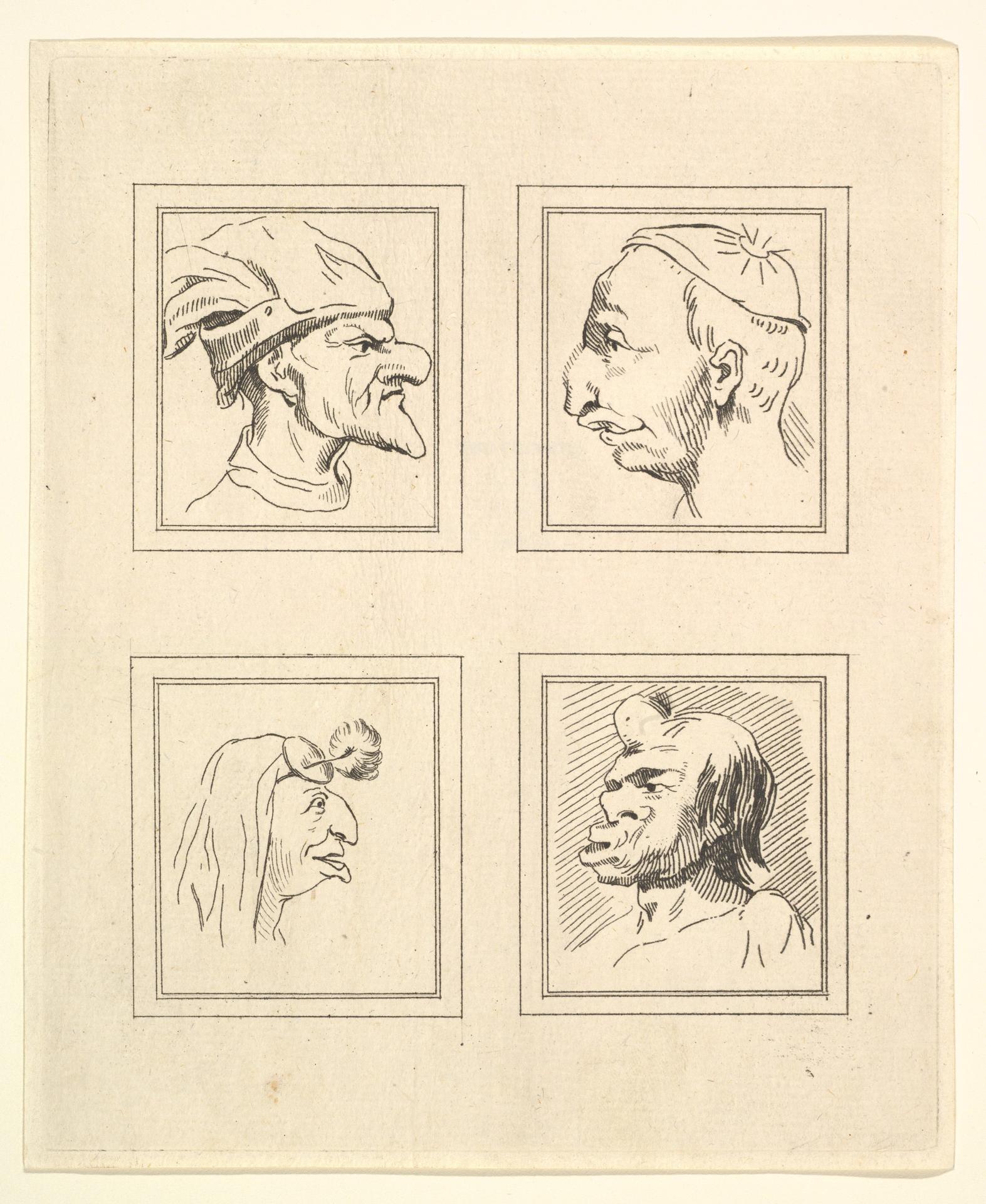
Four Heads (from Characaturas by Leonardo da Vinci, from Drawings by Wincelslaus Hollar, out of the Portland Museum) (1786, Met-Objekt 5567)
Original title: Four Heads (from Characaturas by Leonardo da Vinci, from Drawings by Wincelslaus Hollar, out of the Portland Museum)
kurzbeschreibung
Unlike the other sheets in the series, this 1786 etching by Wenceslaus Hollar does not present a single study but four head portraits in profile, arranged side by side in four square fields. It belongs to a set made after drawings by Leonardo da Vinci. The print is executed as an etching and measures 7 7/8 x 6 7/16 inches.
Description
Each of the four separate squares contains one head. At upper left, a cap sits over restless hair; at upper right, a narrow face appears beneath a cap. At lower left, a head with open hair tilts slightly to the side; at lower right, long hair is tied at the nape. Black and white dominate the image; contours and shading arise solely from lines and strokes. The paper has a faint beige shimmer and bears small spots and signs of wear.
Context
This etching was made in 1786 as part of a series based on drawings by Leonardo da Vinci and reproduced by Wenceslaus Hollar. Hollar, a seventeenth-century Bohemian printmaker, produced a great many reproductive prints after works by well-known artists. The addition 'from the Portland Museum' names the collection from which the models came. Caricatures of this kind were prized collectors' items in the eighteenth century and helped spread Leonardo's ideas.
Impact
Cleanly drawn lines and restrained colour give the sheet a calm, collected presence. The four heads are strictly aligned and form an even rhythm that invites comparison of the facial features. The slight patina of the paper lends the sheet an aura of history.
Technique
The sheet was produced by the intaglio process of etching: the drawing is scratched into an acid-resistant ground on a metal plate and then etched. Delicate shading of the faces emerges from lines and hatching. Printing was done on paper with a faintly beige tone.
AI-generated description text
Source: Metropolitan Museum of Art · Public Domain (CC0 1.0)