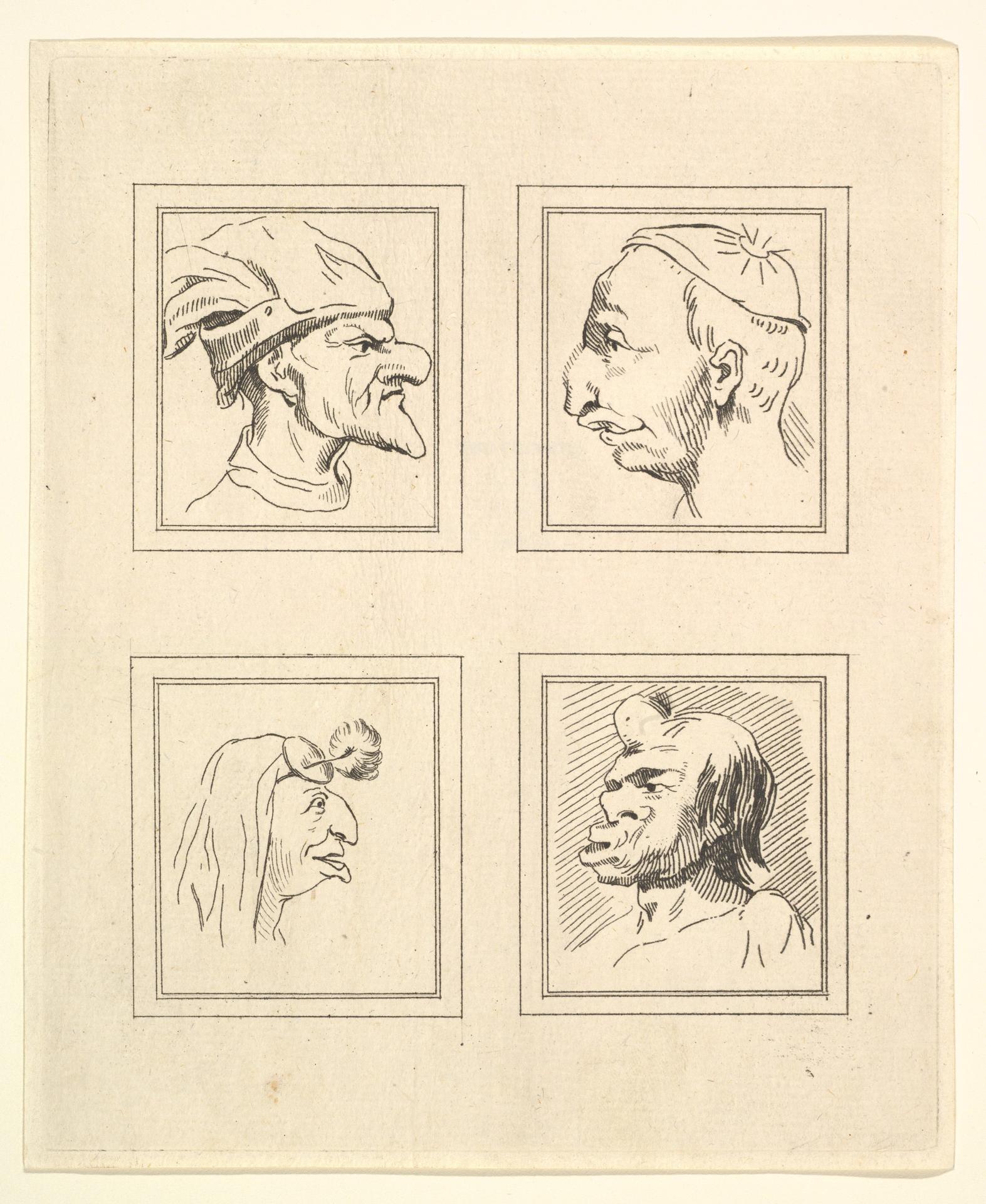
Four Heads (from Characaturas by Leonardo da Vinci, from Drawings by Wincelslaus Hollar, out of the Portland Museum) (1786, Met-Objekt 5563)
Original title: Four Heads (from Characaturas by Leonardo da Vinci, from Drawings by Wincelslaus Hollar, out of the Portland Museum)
kurzbeschreibung
Four separate heads in profile appear on this etching by Wenceslaus Hollar, dated 1786. The sheet belongs to a series made after drawings by Leonardo da Vinci and comes from the Portland Museum. The work was executed as an etching on paper, with the plate measuring 19.5 x 16.2 cm.
Description
Each of the four heads stands alone within its own square frame, shown in profile. The sitters adopt various postures, with different hairstyles and head coverings, some facing the viewer and others turned away. Their expressions range from serious to a slight smile. Precise black-and-white lines and hatching bring out the contours. The ground remains empty, and the framing is plain and clear.
Context
The etching was made in 1786 as part of a series in which Hollar reproduced drawings by Leonardo da Vinci. The seventeenth-century Bohemian printmaker was known for his detailed etchings. The source drawings came from the collection of the Portland Museum, suggesting an art-historical intent to document. The series belongs to Hollar's later output, which is distinguished by the accurate reproduction of models.
Impact
The four heads are arranged clearly and calmly, giving the impression of a systematic study of facial features. The precise linework and balanced layout produce a factual, almost scientific aesthetic. Because expressions and perspectives vary, a quiet dynamism emerges that invites the viewer to compare the portraits.
Technique
For this etching, the drawing was incised into an acid ground on a copper plate and then etched. Different etching times and line thicknesses create the fine lines and shading. The sheet was printed on paper, with the black contours on a white ground producing a clear, high-contrast effect.
AI-generated description text
Source: Metropolitan Museum of Art · Public Domain (CC0 1.0)