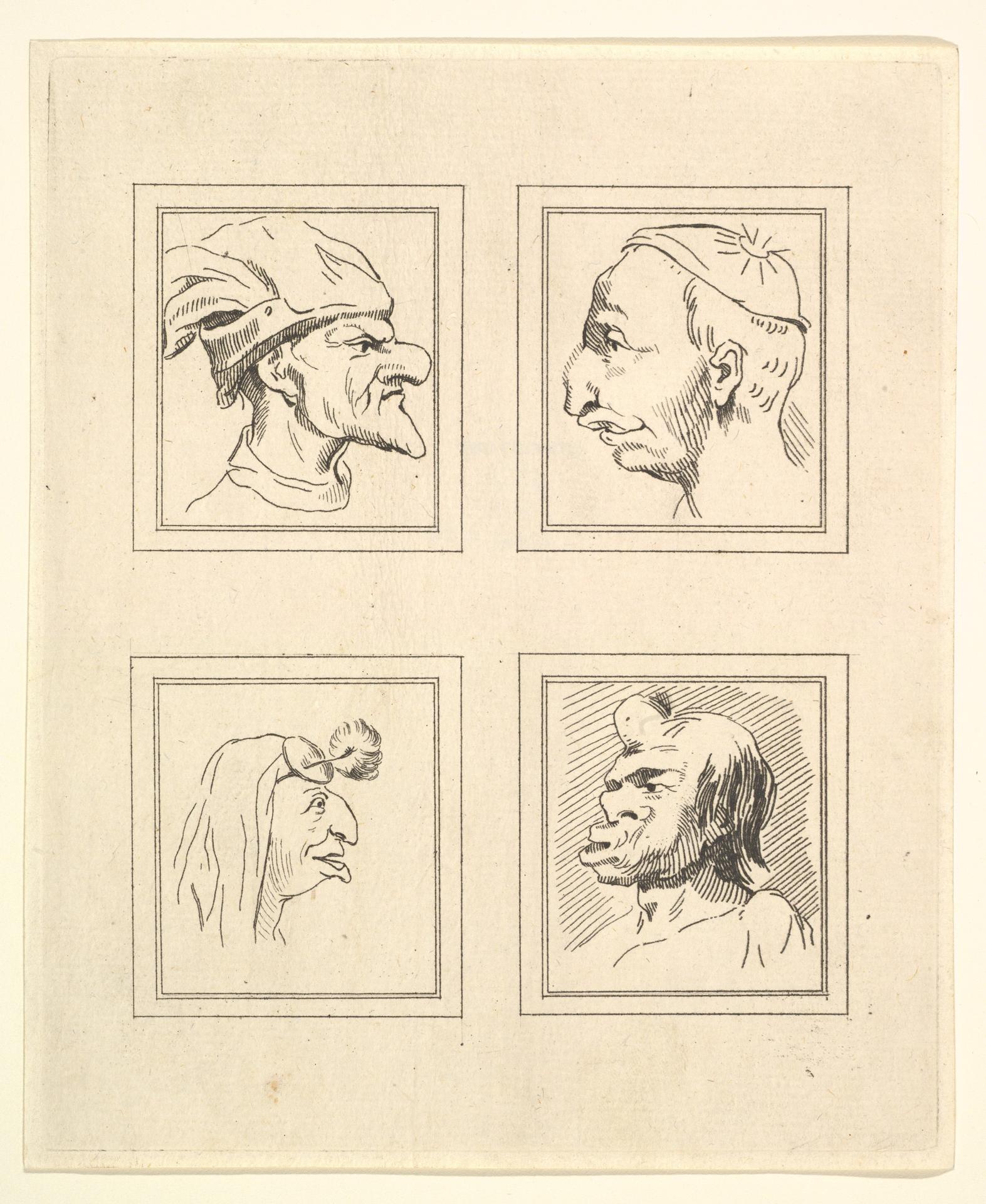
Four Heads (from Characaturas by Leonardo da Vinci, from Drawings by Wincelslaus Hollar, out of the Portland Museum) (1786, Met-Objekt 5560)
Original title: Four Heads (from Characaturas by Leonardo da Vinci, from Drawings by Wincelslaus Hollar, out of the Portland Museum)
kurzbeschreibung
Four heads in profile, each set within its own square frame, gathered on a single sheet by Wenceslaus Hollar from 1786. The etching reproduces drawings by Leonardo da Vinci and appeared as a print within a series.
Description
Four profile heads face one another across four square frames. Each head has its own facial features and hairstyle, and they look in different directions, so that distinct characters and moods stand side by side. In black and white, stronger and more delicate strokes alternate, bringing out both contours and surfaces. The frames stay plain and divide the four views; the paper feels slightly rough.
Context
The etching was made in 1786 as part of a series for which Wenceslaus Hollar reproduced drawings by Leonardo da Vinci. Hollar, a Bohemian printmaker of the seventeenth century, produced numerous prints after works by old masters. The Portland Museum, a London institution that exhibited artworks, handled the publication. In this way, the sheets helped spread Leonardo's ideas further in the eighteenth century.
Impact
The four heads, strictly confined within their frames, give the sheet a clear, almost scientific structure. The precise profile views create a calm, contemplative mood and invite close comparison of the facial features. Because the black-and-white technique remains restrained, the drawing quality and the precision of the linework stand out clearly.
Technique
In etching, the drawing was incised into a metal plate, which was then bitten by acid. Printing was done with black ink on paper; the lines vary in strength to create shading and texture. The plate measures 19.5 x 16 cm, the sheet 20 x 16.7 cm.
AI-generated description text
Source: Metropolitan Museum of Art · Public Domain (CC0 1.0)