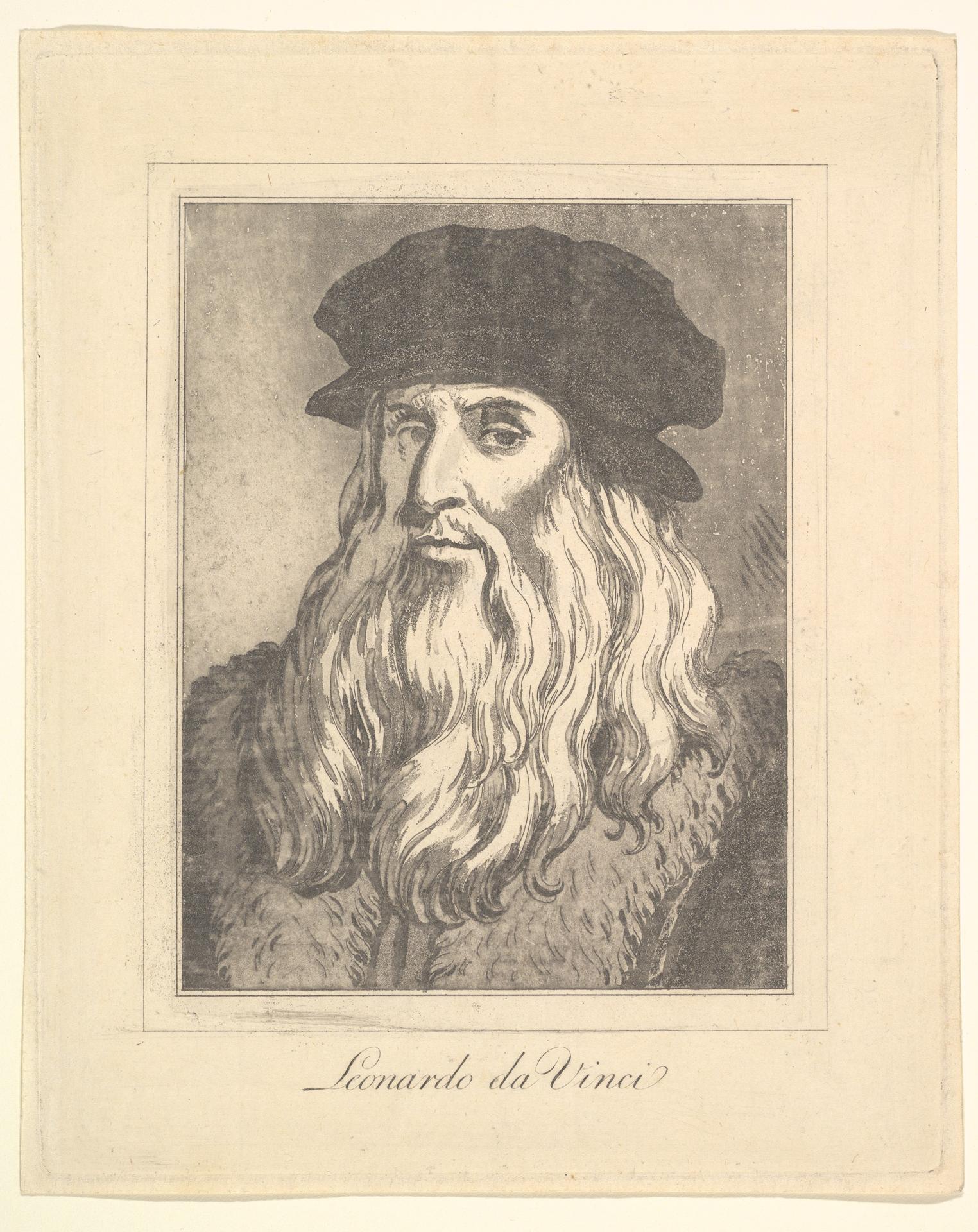
Portrait of Leonardo da Vinci, from "Characaturas by Leonardo da Vinci, from Drawings by Wincelslaus Hollar, out of the Portland Museum"
Original title: Portrait of Leonardo da Vinci, from "Characaturas by Leonardo da Vinci, from Drawings by Wincelslaus Hollar, out of the Portland Museum"
kurzbeschreibung
Unlike the other sheets in the series, this 1786 aquatint etching does not show a caricature face but a portrait of Leonardo himself. It reproduces a drawing by Wenzel Hollar and belongs to a set of caricatures after Leonardo. The artist appears in a bust-length view, with a long beard and a cap.
Description
An old man with a long, wavy beard and a black head covering looks out from the image. The collar is clearly defined over the fur jacket. A dark, empty background makes the figure stand out. Below the portrait, the name 'Leonardo da Vinci' appears in handwriting-like script. The reproduction remains in black-and-white tones, as the printing technique dictates.
Context
The 1786 etching goes back to a 17th-century drawing by Wenzel Hollar. The sheet was published as part of a series for the Portland Museum. Reproductions of this kind made famous artworks and artists' portraits accessible to a wider public in the 18th century. Hollar's source is thought to be a lost self-portrait by Leonardo.
Impact
The dark ground and precise linework focus the gaze on the face. The bearded man in fur looks learned and dignified, his age clearly perceptible. The handwritten line of the name beneath the portrait gives the sheet a personal, almost private touch.
Technique
To capture fine tonal gradations, the print uses aquatint combined with etched line. The aquatint is applied to the copper plate to achieve soft shading. It was printed in black on paper, which reinforces the historical impression.
AI-generated description text
Source: Metropolitan Museum of Art · Public Domain (CC0 1.0)