The Third Knot
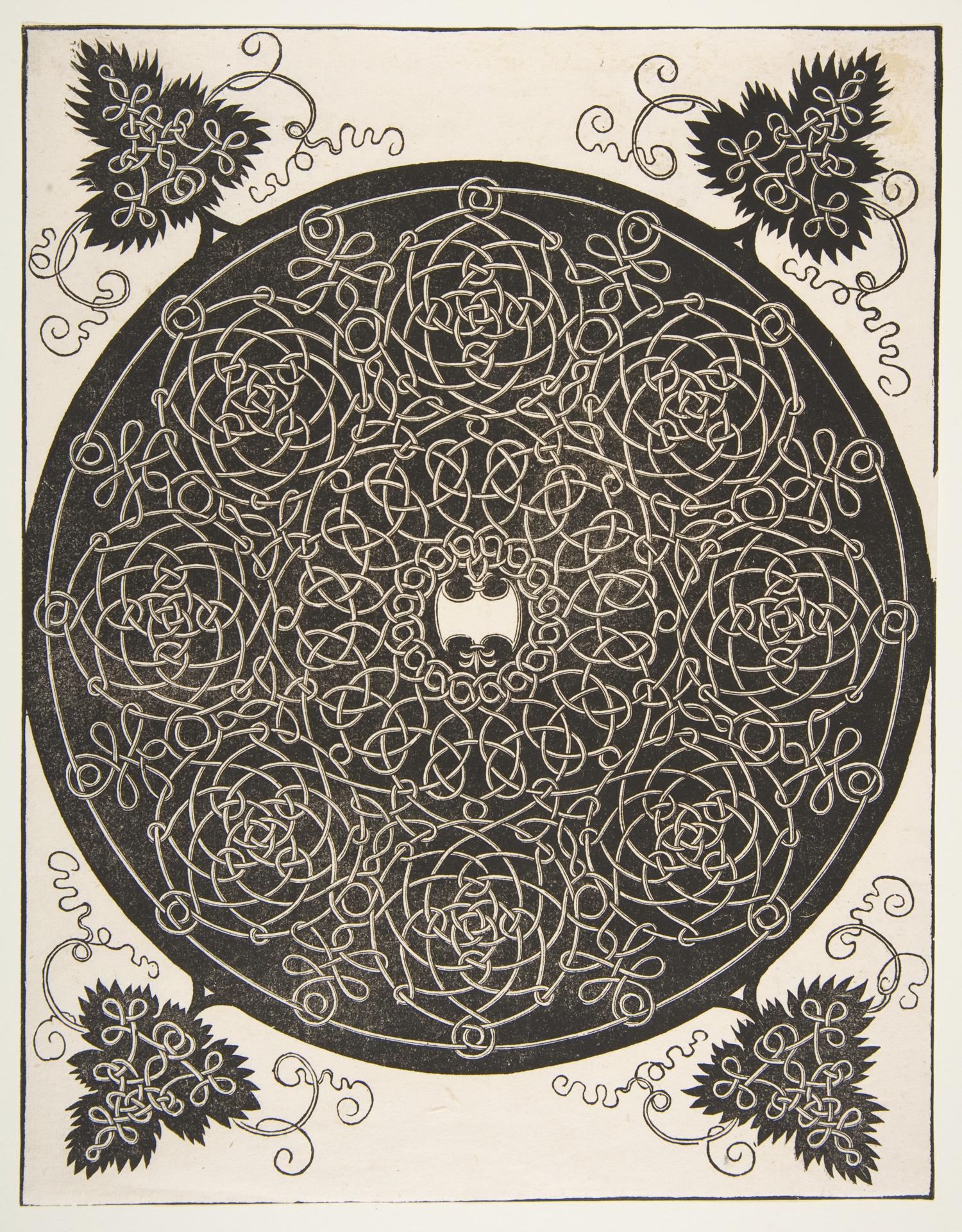
Original title: “The Third Knot”. Interlaced Roundel with Eight Wreaths and a Scalloped Shield in its Center
kurzbeschreibung
Albrecht Dürer's woodcut "The Third Knot," made around 1521, presents an interlaced round medallion. Eight rings of interwoven lines enclose a shell-shaped shield at the center, which carries a plain, symmetrical sign.
Description
A mesh of black lines on white draws the eye first to the inner circle, where spiraling patterns weave into a dense net. This is broken by a small, scale-like shield bearing a simple symbol. Eight further circles with similarly tangled motifs attach around the outside, strictly symmetrical in two rows. The arrangement feels calm and balanced, and the strong contrasts between line and open ground define the forms precisely.
Context
The series of knot patterns was created around 1505–1507, but the printing came later, around 1521. These woodcuts probably served craftsmen as models, for instance for intarsia, embroidery, or metalwork. Dürer's engagement with mathematical and geometric forms, prompted by Italian examples such as Leonardo da Vinci, becomes visible here.
Impact
The exact symmetry and even flow of lines exert a meditative, almost hypnotic pull. The interwoven pattern seems at once delicate and strict, a hallmark of Dürer's ornamental printmaking.
Technique
The fine, regular lines of this sheet reveal the precision of the printing process, with black ink sitting crisply against the white paper ground. The impression's even, uniform tone and the sharp contrast between pattern and background reflect a well-preserved early print. Its symmetrical ornamentation depends entirely on this clarity of line and surface.
AI-generated description text
Source: Metropolitan Museum of Art · Public Domain (CC0 1.0)