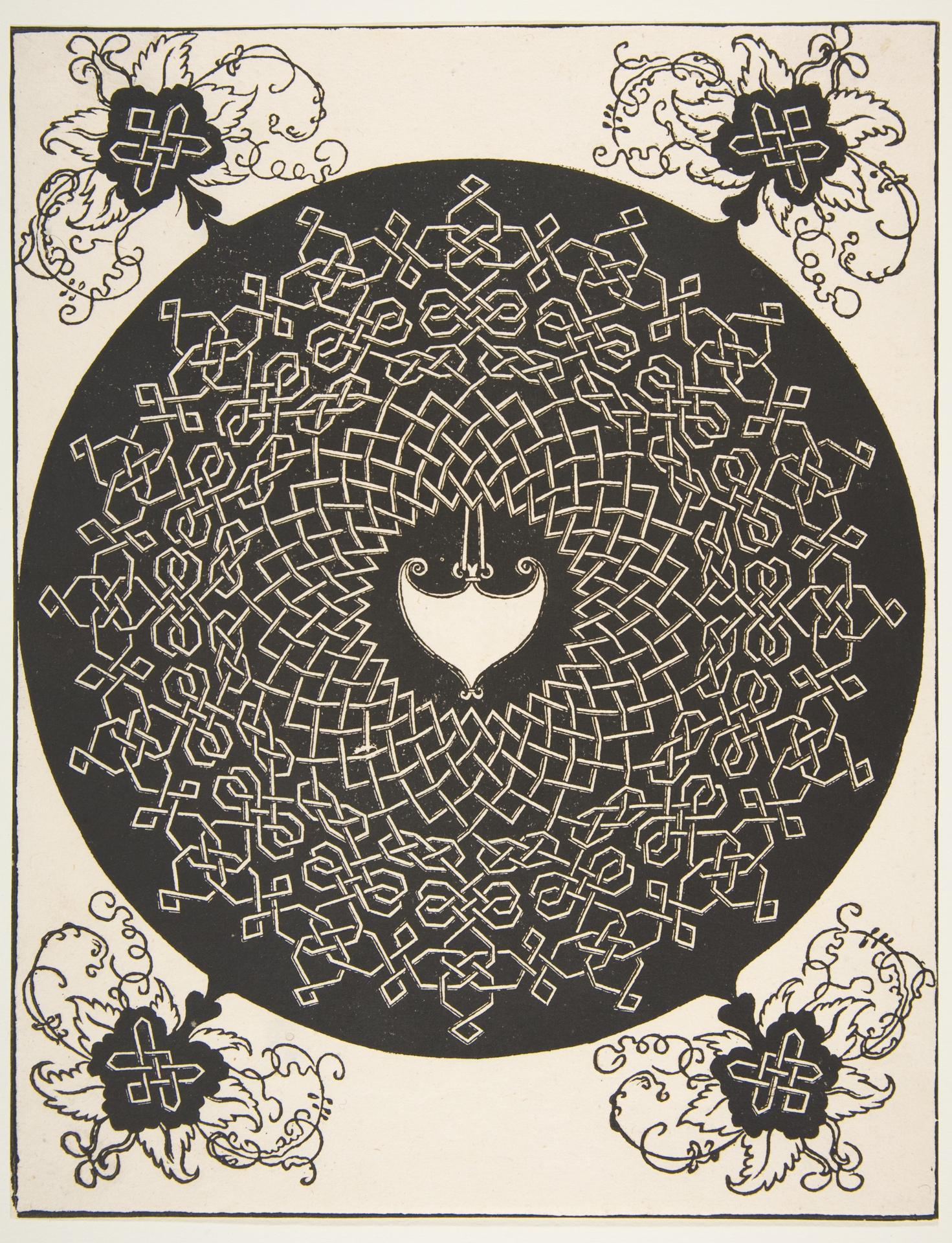
The Second Knot. Interlaced Roundel with an Amazon Shield in its Center
Original title: “The Second Knot”. Interlaced Roundel with an Amazon Shield in its Center
kurzbeschreibung
This woodcut by Albrecht Dürer, dated before 1521, presents an intricate interlaced roundel. At its center lies a small shield, surrounded by a dense, spiraling knot pattern and floral motifs at the rim.
Description
The composition is a perfect circle filled with a complex, symmetrical arrangement of white lines on a black background. In the center, a simple heart-shaped symbol sits within a small shield, which is encircled by a tightly woven, spiral-like knot that expands outward. Four stylized flower motifs, also formed from interlaced lines, punctuate the outer edge of the roundel. The overall effect is one of meticulous precision and balanced, ornamental harmony.
Context
Dürer created this woodcut as part of a series of six 'knots' (Knoten), which were inspired by Islamic geometric patterns, likely encountered through Venetian sources. These prints were experimental, exploring the interplay of line and negative space. The 'Amazon shield' in the title likely refers to the small central emblem, though its exact symbolic meaning remains unclear. The series was influential in spreading Moresque ornamental style across Europe.
Impact
The stark contrast between the white lines and the black ground gives the image a striking, almost hypnotic presence. The intricate knotwork draws the viewer's eye inward, while the surrounding flowers add a delicate, decorative counterpoint. The print conveys a sense of mathematical order and artistic virtuosity, inviting close inspection.
Technique
This is a woodcut, a relief printing technique where the image is carved into a wooden block, inked, and pressed onto paper. Dürer's precision in carving the fine, interlacing lines demonstrates his exceptional skill in handling the medium. The use of white lines on a black background is a notable inversion of typical woodcut practice, emphasizing the pattern's graphic quality.
AI-generated description text
Source: Metropolitan Museum of Art · Public domain (CC0)