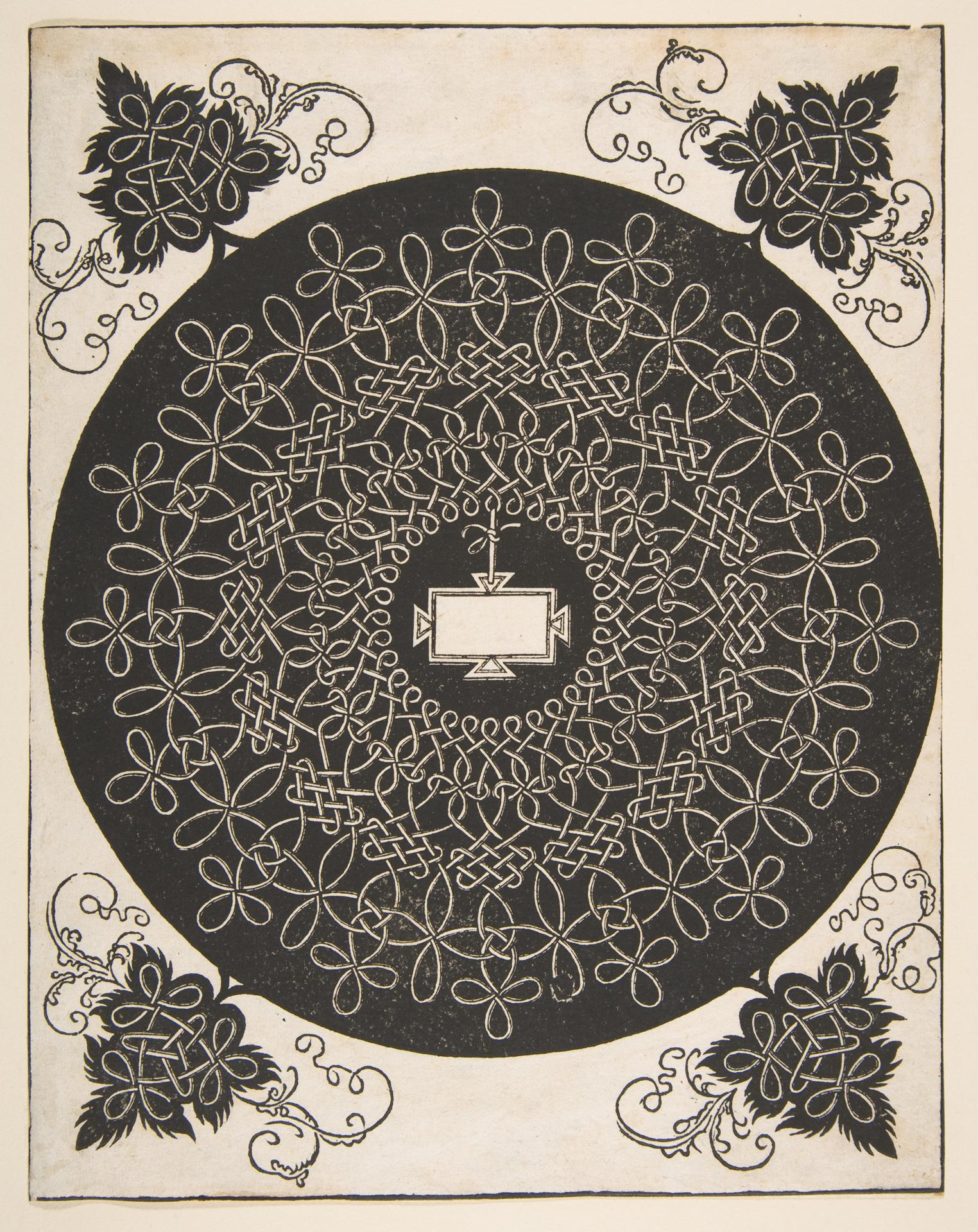
Embroidery Pattern with an Oblong Panel in its Center
Original title: Embroidery Pattern with an Oblong Panel in its Center
kurzbeschreibung
This woodcut by Albrecht Dürer, created before 1521, presents an intricate embroidery design centered around an oblong panel. The pattern features symmetrical interlace and foliage, showcasing Dürer's mastery in ornamental composition.
Description
The composition centers on a long, rectangular panel framed by a dense network of interlocking lines and leafy tendrils. Symmetrical on both axes, the design radiates outward, with corners filled by stylized floral motifs. Rendered in stark black and white, the woodcut uses fine, precise lines to create a lace-like effect, with the dark background making the white pattern stand out clearly.
Context
Dürer produced this pattern as part of a series of designs for decorative arts, likely intended for use by craftsmen in creating embroidered textiles. Such pattern books were popular in the early 16th century, providing templates for artisans. The work reflects the Renaissance interest in geometry and ornament, as well as Dürer's engagement with applied arts beyond painting and printmaking.
Impact
The design impresses with its intricate symmetry and rhythmic repetition, drawing the eye inward to the central panel. The contrast between the dark ground and the delicate white lines gives the image a crisp, almost luminous quality, while the dense ornamentation evokes a sense of opulence and craftsmanship.
Technique
Executed as a woodcut, the design is carved into a wooden block, with the lines left raised to receive ink. The fine, detailed lines demonstrate the precision possible with this medium, though they also reveal the technical skill required to avoid breaking the delicate ridges during printing.
AI-generated description text
Source: Metropolitan Museum of Art · Public domain (CC0)