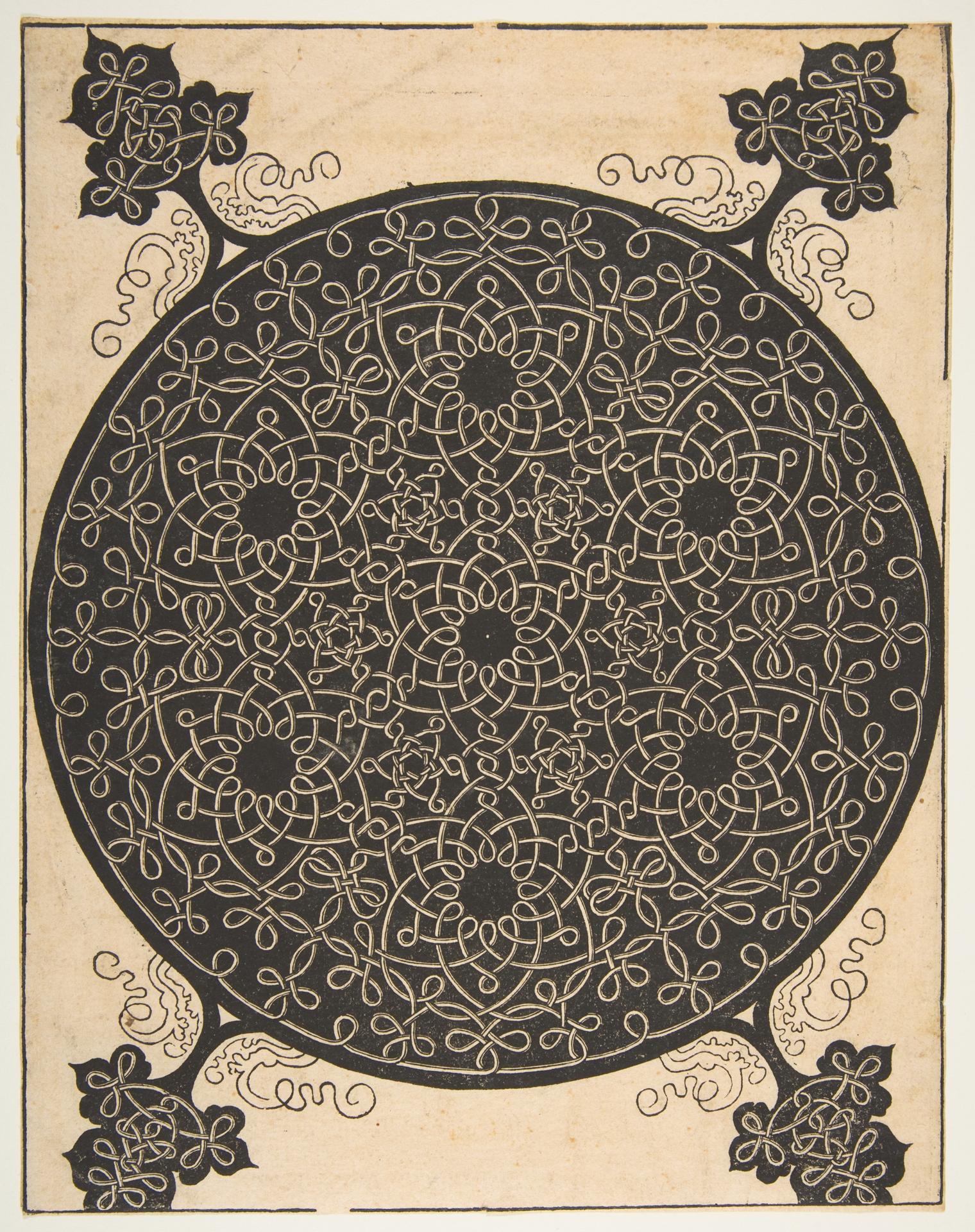
Embroidery Pattern with Seven Six-pointed Stars and Four Corner Pieces (before 1521, Met-Objekt 5548)
Original title: Embroidery Pattern with Seven Six-pointed Stars and Four Corner Pieces
kurzbeschreibung
Albrecht Dürer made this woodcut before 1521 as an ornamental model for embroidery. Seven six-pointed stars and four corner motifs form the pattern, which served needleworkers as a guide.
Description
A central star is surrounded by six more stars, arranged symmetrically. The corner pieces, with leaf- or blossom-like shapes, frame the image. Black ground and white lines stand in clear, precise contrast. Flat and without spatial depth—as was typical for graphic models.
Context
Dürer produced several pattern sheets for handwork, intended as models for embroidery and other textile arts. Such prints were widespread in the sixteenth century; they allowed craftspeople to use complex patterns without designing their own. Dürer was among the first artists to produce this kind of utilitarian graphic work at high quality.
Impact
Clear geometric order and calm balance of forms define the sheet. The restriction to black and white gives the pattern timeless elegance and functionality.
Technique
The fine lines and precise contours were carved into the block and inked for a single impression. The resulting print brings out the sharp edges of the seven six-pointed stars and four corner pieces, where the white pattern stands in crisp contrast against the solid black ground, with no visible shading or highlights to soften the geometric clarity.
AI-generated description text
Source: Metropolitan Museum of Art · Public Domain (CC0 1.0)