The Sixth Knot
Original title: “The Sixth Knot”. Interlaced Roundel with Seven Wreaths
kurzbeschreibung
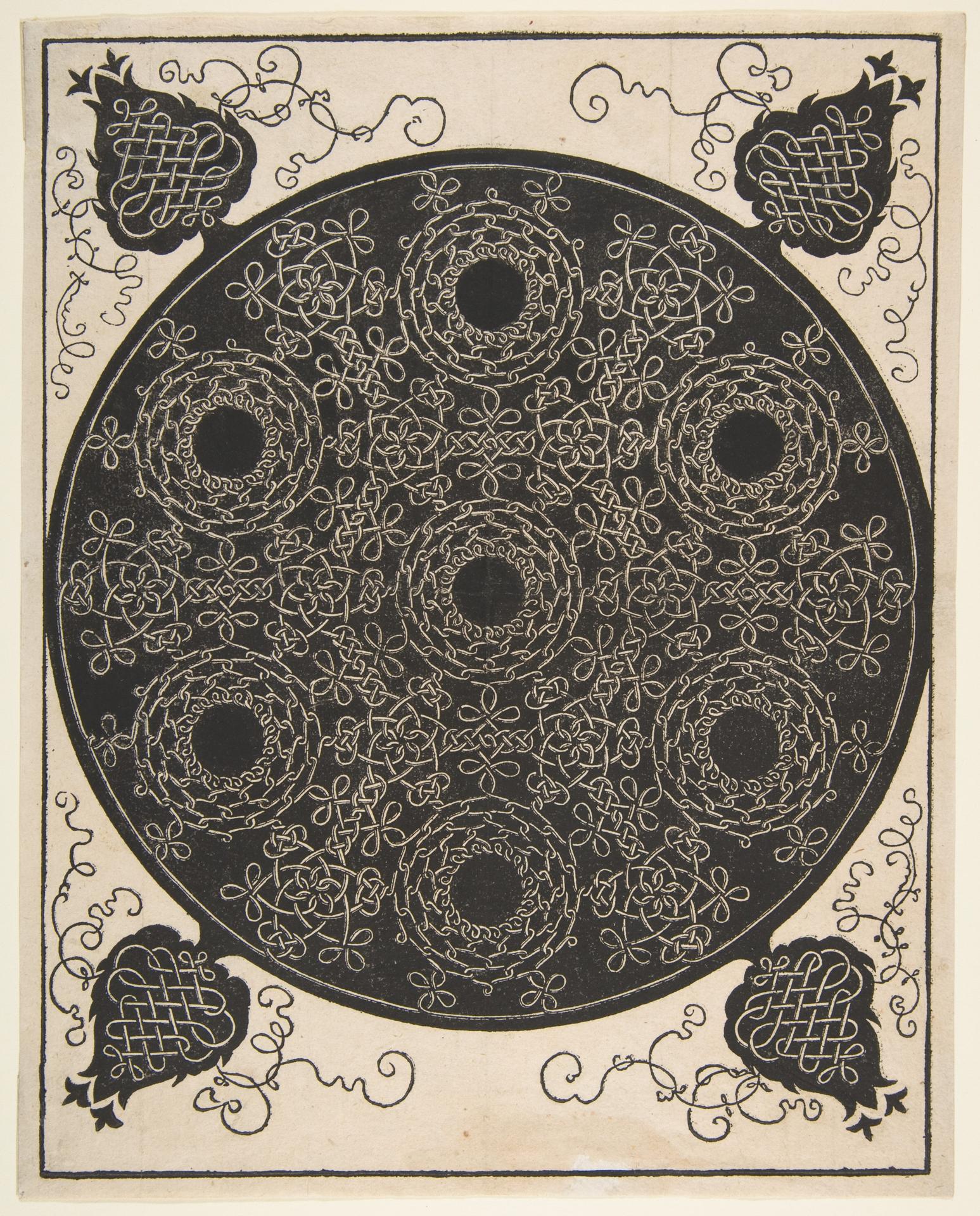
The Sixth Knot is a woodcut by Albrecht Dürer, created before 1521. It is an interlaced roundel featuring seven wreaths, a prime example of Renaissance geometric ornament. The print showcases Dürer's mastery of intricate linear design and symmetry.
Description
The composition centers on a large, complex interlace of bands that form a roundel, surrounded by seven smaller wreaths, each decorated with similar interlacing. At the edges, two large stylized flowers frame the design, with an additional pattern in the middle. The image is strictly black and white, with a white background and black foreground, ensuring a stark contrast. The overall arrangement is symmetrical, precise, and evenly lit, typical of a print.
Context
Dürer created this woodcut as part of a series of six knot designs, likely inspired by Islamic geometric patterns and Italian Renaissance ornament. The knots were probably intended as decorative patterns for craftsmen, such as goldsmiths or woodworkers, to use in their own creations. This print dates from the early 16th century, a period when Dürer was exploring mathematical and geometric principles in art. The series demonstrates the influence of Leonardo da Vinci's and other artists' fascination with knot motifs.
Impact
The print's intricate, interlocking lines create a hypnotic, almost meditative effect, drawing the viewer's eye into the complexity of the design. Its symmetry and precision convey a sense of order and intellectual rigor, while the stark black-and-white contrast gives it a bold, graphic presence. The piece feels both decorative and mathematical, appealing to those who appreciate fine craftsmanship and geometric beauty.
Technique
This is a woodcut, a relief printing technique where the image is carved into a wooden block, inked, and transferred to paper. Dürer's skill in woodcut is evident in the clean, precise lines and the careful balance between positive and negative space. The use of black ink on white paper highlights the sharpness of the carved lines, allowing the intricate interlace to stand out clearly.
AI-generated description text
Source: Metropolitan Museum of Art · Public domain (CC0)