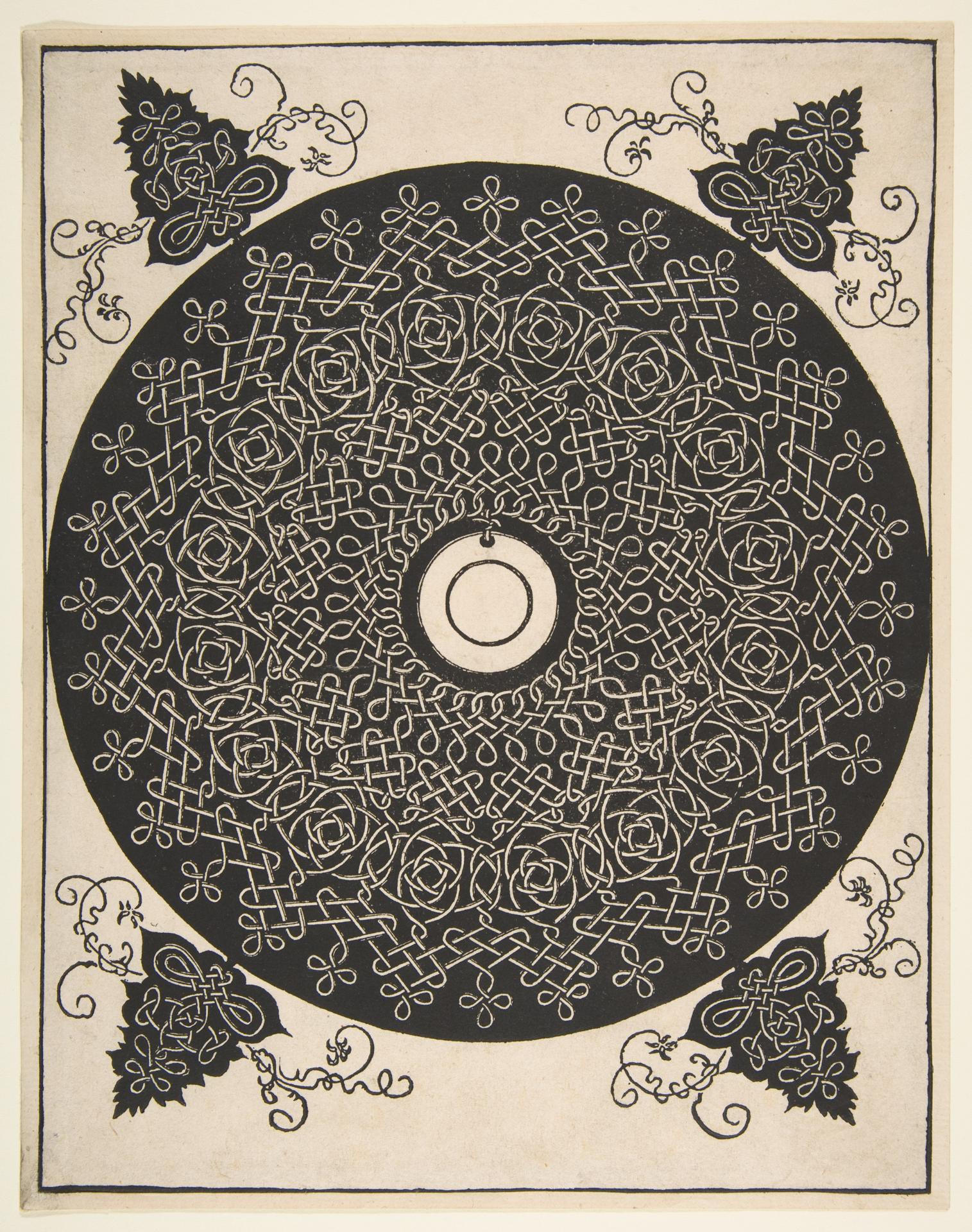
Embroidery Pattern with Round Medallion in its Center
Original title: Embroidery Pattern with Round Medallion in its Center
kurzbeschreibung
This is a woodcut by Albrecht Dürer, created before 1521. It presents a symmetrical pattern with a round medallion at its center, surrounded by intricate knots and rosettes. The print is in black and white, typical of Renaissance woodcut designs.
Description
The composition centers on a black medallion containing a simple circular motif. From this center, a dense network of white knots and rosettes radiates outward in a symmetrical arrangement. Stylized leafwork fills the upper and lower areas, framing the corners. The entire design is enclosed within a plain black border, and the lighting is even, with no shadows, indicating a printed image.
Context
Dürer produced this pattern as part of his work in printmaking, which often included designs for decorative arts. The woodcut likely served as a source for embroiderers, providing a repeatable pattern for textiles. Such patterns were popular in the early 16th century, reflecting the Renaissance interest in geometric and ornamental design. Dürer's prints were widely disseminated, influencing crafts across Europe.
Impact
The pattern is visually striking for its precision and intricate symmetry, drawing the eye inward to the medallion. The contrast between the black medallion and the white knots creates a dynamic yet balanced composition. It conveys a sense of order and craftsmanship, typical of Dürer's meticulous style.
Technique
The work is a woodcut, a relief printing technique where the design is carved into a wooden block, inked, and pressed onto paper. Dürer's skill in carving fine lines and complex patterns is evident in the detailed knots and leafwork. The use of black ink on white paper is standard for woodcuts, allowing for clear, bold reproduction.
AI-generated description text
Source: Metropolitan Museum of Art · Public domain (CC0)