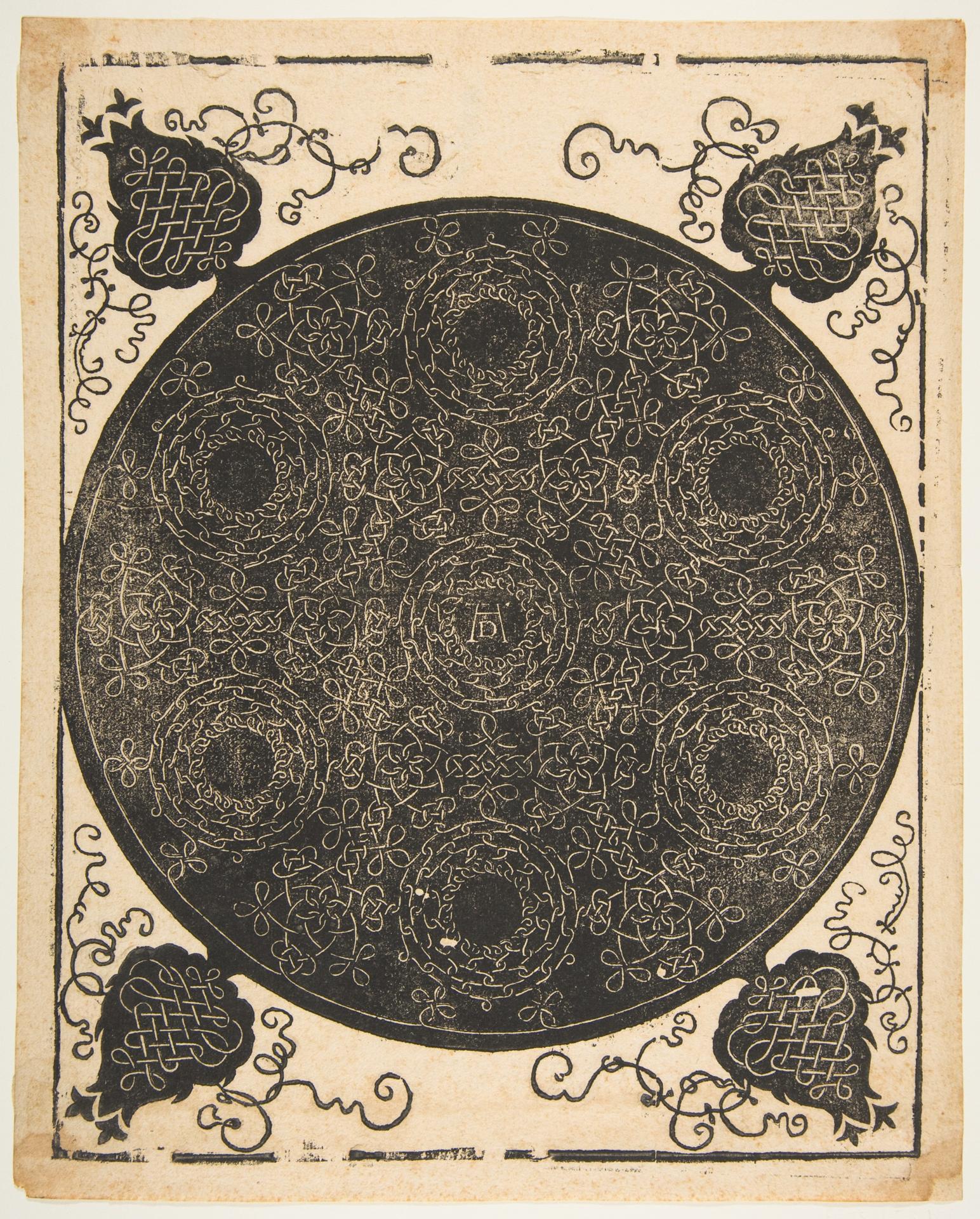
Embroidery Pattern with Seven Wreaths and Four Corner Pieces
Original title: Embroidery Pattern with Seven Wreaths and Four Corner Pieces
kurzbeschreibung
This woodcut by Albrecht Dürer, created before 1521, presents an ornamental design intended for embroidery. The print features a central circular motif surrounded by seven wreaths and four corner pieces, showcasing Dürer's mastery in pattern design.
Description
The composition is dominated by a large dark circle at the center, within which seven smaller circular areas are arranged: one in the middle encircled by six others in a hexagonal layout. Around this central medallion, four corner pieces contain intricate floral or geometric ornaments, balancing the overall design. The use of bold black lines and contrasting white spaces creates a striking, graphic quality.
Context
Dürer produced this pattern as part of a series of designs for decorative arts, likely intended for use by craftsmen and embroiderers. Such patterns were popular in the early 16th century, as they allowed artisans to replicate complex designs with precision. The woodcut medium was ideal for mass-producing these templates, making them widely accessible.
Impact
The print exudes a sense of order and symmetry, reflecting the Renaissance fascination with geometry and proportion. The intricate interweaving of lines draws the viewer's eye inward, creating a meditative focus on the central motif. Its stark black-and-white contrast gives it a timeless, almost modern aesthetic appeal.
Technique
This is a woodcut, a relief printing technique where the design is carved into a wooden block, inked, and pressed onto paper. Dürer's precise carving allows for fine, detailed lines that define the delicate wreaths and corner ornaments. The high contrast between ink and paper demonstrates the technical skill required to achieve such clean, crisp prints.
AI-generated description text
Source: Metropolitan Museum of Art · Public domain (CC0)