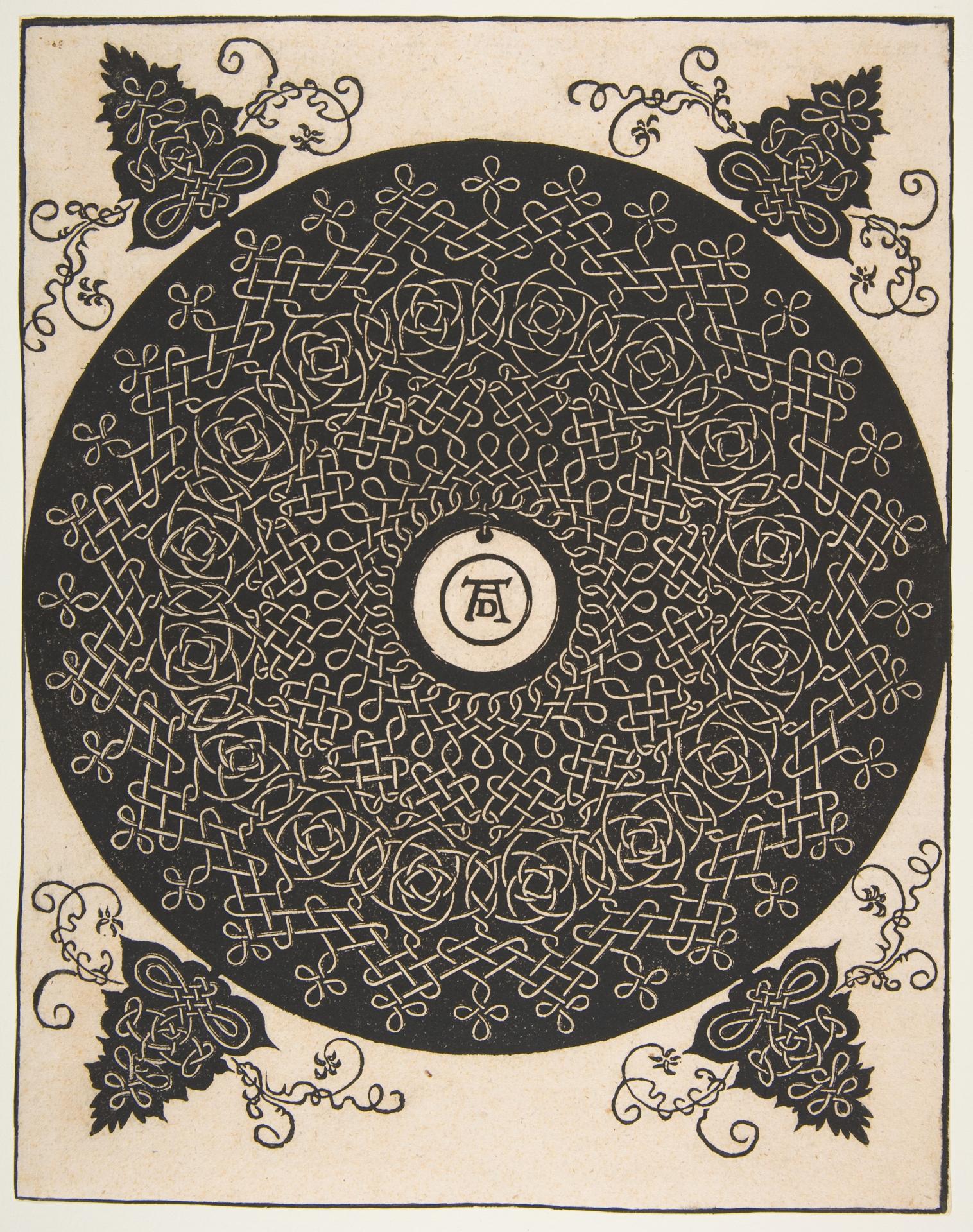
The Fourth Knot, Interlaced Roundel with a Round Medallion in its Center
Original title: “The Fourth Knot”, Interlaced Roundel with a Round Medallion in its Center
kurzbeschreibung
This woodcut by Albrecht Dürer, created before 1521, is a geometric ornament featuring a central medallion surrounded by intricate interlaced patterns. The composition is monochromatic and radially symmetrical, showcasing Dürer's mastery of linear design.
Description
The image presents a dense, radial arrangement of knotwork and rosette forms in concentric circles, centered on a small white medallion with a black, stylized symbol resembling a loop. In the four corners of the square field, outside the large central circle, are additional black ornaments with tendril and leaf structures, also incorporating knot-like elements. The overall layout is strictly symmetrical, with a dominant black circle at the center and white margins in the corners, creating a stark contrast.
Context
Dürer created this woodcut as part of a series of six knot ornaments, likely inspired by Islamic geometric patterns and Italian Renaissance decorative arts. These prints were intended as exercises in linear precision and were possibly used as models for craftsmen. The exact date of creation is unknown, but it is placed before 1521, a period when Dürer was deeply engaged with mathematical and geometric studies.
Impact
The intricate interlacing draws the eye inward, creating a sense of hypnotic motion within a static frame. The stark black-and-white contrast enhances the clarity of the pattern, making the design appear both precise and almost three-dimensional.
Technique
This is a woodcut, a relief printing technique where the design is carved into a wooden block, inked, and pressed onto paper. Dürer’s fine, consistent lines demonstrate his exceptional control over the medium, achieving a level of detail that was highly influential for later printmakers.
AI-generated description text
Source: Metropolitan Museum of Art · Public domain (CC0)