Two Grotesque Heads (1538–73)
Original title: Two Grotesque Heads
kurzbeschreibung
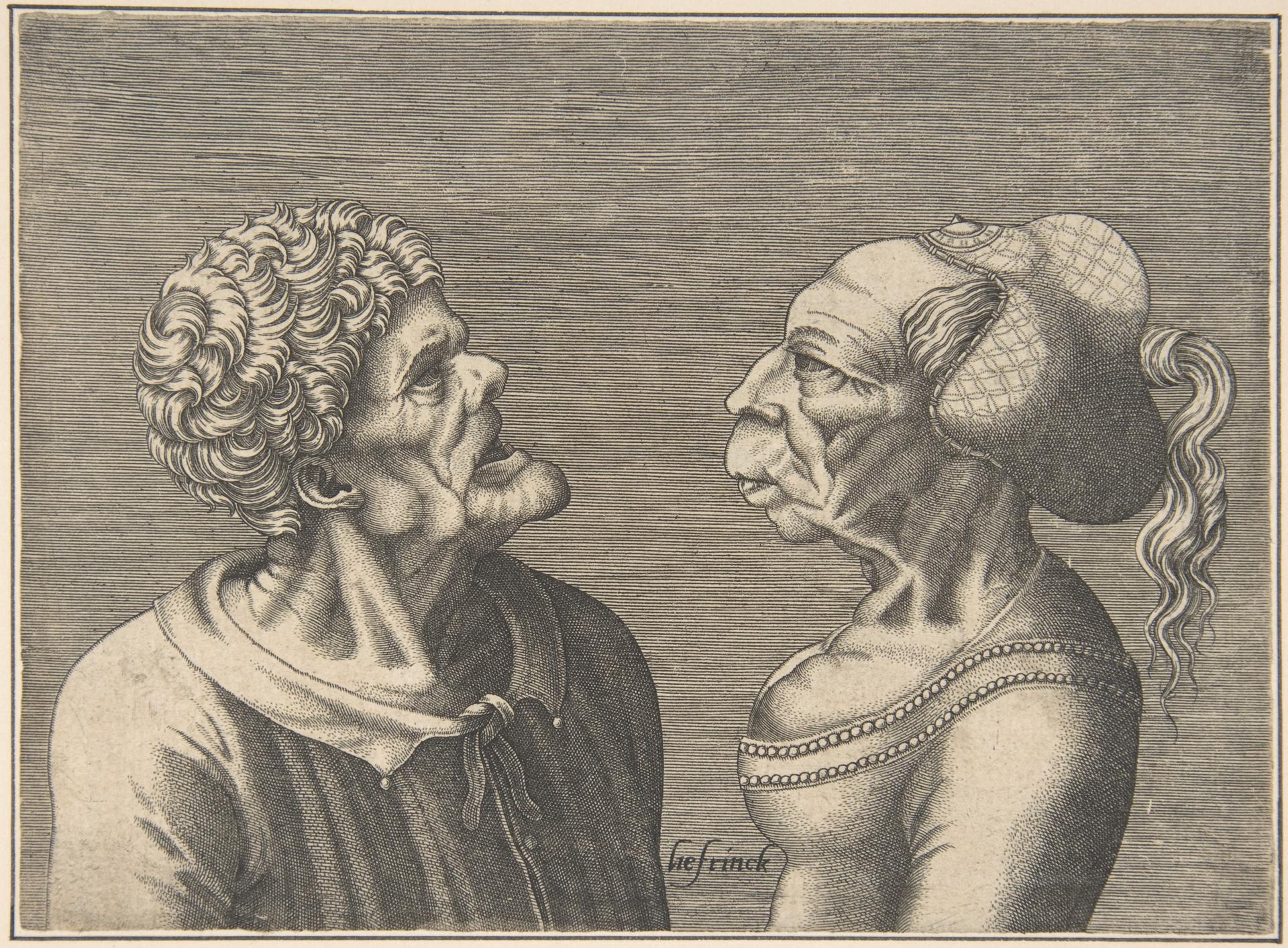
Hans Liefrinck's engraving Zwei groteske Köpfe, made between 1538 and 1573, brings together two fantastic head studies facing each other. The upright sheet measures 11.5 by 15.7 cm and is executed as an etching.
Description
Two grotesque heads confront one another in profile. Curly, wavy hair surrounds the left head, which also wears a kind of apron; the right head is bald and topped with a head covering from which a long, wavy strand of hair hangs down. Both heads point in the same direction, and the view is taken at half-length. The layout feels symmetrical, with the heads placed centrally. Grey tones dominate the monochrome sheet; light is evenly distributed and no shadows are discernible.
Context
The Fleming Hans Liefrinck worked as an engraver and publisher in Antwerp. Grotesque heads enjoyed great popularity during the Renaissance; artists often drew on antique models, and the motif was widespread in printmaking as well. Such studies could serve as models for decorations or stand as independent works through which an engraver demonstrated his skill.
Impact
Precisely guided lines and richly detailed facial features hold the viewer's gaze. The symmetrical arrangement and evenly distributed light give the sheet a calm, balanced presence; the grotesque features thus seem more playful than threatening.
Technique
The lines are engraved into a copper plate, as in copper engraving. Fine hatching and cross-hatching create the gradations of grey tone and shape the facial features. The fact that light is distributed evenly, without shadows, corresponds to the printmaking of that period.
AI-generated description text
Source: Metropolitan Museum of Art · Public Domain (CC0 1.0)