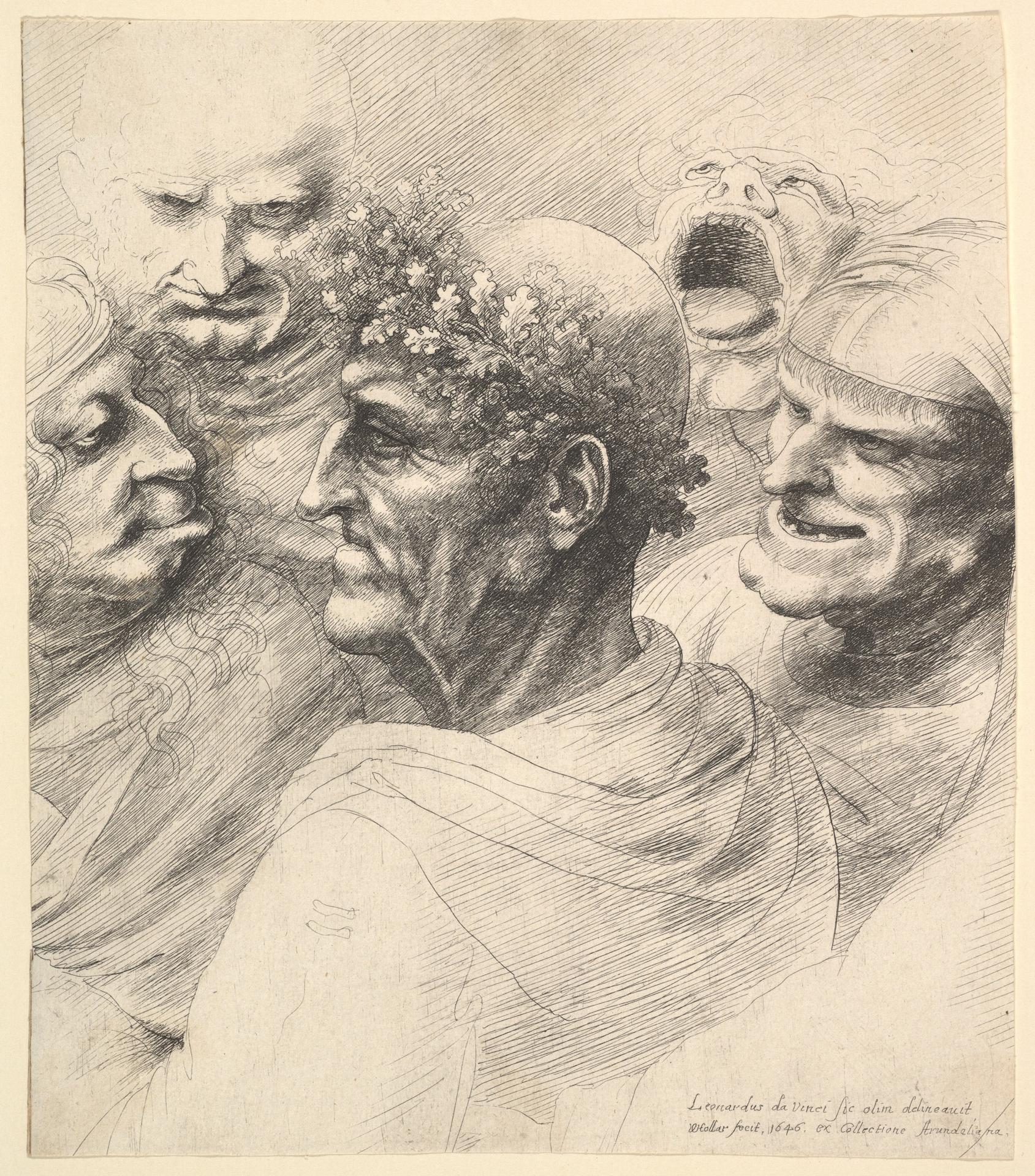
Five grotesque heads, including an elderly man with an oak leaf wreath (1646, Met-Objekt 5537)
Original title: Five grotesque heads, including an elderly man with an oak leaf wreath
kurzbeschreibung
In 1646 Wenceslaus Hollar etched five exaggerated heads onto a single sheet, including an older man wearing an oak-leaf wreath. The print survives in only one state and was executed as an etching.
Description
The five heads stand close together, slightly overlapping one another. The central head is adorned with a floral wreath and wears a garment reminiscent of Roman antiquity. The other faces bear quite different features: one lets out a shout, one looks sorrowful, one pensive, one is adorned with a flower, and one shows a rough, almost frightening expression. Skin and folds of clothing are rendered with dense lines of varying strength and finely graduated shading. The background remains sparse, so that the heads stand out clearly and the sheet gains spatial depth.
Context
The Bohemian etcher Wenceslaus Hollar made this sheet in 1646 in England, where he was working at the time. Grotesque heads were among the common motifs of seventeenth-century printmaking; inspiration often came from Leonardo da Vinci's head studies or from the tradition of caricatura. Hollar worked for various collectors and publishers and was regarded as a master of precise, detailed etching. The fact that only a single state has come down to us might point to a small edition or an unfinished printing process.
Impact
The tight row of heads and their exaggerated expressions confront the viewer directly and have an almost unsettling effect. Realistic precision and grotesque distortion enter into a tension that encourages reflection on the boundary between portrait and caricature. Because the sheet remains monochrome, facial expression and line work move to the center of attention.
Technique
For this etching, the lines were incised into an etched plate and then printed. The differentiated shading and the varying line strength attest to a confident handling of drypoint and etching technique. Since the sheet exists in only one state, the plate was not subsequently reworked.
AI-generated description text
Source: Metropolitan Museum of Art · Public Domain (CC0 1.0)