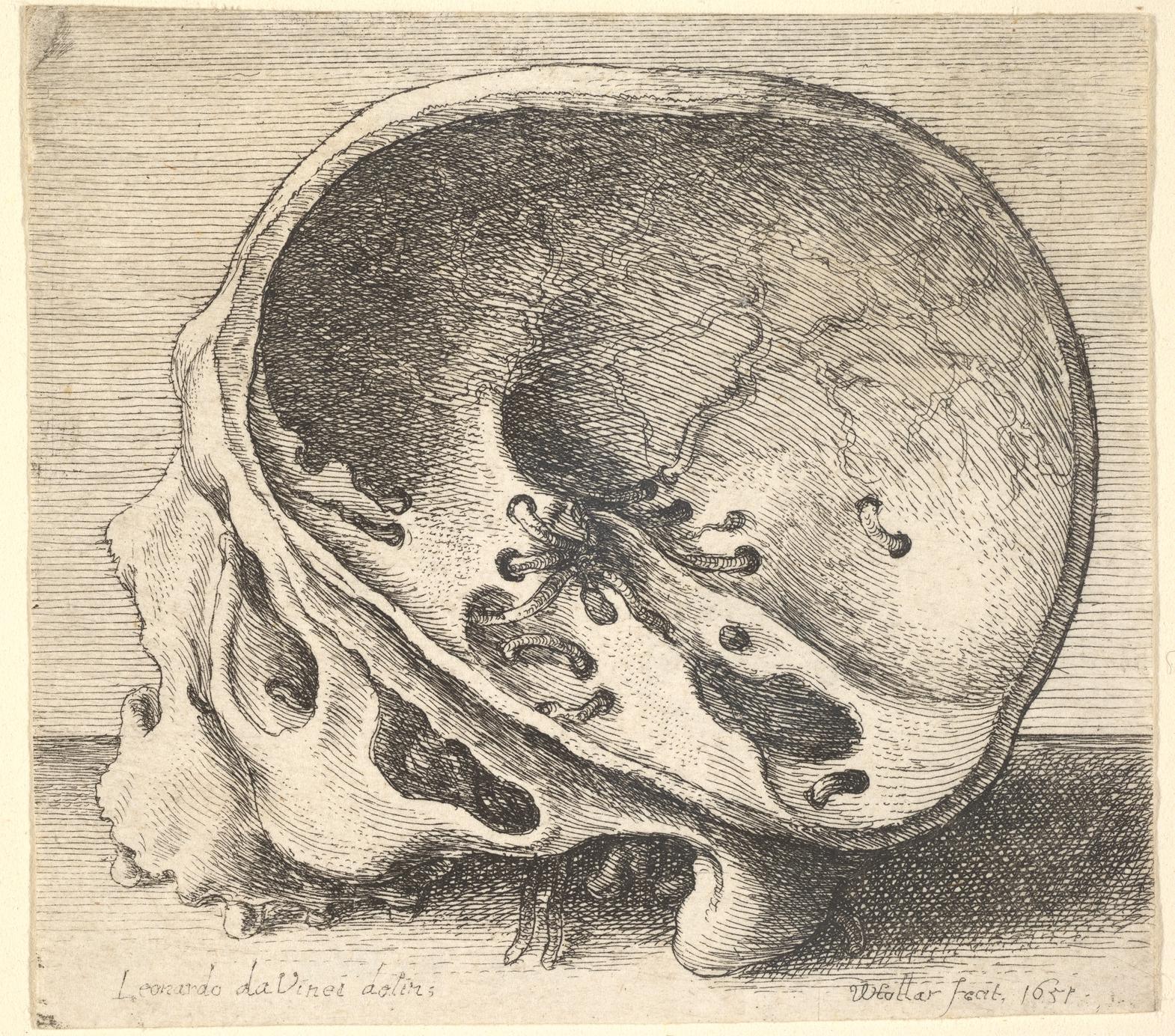
Sectioned skull in profile to left with the left side of the cranium removed (1651, Met-Objekt 5536)
Original title: Sectioned skull in profile to left with the left side of the cranium removed
kurzbeschreibung
A human skull turned in profile to the left, with its left half missing so that the inner anatomy lies exposed: Wenceslaus Hollar etched this motif in 1651. The small sheet measures about 6.8 × 7.5 cm and survives in only this one known state.
Description
In side view, the left half of the cranium is cut away, revealing the bone structures inside. Fine hatching teases out the curves and edges of the bone, and the lines are precise and detailed. There is no color; the contours of the anatomy stand on their own, without added shading. The skull sits centrally against a neutral ground, and the etching needle creates a clear, high-contrast structure of lines.
Context
Hollar based the print on a drawing by Leonardo da Vinci. The etching was made in 1651, at a time when anatomical studies were gaining importance for art and artists and scientists often worked together. The Bohemian-born engraver was known for his accurate reproductions after various models, including works by Italian masters. Only the one known state of this print exists.
Impact
The etching comes across as factual and clear, with anatomical details precisely captured, suggesting a sober, scientific gaze. Because the sheet restricts itself to contour lines, it gains a graphic elegance that also makes the fragility of the skull palpable. Nothing is dramatized; attention goes entirely to the anatomical study.
Technique
In etching, lines are bitten into a metal plate that has been treated with acid, and the plate then serves as the printing matrix. The sheet survives in the only known state; about 2 mm has been trimmed from its top edge. The fine lines and hatching show how confidently the etching needle was guided.
AI-generated description text
Source: Metropolitan Museum of Art · Public Domain (CC0 1.0)