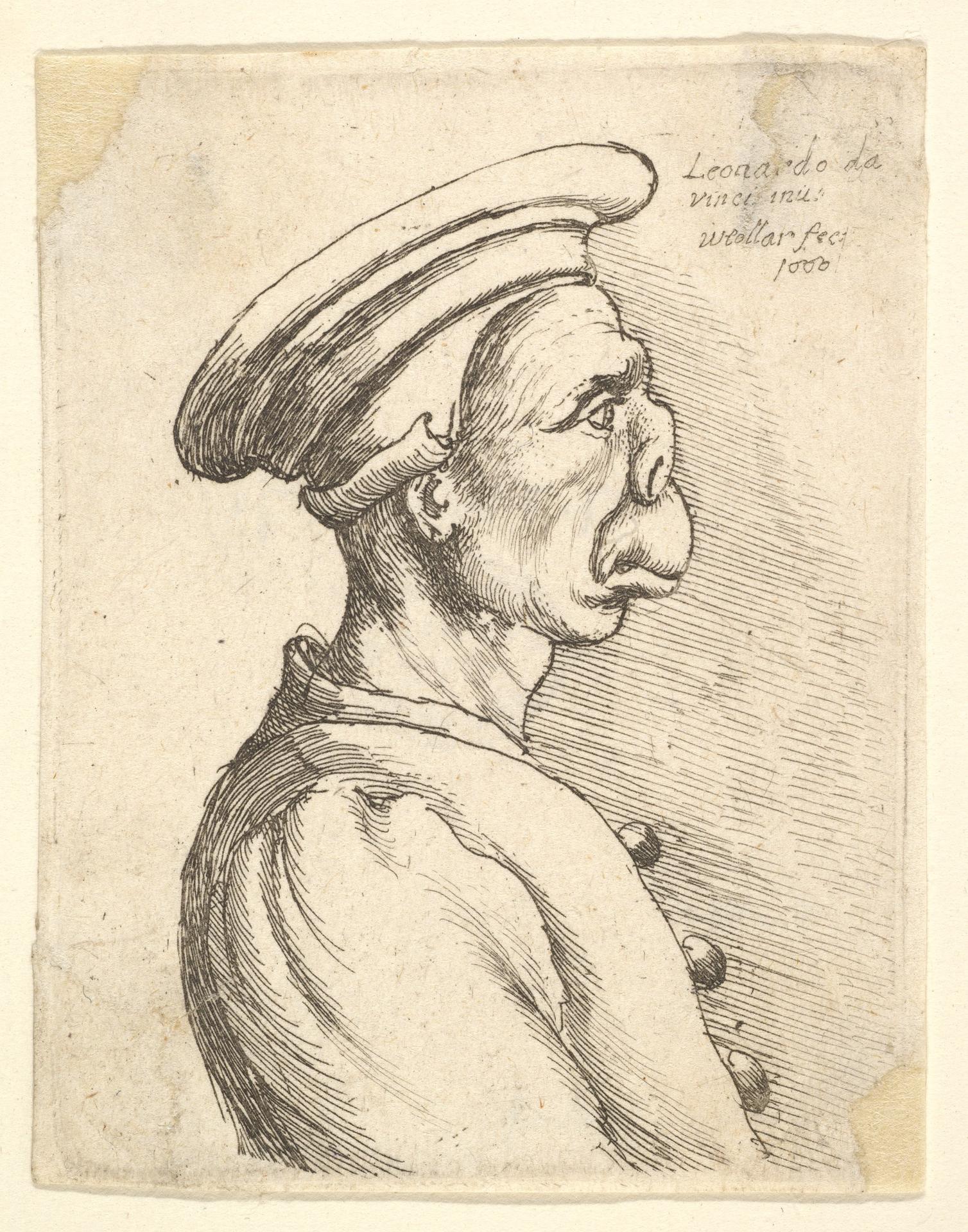
Bust of a man with a flat nose and protruding mouth, wearing flat cap and buttoned coat in profile to right
Original title: Bust of a man with a flat nose and protruding mouth, wearing flat cap and buttoned coat in profile to right
kurzbeschreibung
An etching by Wenceslaus Hollar from 1660 showing an unknown man in profile facing right, wearing a flat cap and a buttoned coat. This is a single print measuring only about 6.2 × 4.8 cm. The subject is a simple yet precise bust portrait in side view.
Description
A man is seen in profile facing right, his head slightly tilted to the left. He wears a flat cap and a coat with buttons. The nose is prominent and turns slightly downward, and the mouth protrudes noticeably. The linework is detailed, creating a texture that emphasizes the curves and folds of the face and clothing. In the upper right area there is handwritten text with the name Leonardo da Vinci and the year 1660. The paper is slightly yellowish and shows some creases.
Context
Wenceslaus Hollar made this etching in 1660, presumably as part of a series of studies after older models. The inscription with Leonardo da Vinci's name suggests that Hollar was referring to a drawing or work from Leonardo's circle. Such small-format portraits were popular as collectibles in the 17th century. Hollar was known for his precise reproductions of various artworks.
Impact
The etching derives its effect from fine lines that give the small format remarkable detail. The man's distinctive facial features appear idiosyncratic and full of character. Despite the simplicity of the subject, the print has a calm, concentrated presence.
Technique
The work is an etching in a single state. The plate measures about 6.2 × 4.8 cm, and the sheet is somewhat larger. The etching technique allows for fine, even lines, which are used here for the details of the face and clothing.
AI-generated description text
Source: Metropolitan Museum of Art · Public Domain (CC0 1.0)