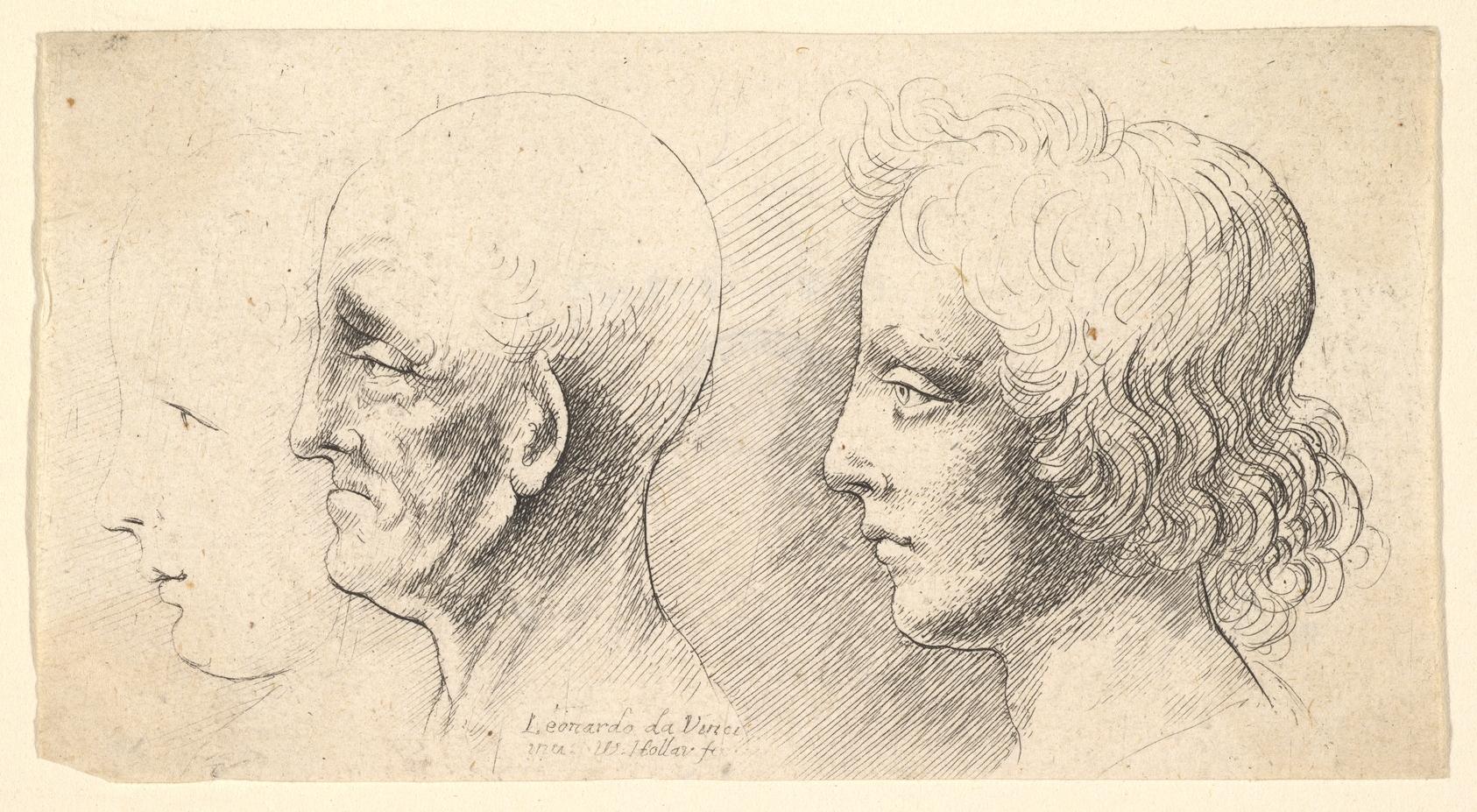
Three profile heads, one in outline only
Original title: Three profile heads, one in outline only
kurzbeschreibung
Wenceslaus Hollar's etching Drei Profilköpfe, einer nur als Umriss (Three Profile Heads, One Only an Outline), made between 1644 and 1652, gathers three male portraits in profile on a single sheet. Two of the heads are fully worked out, while the third survives only as a bare contour line. The print is the first of two states and measures 6 × 11.1 cm.
Description
Three men's heads appear in profile, but only two are carried through to the last detail; the third exists as nothing more than an outline. The finished portraits differ in their hair: one has short, close-cropped hair, the other curls. Delicate strokes give the hair its structure and texture. Each face shows a clear profile with plainly visible eyes and features. The background is left empty, so the heads stand out all the more; a signature referring to Leonardo da Vinci sits at the lower right.
Context
The etching dates from the mid-seventeenth century, when Hollar was working for various patrons across Europe, in England and the Netherlands among other places. The sheet probably goes back to a drawing by Leonardo da Vinci, as the signature suggests. It belongs to Hollar's series of reproductions after Italian masters. He was known for his precise graphic work, with which he often passed on the work of other artists.
Impact
The plain, pared-down layout sets the profiles in immediate contrast with one another. A tension arises between the fully realized heads and the mere outline, best described as a shift between presence and absence. The fine linework lends the portraits a calm, almost meditative air.
Technique
For this etching the lines were scratched into an acid ground on a copper plate and then bitten. The delicate strokes and shading show Hollar's sure command of the process, which let him grade texture and tone with great precision. The sheet is trimmed to the plate mark; a slight beige tint and traces of weathering testify to its age.
AI-generated description text
Source: Metropolitan Museum of Art · Public Domain (CC0 1.0)