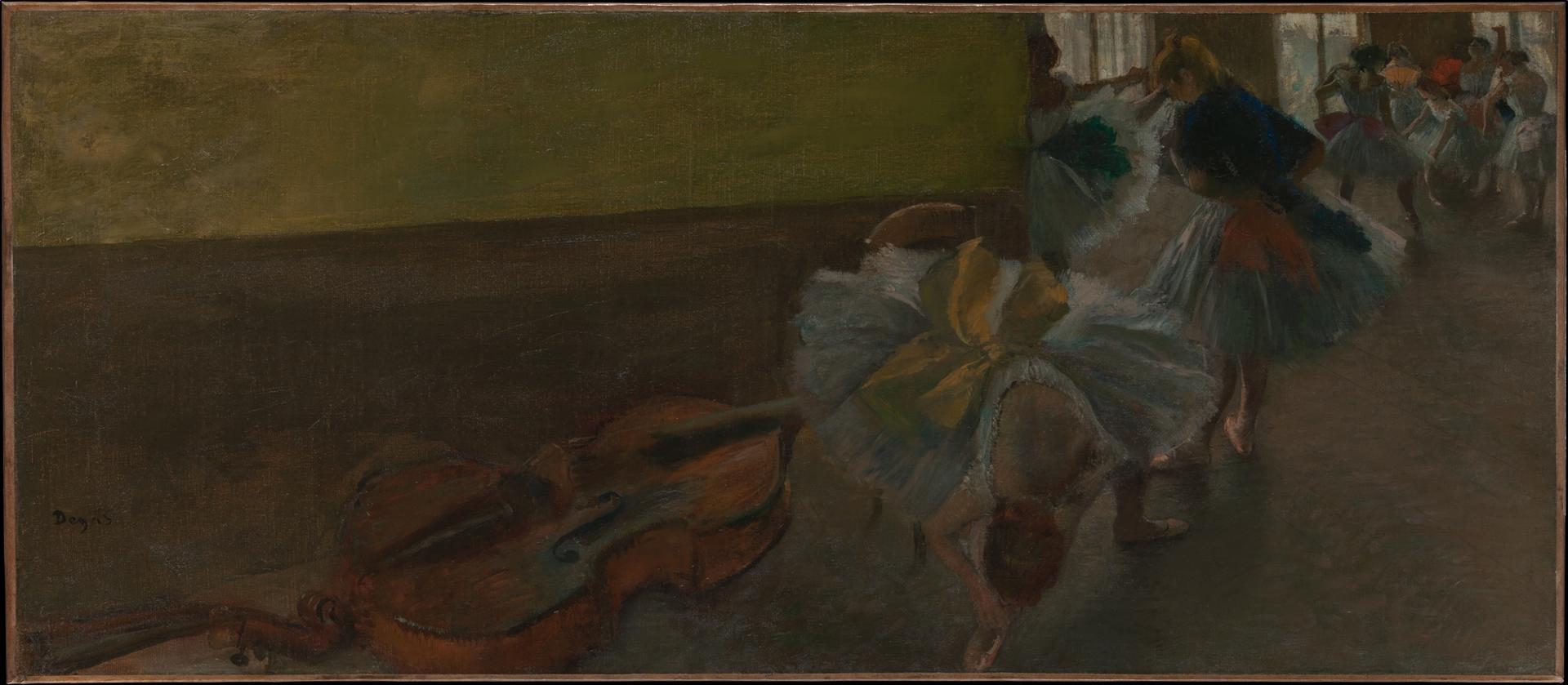
Dancers in the Rehearsal Room with a Double Bass
Original title: Dancers in the Rehearsal Room with a Double Bass
kurzbeschreibung
Edgar Degas's oil painting 'Dancers in the Rehearsal Room with a Double Bass', from around 1882–85, differs from many of his ballet scenes by the emphasis on the instrument: a double bass lies flat on the floor while a dancer in a yellow tutu kneels beside it and stretches. The painting captures an observed moment from a rehearsal, with other dancers distributed around the room.
Description
Unlike scenes that direct the gaze to the stage, here the foreground comes into focus, with the double bass resting on the floor and the kneeling dancer in yellow. Behind her, several dancers in blue tutus stand, some motionless, some in motion. The space is defined by a dark, greenish background, from which the figures and the instrument emerge under light falling from above.
Context
In the 1880s Degas devoted himself increasingly to ballet, often observing the dancers during rehearsals at the Paris Opera, where he captured incidental moments. The horizontal format with its unusual aspect ratio may, as with other later works by the artist, have been intended for a decorative wall arrangement.
Impact
Because the instrument lies in the foreground and the dancer kneels beside it, an almost accidental closeness to the action arises. The restrained colors and the light from above give the image a quiet, inward-looking mood and allow the viewer to share in the everyday life of a rehearsal.
Technique
Executed in oil on canvas, Degas worked with thick and partly transparent layers. The brushwork remains loose and sketchy, thus underlining the fleetingness of the moment. The tonal values are finely graded, with greenish tones in the background and accents in yellow and blue on the tutus.
AI-generated description text
Source: Metropolitan Museum of Art · Public Domain (CC0 1.0)