Five Heads
Original title: Five Heads
kurzbeschreibung
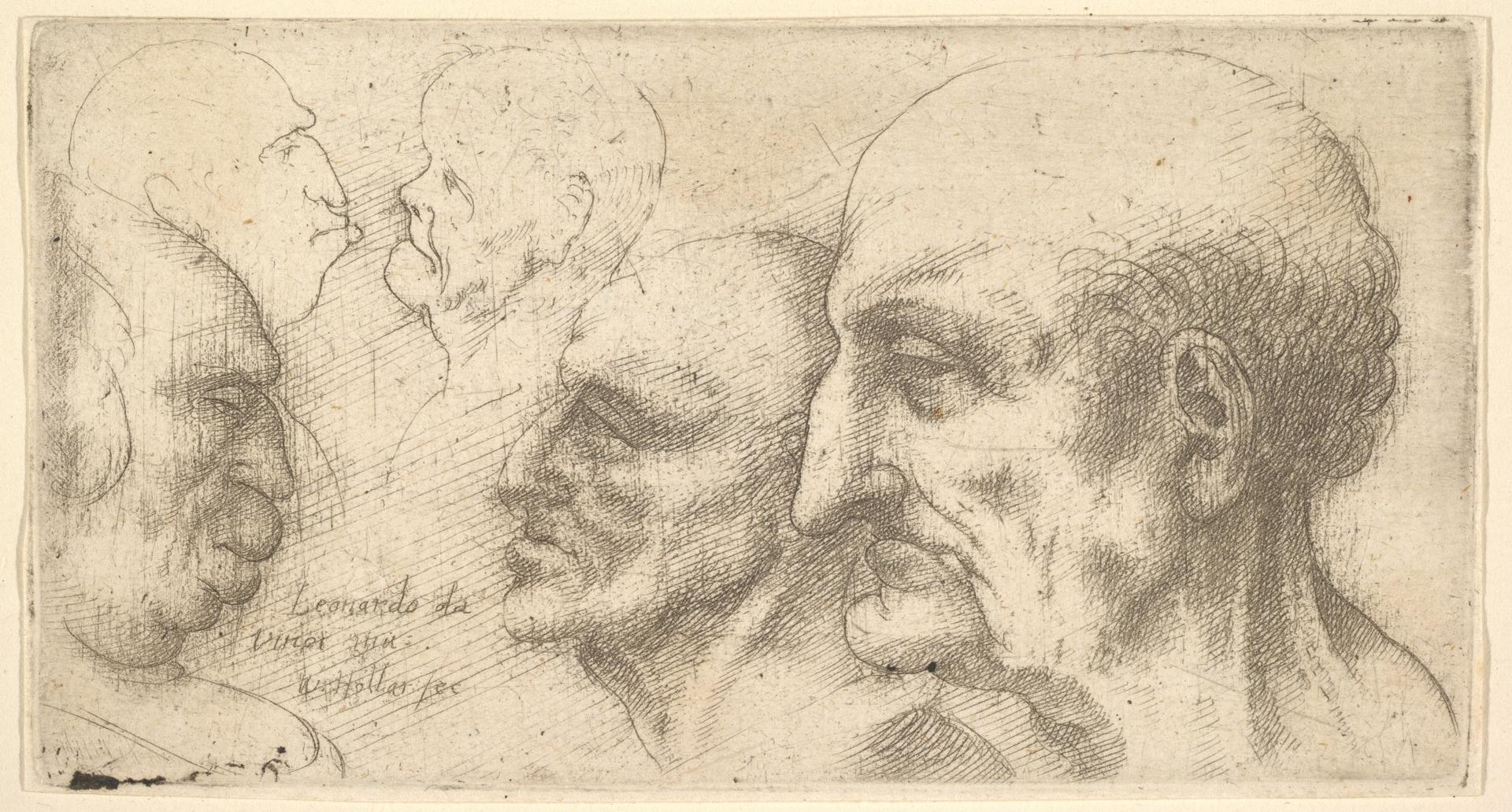
Five human heads, some in profile and others facing forward, are gathered on this sheet by Wenceslaus Hollar. The etching was made between 1644 and 1652 and goes back to a drawing by Leonardo da Vinci, as the inscription 'Leonardo da Vinci inv. et f.' indicates. Hollar executed the motif as an etching; the print exists in only one state.
Description
Heads in varying turns and sizes are distributed across the sheet: several in profile, others turned toward the viewer. The arrangement feels loose, almost like a study, with changing intervals between the faces. Black and white governs the entire print; lines and hatching work out the contours and surfaces of the faces. The layout gains rhythm from the shifting head positions and a dense succession of details.
Context
Hollar, a seventeenth-century Bohemian printmaker, worked for this etching after a model by Leonardo da Vinci, whose drawings were then circulating in Europe. Hollar was known for accurate reproductions of artworks and natural-history studies. The sheet was made during his stay in England, where he worked on commission for noblemen and scholars. The signature referring to Leonardo underscores the prestige of the source.
Impact
Fine lines and clearly defined facial structures shape the impression of the sheet. The different head positions create a lively, sketch-like effect that invites close looking. The restriction to black and white emphasizes the graphic character and draws attention to form.
Technique
In the etching process, lines were bitten into a copper plate with acid, then inked and printed on paper. For the precise lines and hatching, Hollar used a fine needle. Only one state of the print is known, which suggests careful control of the printing process.
AI-generated description text
Source: Metropolitan Museum of Art · Public Domain (CC0 1.0)