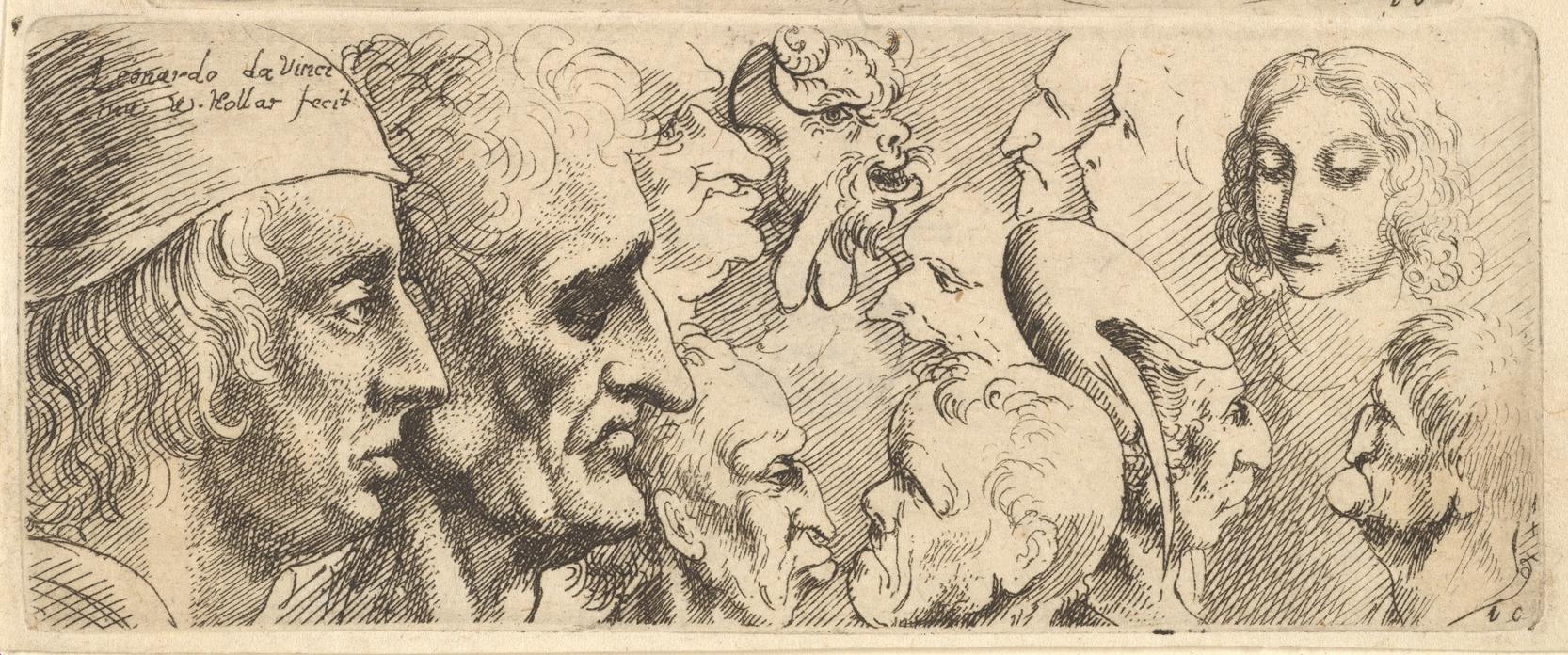
A variety of heads
Original title: A variety of heads
kurzbeschreibung
Wenceslaus Hollar's etching A Selection of Heads from 1645 gathers several head studies that show different directions of gaze and facial expressions. This is the second state of two; the sheet measures 4.3 × 10.6 cm.
Description
Stretched wide, the heads line up side by side, some facing forward, others turned to the side or seen in profile. Age, sex, and expression shift from one head to the next: bearded men beside bald skulls, curly hair beside short-cropped. An accompanying text in the image field names Leonardo da Vinci and carries the signature of W. Hollar. In black on white, the gradations arise solely from thin lines and hatching; the light falls evenly, with no shadow anywhere.
Context
The etcher Wenceslaus Hollar, a native of Bohemia, published this sheet in England in 1645. It takes up the tradition of head studies that goes back to Leonardo da Vinci, to whom the text in the background also refers. Hollar often worked for collectors and publishers and was known for the accuracy of his depictions. That a second state of the sheet exists suggests that the artist later revised or added to the plate.
Impact
The very precise linework captures the particularities of each face, wrinkles as well as hair structures. As the heads line up, a steady rhythm emerges that the eye follows from one face to the next. The even lighting and fine hatching give the sheet something calm, almost scientific.
Technique
The sheet was produced as an etching: the drawing is scratched into an acid-resistant layer on a copper plate, and the plate is then etched. Tonal values and surfaces of the heads are built up from thin lines and hatching. In the second state of the print, additional lines or corrections were probably added to the plate after the first pull.
AI-generated description text
Source: Metropolitan Museum of Art · Public Domain (CC0 1.0)