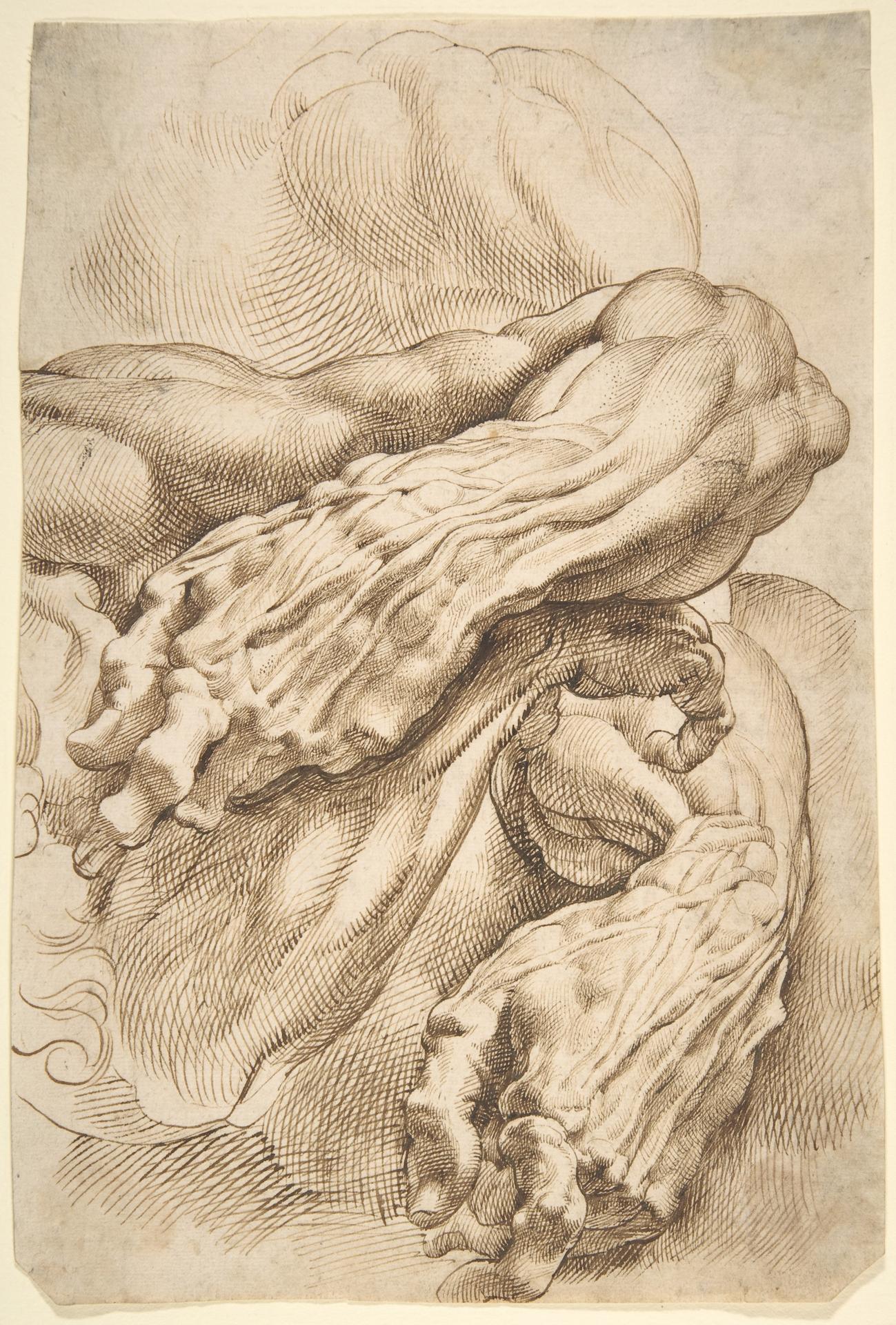
Anatomical Studies: a left forearm in two positions and a right forearm
Original title: Anatomical Studies: a left forearm in two positions and a right forearm
kurzbeschreibung
Unlike many contemporary anatomical sheets that present isolated limbs, Rubens pairs two forearms moving in opposite directions. Drawn around 1600–05 in pen and brown ink, the sheet captures muscle paths and states of tension with rapid strokes.
Description
Two arms appear on the page: at left, a forearm pointing upward; at right, one angled downward. Both are sketched in detail with muscles and fleshy areas, each hand clenched into a fist, emphasizing strength. Brown tones dominate; hatching and lines convey form and texture. The arrangement is asymmetrical, with the left arm overlapping the right. Light and shadow emerge from varying stroke widths and hatching density.
Context
Rubens made this study during his early Italian period, when he was deeply engaged with human anatomy. Such sheets served as preparations for larger paintings and reflect the influence of Italian Renaissance artists who stressed anatomical accuracy. The motif demonstrates Rubens's interest in movement and muscle tension.
Impact
The precise rendering of musculature gives the sheet an immediate physical presence. Clenched fists and opposing positions create tension that highlights the body's power. Viewers may be reminded of Leonardo da Vinci's anatomical studies, yet Rubens's own hand remains forceful and distinct.
Technique
Pen and brown ink allow for fine lines and hatching. Rubens varied stroke thickness to model volume and light. The quick, assured marks reveal a spontaneous yet controlled working method.
AI-generated description text
Source: Metropolitan Museum of Art · Public Domain (CC0 1.0)