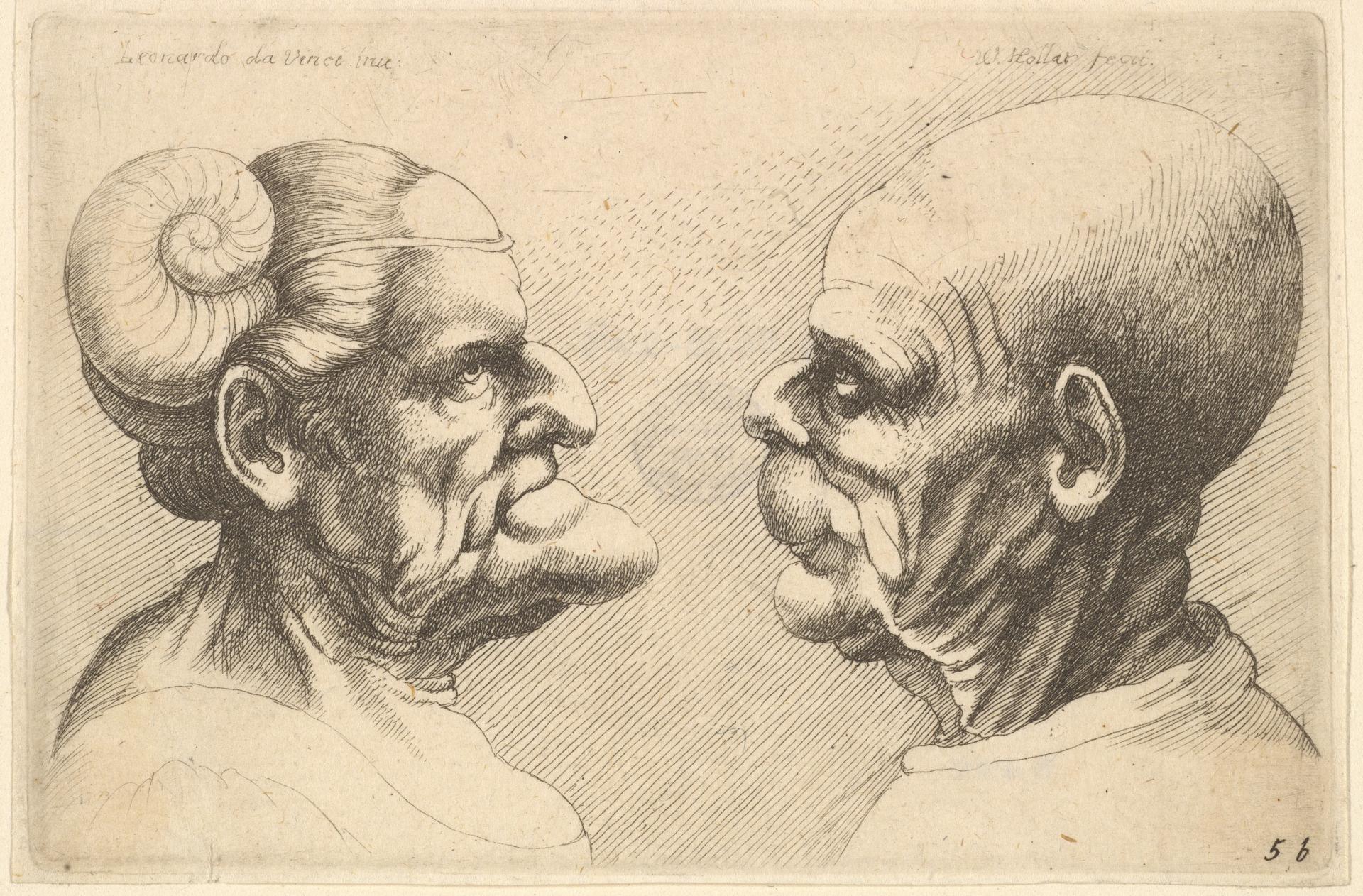
Two deformed heads facing each other (1645, Met-Objekt 5498)
Original title: Two deformed heads facing each other
kurzbeschreibung
This sheet by Wenceslaus Hollar from 1645 presents two severely distorted facial profiles in side view. Executed as an etching and engraving, it is the second of two states and measures 9.5 × 14 cm. The heads are shown without shoulders, which makes the grotesque features stand out all the more.
Description
The left head bears a spiral formation on its crown, the right a round, almost spherical shape; both turn to face each other frontally. Oversized, expressive eyes and broad noses drive the distortion. Diagonal hatching in the background suggests shadow and spatial depth. Black and white dominates the entire sheet, as is usual for printmaking, and the facial features are captured with high precision.
Context
Hollar, a Bohemian printmaker of the 17th century, was working in England in 1645 for court and collectors. The deformed heads likely fall within the period's fascination with the grotesque and physiognomic studies, as known in the Renaissance and Baroque. Hollar was known for precise etchings, often after his own designs or works by other artists. The signature “W. Kollwitz fecit” was probably added later or confused, as it does not match the artist.
Impact
The distorted faces strike the viewer as uncanny and surreal, oscillating between irritation and fascination. The clear black-and-white graphics heighten the expressive power of the deformations, which stand between grotesque and portrait study. Because the heads face each other, a comparative gaze is prompted, emphasizing the asymmetry of the forms.
Technique
Etching and engraving combine here to produce fine linework and precise hatching. This allows both delicate details and strong contrasts to be brought out, as visible in the eyes and noses. The second state indicates that Hollar reworked the plate to sharpen the effect.
AI-generated description text
Source: Metropolitan Museum of Art · Public Domain (CC0 1.0)