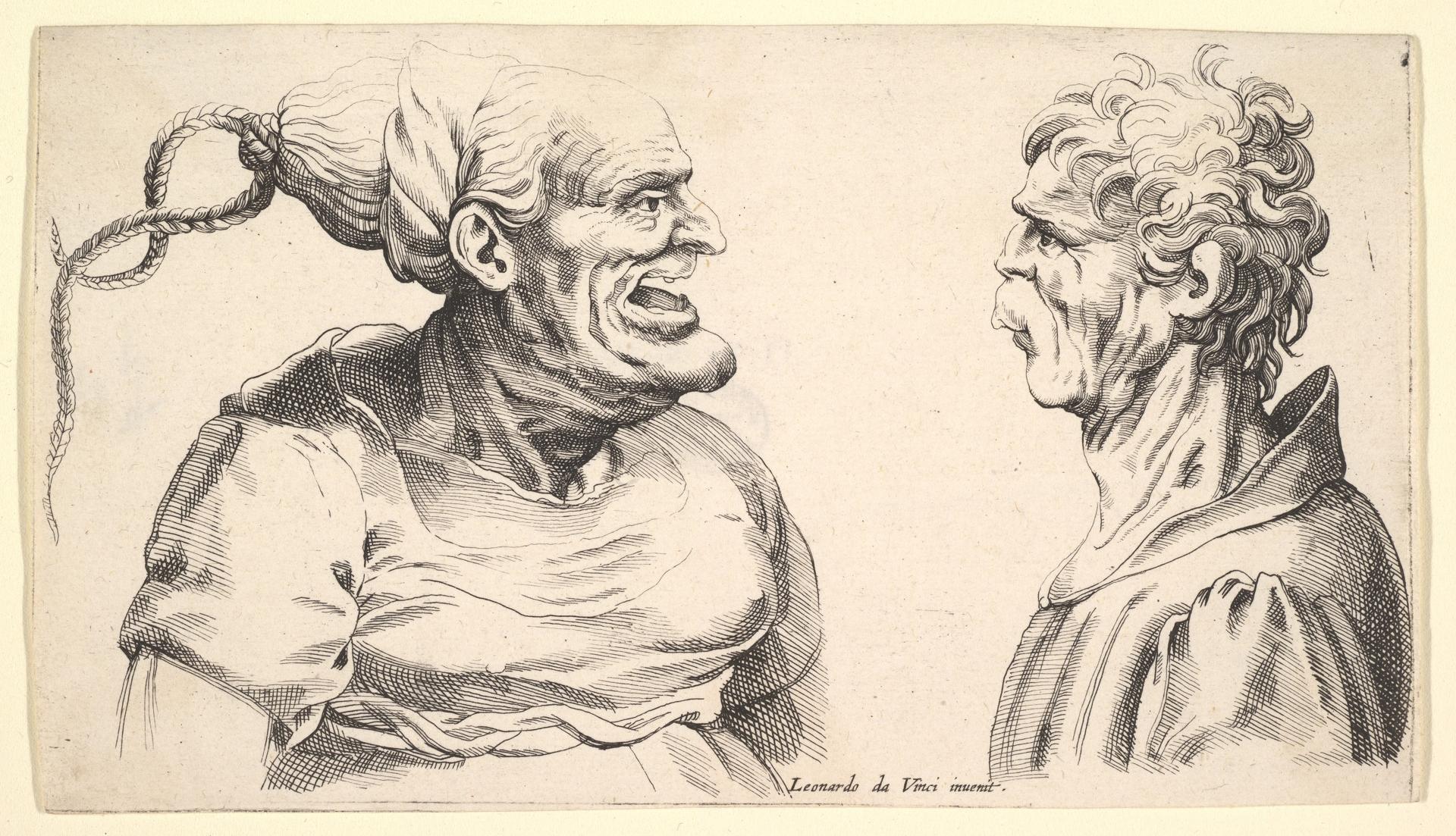
Two deformed heads (1645–50, Met-Objekt 5497)
Original title: Two deformed heads
kurzbeschreibung
Between 1645 and 1650 Wenceslaus Hollar made the engraving "Two Deformed Heads," setting two human heads in profile opposite each other. As the inscription on the sheet records, the motif goes back to an invention of Leonardo da Vinci. This is a single print in landscape format.
Description
Two heads, both seen from the side, are pushed close to the viewer. The left one is badly distorted: mangled features, an open mouth as if screaming, something like an apron, and a cap with a bow. On the right, by contrast, is a fairly ordinary head with curly hair in profile. The layout feels balanced, with the left head shifted slightly outward. Fine lines and graded shading in black and white define the sheet.
Context
Hollar was working in Antwerp or London during the years the engraving was made. The caption "Leonardo da Vinci inuenit" names a model from Leonardo's circle, which the printmaker adapted to his own medium. Physiognomic studies of this kind were common in the sixteenth and seventeenth centuries, used to probe expression and deformation. Hollar was known as a careful reproducer of older masters.
Impact
The contrast between the distorted head and the intact one produces an unsettling tension. The calm arrangement and precise lines give the sheet a detached, almost scientific air. At the same time the motif reads as grotesque and probing without tipping into caricature.
Technique
It was executed as a copperplate engraving, evident in the exactly drawn lines and densely set shading. Only one state of the print is known. The process allowed facial features and the different textures of hair to be rendered precisely.
AI-generated description text
Source: Metropolitan Museum of Art · Public Domain (CC0 1.0)