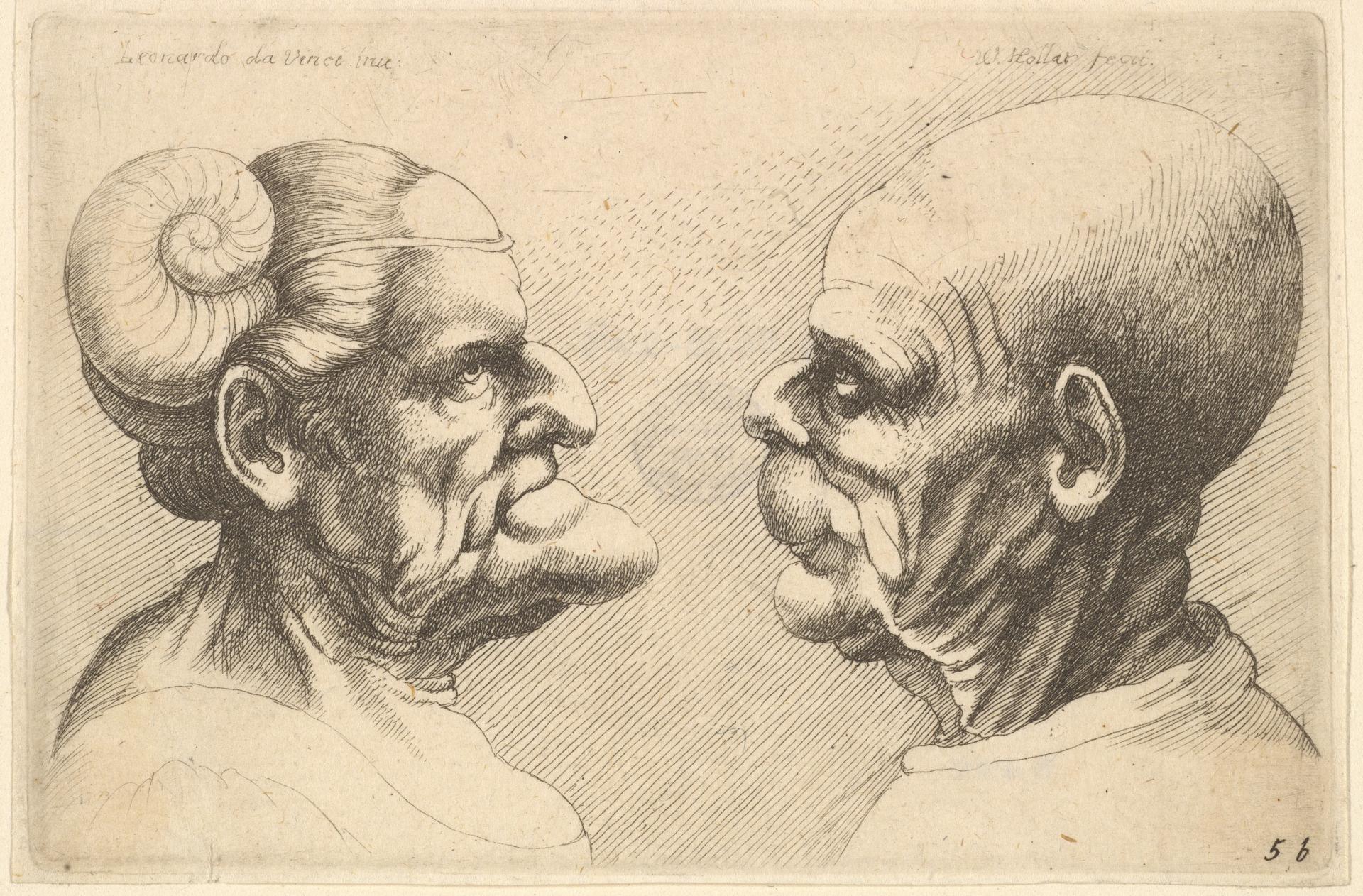
Two deformed heads facing each other (1645, Met-Objekt 5494)
Original title: Two deformed heads facing each other
kurzbeschreibung
Two grotesque heads in profile face each other in this 1645 etching by Wenceslaus Hollar. The print, in its second state, derives from a model attributed to Leonardo da Vinci and was executed in etching.
Description
Two stylized heads in profile are turned toward one another. On the left head the hair coils into a spiral, snail-like form; the right one is bald and bears a pronounced fold above the brow. Both have large, expressive eyes and broad noses tilted slightly upward. Diagonal strokes running from left to right make up the ground, while the contours stand out sharply, with shading that ranges from light to dark. At the top of the sheet appear the names "Leonardo da Vinci" and "W. Kollner".
Context
Hollar made the etching in 1645, during his years in Antwerp, when he became known for richly detailed prints. A drawing attributed to Leonardo da Vinci served as his model, and the subject belongs to the grotesque studies widespread in the sixteenth century. Deformed heads of this kind were often treated as inquiries into physiognomy and expression, and artists like Hollar used them as models for their own work.
Impact
The odd proportions and intense gazes of the two deformed heads leave the viewer wavering between unease and fascination. Crisp lines and strongly contrasted shadow heighten the grotesque character of the faces and lend the sheet an almost sculptural presence.
Technique
The work was produced as an etching, an intaglio process in which the drawing is scratched into a metal plate bitten with acid. Through fine lines and varying stroke weight Hollar achieved the shading and the three-dimensional effect of the heads. This sheet is the second state, which points to a reworking of the plate after the first impression.
AI-generated description text
Source: Metropolitan Museum of Art · Public Domain (CC0 1.0)