Rex et Regina de Tunis
Original title: Rex et Regina de Tunis
kurzbeschreibung
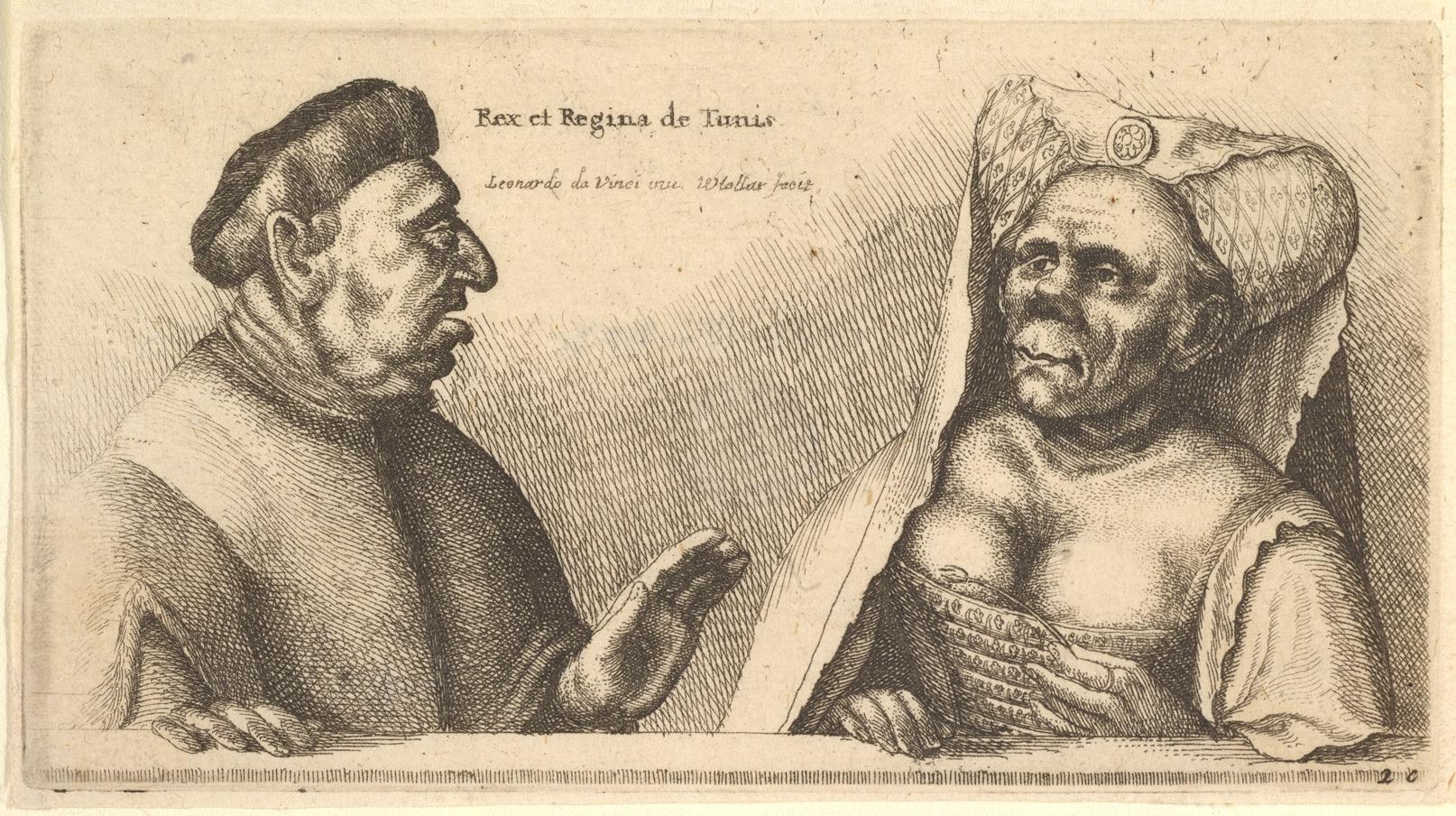
Wenceslaus Hollar's 1645 etching 'Rex et Regina de Tunis' presents a king and queen of Tunis in a frontal, face-to-face arrangement. This impression is from the second state of two, a later pull, and the design is based on a work attributed to Leonardo da Vinci.
Description
On the left stands a man with short hair and a hood, one hand extended; on the right, a woman with a patterned headscarf and a sleeved dress rests a hand on her chest. A table or partition separates them. Diagonal strokes suggest the setting. Above, the title reads 'Rex et Regina de Tunis', with the signature 'Leonardo da Vinci inv. W Albar fecit' below. Fine lines and hatching, monochrome, and evenly distributed light define the image.
Context
Hollar made this etching in Antwerp in 1645. The model is attributed to Leonardo da Vinci, evidence of the reception of Italian art in the seventeenth century. The sheet belongs to a series that appeared together with other prints on a single sheet, a sign of collecting or serial publication. The portrayal of a Tunisian royal couple reflects European interest in North Africa and its representation in print.
Impact
The print appears clear and precise thanks to fine linework and a calm, symmetrical layout. Even light and reduced detail create a factual, documentary mood; the figures feel distant and representative.
Technique
A black-and-white etching with fine lines and hatching is at hand. As a later pull in the second state, it points to a reworking of the plate. The technique allows detailed rendering of fabrics and patterns; shadows arise from parallel and crossed lines.
AI-generated description text
Source: Metropolitan Museum of Art · Public Domain (CC0 1.0)