Two Grotesque Heads (1640s)
Original title: Two Grotesque Heads
kurzbeschreibung
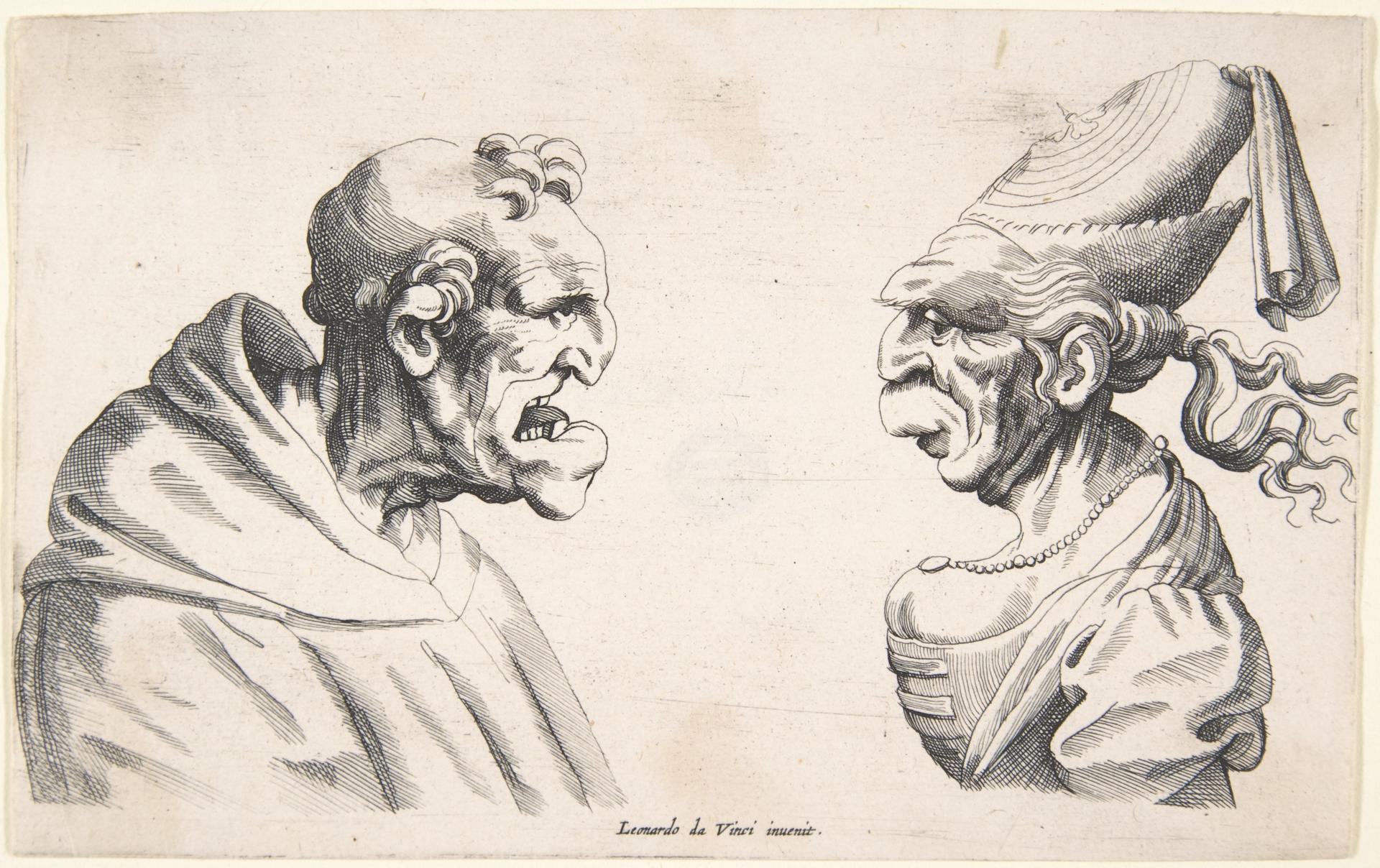
This etching from the 1640s, titled Two Grotesque Heads, was made by an anonymous Netherlandish artist of the 17th century. It shows two distorted faces turned toward each other. The print exists in only one state and measures 10.6 × 16.8 cm. According to the inscription “Leonardo da Vinci inuenit” at the bottom, the invention of the composition goes back to Leonardo da Vinci.
Description
Two heads in profile face each other directly, filling the picture surface. The left, male head with wildly curled hair wears an aggressive, almost shouting expression. On the right, a female head with a pointed, helmet-like headdress looks serious and withdrawn. Dense, precise lines and fine shading model the faces and create strong contrasts of light and dark. The rendering remains monochrome in black and white and follows a style typical of the 16th century.
Context
The etching was made in the 17th-century Netherlands, at a time when prints after Italian models were widely circulated. The inscription names Leonardo da Vinci as the inventor of the composition, suggesting an reception of his grotesque head studies. Such sheets often served as collectibles or study models. The anonymous engraver likely worked from a lost drawing or an earlier reproduction.
Impact
Dramatic tension arises immediately from the juxtaposition of the two extreme facial expressions, which directly engages the viewer. Thanks to the fine linework and high-contrast shading, the heads appear almost sculpturally three-dimensional. Thus the etching seems at once precisely studied and expressively idiosyncratic.
Technique
In etching, the drawing is scratched into an acid-resistant layer on a copper plate and then bitten with acid. The print was made in black on paper; only a single state is known. The nuanced gray values and fine lines testify to a careful etching technique that renders the details of the faces precisely.
AI-generated description text
Source: Metropolitan Museum of Art · Public Domain (CC0 1.0)