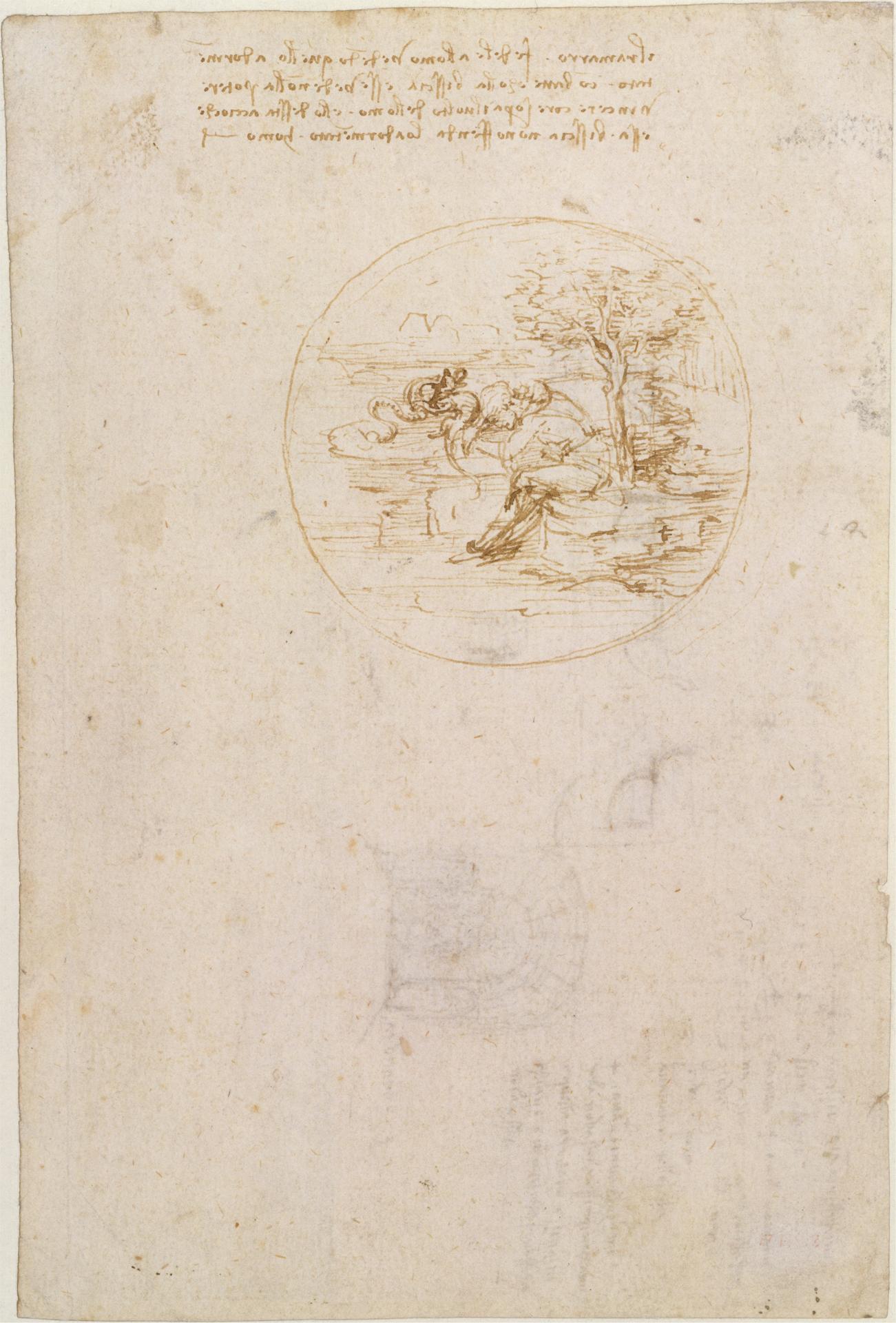
Allegory on the Fidelity of the Lizard (recto); Design for a Stage Setting (verso)
Original title: Allegory on the Fidelity of the Lizard (recto); Design for a Stage Setting (verso)
kurzbeschreibung
Leonardo da Vinci made this sheet in 1496. The recto offers an allegorical scene within an oval frame, while the verso shows sketches for a stage set. The drawing is executed in pen and brown ink, and the format measures 20.2 x 13.3 cm.
Description
Within an oval field, two figures stand in a landscape with trees and a river. One turns toward the other, making gestures of speaking or explaining. Fine brown lines define the image, with no color and no elaborated background details. The verso carries simple line sketches for a stage set. A Latin text at the upper edge apparently comments on the scene.
Context
The sheet dates from 1496, when Leonardo was working at the Milanese court of Ludovico Sforza. At that time he devoted himself increasingly to allegories and emblems, often intended for court festivities and theatrical designs. The stage-set design on the verso points to the elaborate festive productions at the Milanese court. The Latin inscription suggests a learned or moralizing purpose, typical of Leonardo's allegorical studies.
Impact
The viewer's eye is first drawn by the calm linework and the clear arrangement of the figures. The sparing drawing makes the scene appear light and sketch-like, typical of Leonardo's designs. Recto and verso together offer insight into the artist's working method, capturing ideas for different purposes on a single sheet. The concentration on outlines gives the sheet an immediate impact.
Technique
Pen and brown ink on paper determined the execution, a method Leonardo often used for studies and designs. The lines were probably drawn with a pointed pen, which allowed high precision. The brown ink, presumably iron gall ink, gives the drawings a warm tone characteristic of Renaissance drawings.
AI-generated description text
Source: Metropolitan Museum of Art · Public Domain (CC0 1.0)