The Death of Leonardo da Vinci
Original title: The Death of Leonardo da Vinci
kurzbeschreibung
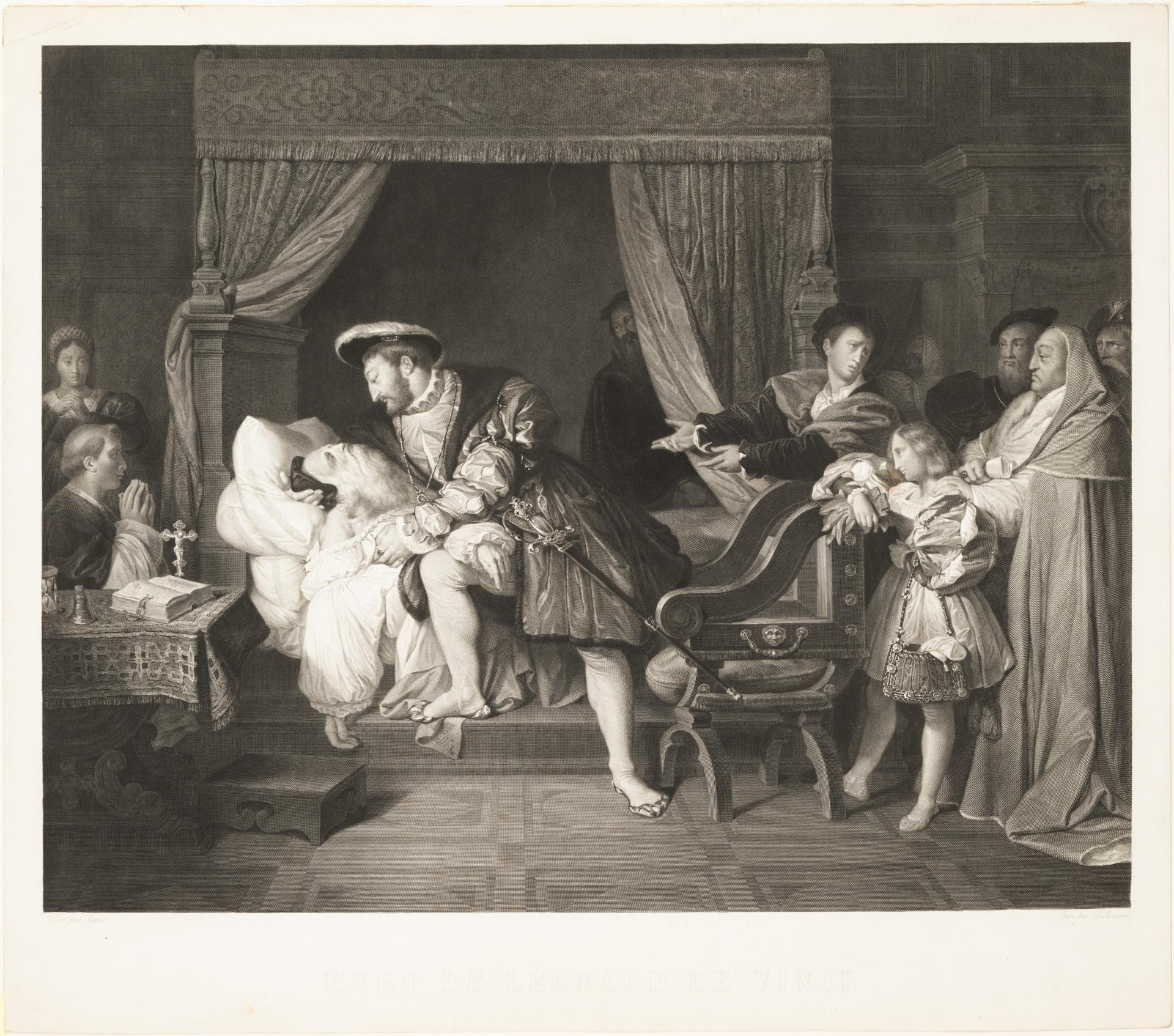
Around 1825, Joseph Théodore Richomme made this etching with engraving, capturing the dying Leonardo da Vinci surrounded by pupils and companions. The print belongs to 19th-century history painting and combines portraiture with event imagery.
Description
In a richly furnished room with curtains, columns and a table bearing a cross and a book, Leonardo lies on a bed. Mourners stand around him, and a figure in traditional dress holds his hand. Historical costumes and the symmetrical alignment toward the reclining man shape the layout. Subdued light picks out the central figure and those standing by; the monochrome rendering relies on black-and-white contrasts.
Context
The print was made around 1825 in France, when interest in the Renaissance and its artists was growing. Richomme, a painter and printmaker, produced this reproductive engraving after a 1781 painting by François-Guillaume Ménageot. The motif of the dying Leonardo became popular in the 19th century because it reflects the veneration of the artist as a genius and the Romantic idea of the artist's death. The etching made the history painting accessible to a wider audience.
Impact
A solemn, almost reverent mood arises from the central arrangement and the subdued light. The dying artist prompts a mixture of tragedy and deference that draws the viewer into the event. Symmetry and the calm gestures of the figures give the print a dignified stillness.
Technique
Etching and engraving complement each other: they allow fine lines and precise reproduction of details. The technique enables nuanced shading that emphasizes the light and shadow effects of the source. The print on paper measures 46.8 × 53.1 cm as a sheet, with an image format of 39.4 × 49.5 cm.
AI-generated description text
Source: Metropolitan Museum of Art · Public Domain (CC0 1.0)