The Dance Lesson
Original title: The Dance Lesson
kurzbeschreibung
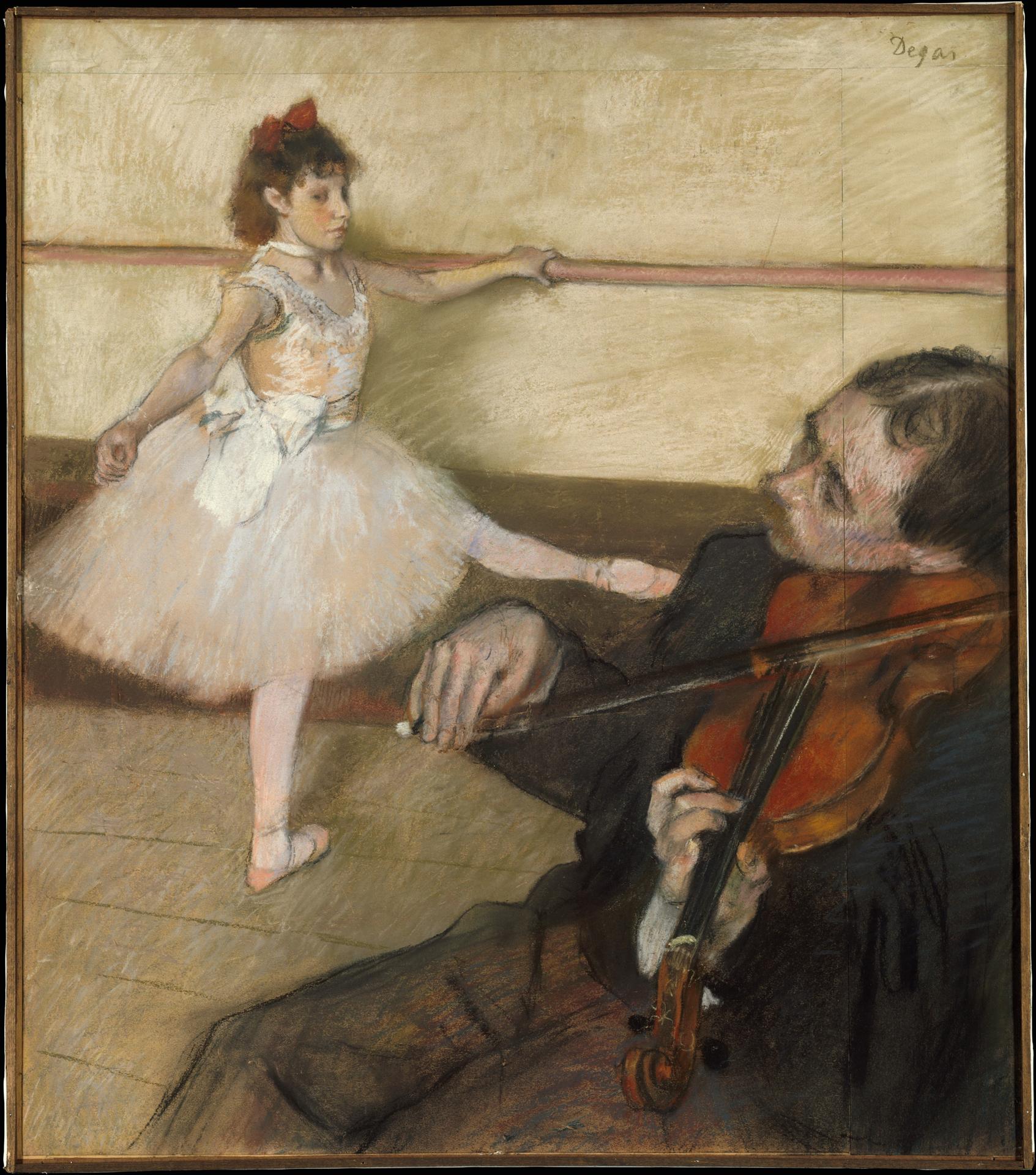
Around 1879, Edgar Degas made the pastel drawing 'The Dance Lesson.' It shows a young ballet student in a white tutu practicing at the barre, while a man with a cello sits beside her and watches. The work is executed in pastel and black chalk on three joined pieces of wove paper.
Description
At the front, the dancer, one leg extended long, one hand on the barre. Behind her, in a dark jacket and trousers, the cellist, instrument in his arm, his gaze fixed on the practicing girl. Pastel tones with sepia and brown bring out the paper's texture. Soft, diffuse light gently highlights the pastel texture. The layout thrives on the contrast between dancer and musician.
Context
This work belongs to a period when Degas was deeply engaged with ballet, producing numerous scenes of rehearsals and classes. The fact that three sheets of paper are joined here points to an experimental approach typical of his pastel technique. The cellist represents the musical accompaniment of ballet lessons, a common practice at the time. The date around 1879 falls during the third Impressionist exhibition, in which Degas participated.
Impact
Gentle pastel tones and subdued light create a quiet, intimate mood. The focused musician and the concentrated dancer reveal a moment of silent interaction that holds the viewer's gaze. One senses the calm before movement that fills the room.
Technique
Pastel and black chalk were applied to three joined pieces of wove paper. The layers are set so that the paper's structure shows through and the color transitions blend softly into one another. This gives the surface its own texture and depth.
AI-generated description text
Source: Metropolitan Museum of Art · Public Domain (CC0 1.0)