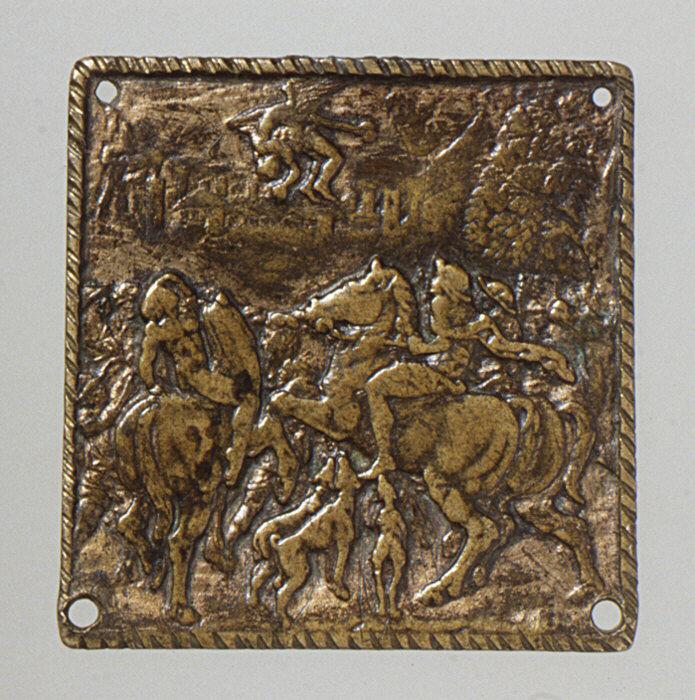
The Rape of Ganymede
Original title: The Rape of Ganymede
kurzbeschreibung
A small, almost square bronze relief measuring roughly 4.9 by 4.8 cm, attributed to Caradosso (Cristoforo Caradosso Foppa) and dating from the 16th century. It depicts the myth of the abduction of Ganymede. Traces of former gilding survive; the piece may once have belonged to a larger relief.
Description
Two figures on horseback dominate the foreground: one grasps a branch, the other sits in a lively pose in the saddle. Behind them, other figures emerge in flowing motion. An ornamental frame encloses the picture field, whose surface shimmers with a copper tone, interspersed with remnants of gold gilding.
Context
The piece is attributed to Caradosso, an Italian medallist and goldsmith of the Renaissance. It was made in the 16th century, when ancient myths were omnipresent in art. What the fragment originally served is not recorded; its small size and gilding suggest a decorative element or an inlay.
Impact
From the first glance, the movement of the riding figures captivates, giving the tiny relief a surprising liveliness. Where the gilding survives, it stands out nobly against the dark bronze ground and brings out the finesse of the workmanship.
Technique
The work was cast in bronze; remnants of fire gilding testify that the surface was once probably entirely covered with gold. The relief rendering was likely produced using the lost-wax casting method, which permits the finest details.
AI-generated description text
Source: Metropolitan Museum of Art · Public Domain (CC0 1.0)