Landscape, after Rembrandt
Original title: Landscape, after Rembrandt
kurzbeschreibung
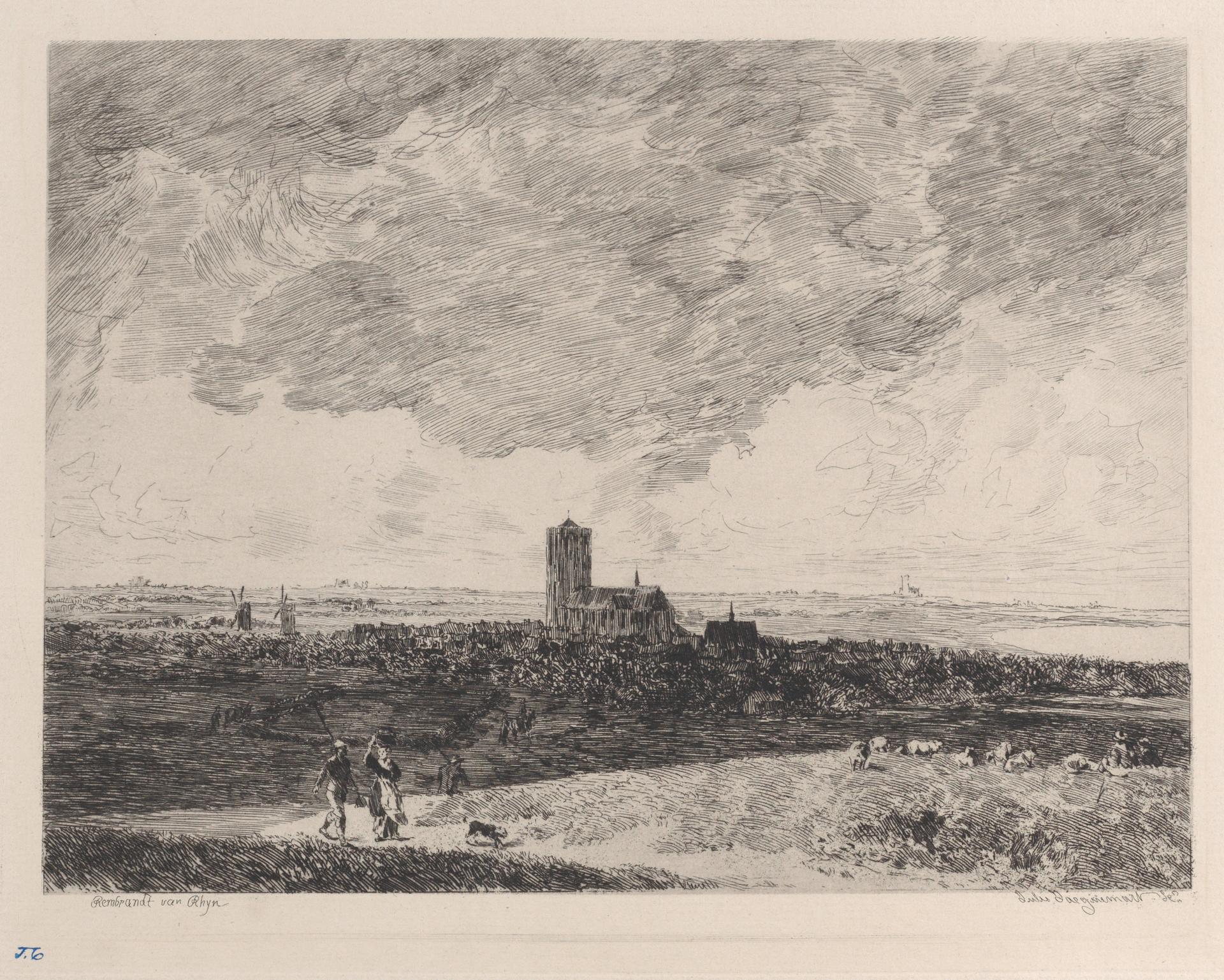
In this 1877 print, Jules-Ferdinand Jacquemart presents a rural scene with people, animals, a house, and a church. He based it on a work by Rembrandt, which he reproduced in the monochrome linear manner characteristic of etching.
Description
Across a field in the foreground, people and animals move about; some figures stay near a house that a church towers over. Behind them rise windmills and other buildings. The cloudy sky is rendered with dense hatching, giving the image depth and mood. The lighting comes entirely from the density and direction of the hatched lines.
Context
The French etcher Jacquemart made this sheet in 1877 as a reproductive print after a painting or etching by Rembrandt. Such copies were widespread in the 19th century, making artworks accessible to a broad public. The etching appeared at a time when interest in Rembrandt and 17th-century Dutch art was particularly strong in France.
Impact
The delicate lines and varied hatching create a quiet, almost melancholic atmosphere. The open landscape draws the viewer into the scene without any single detail feeling overloaded.
Technique
For this etching, the drawing was scratched into an acid-resistant ground on a copper plate and then etched. Jacquemart used fine lines and different densities of hatching to model light and shadow. The sheet is printed on paper and measures 17 × 21.5 cm at the plate mark.
AI-generated description text
Source: Metropolitan Museum of Art · Public Domain (CC0 1.0)