Rembrandt's Mill
Original title: Rembrandt's Mill
kurzbeschreibung
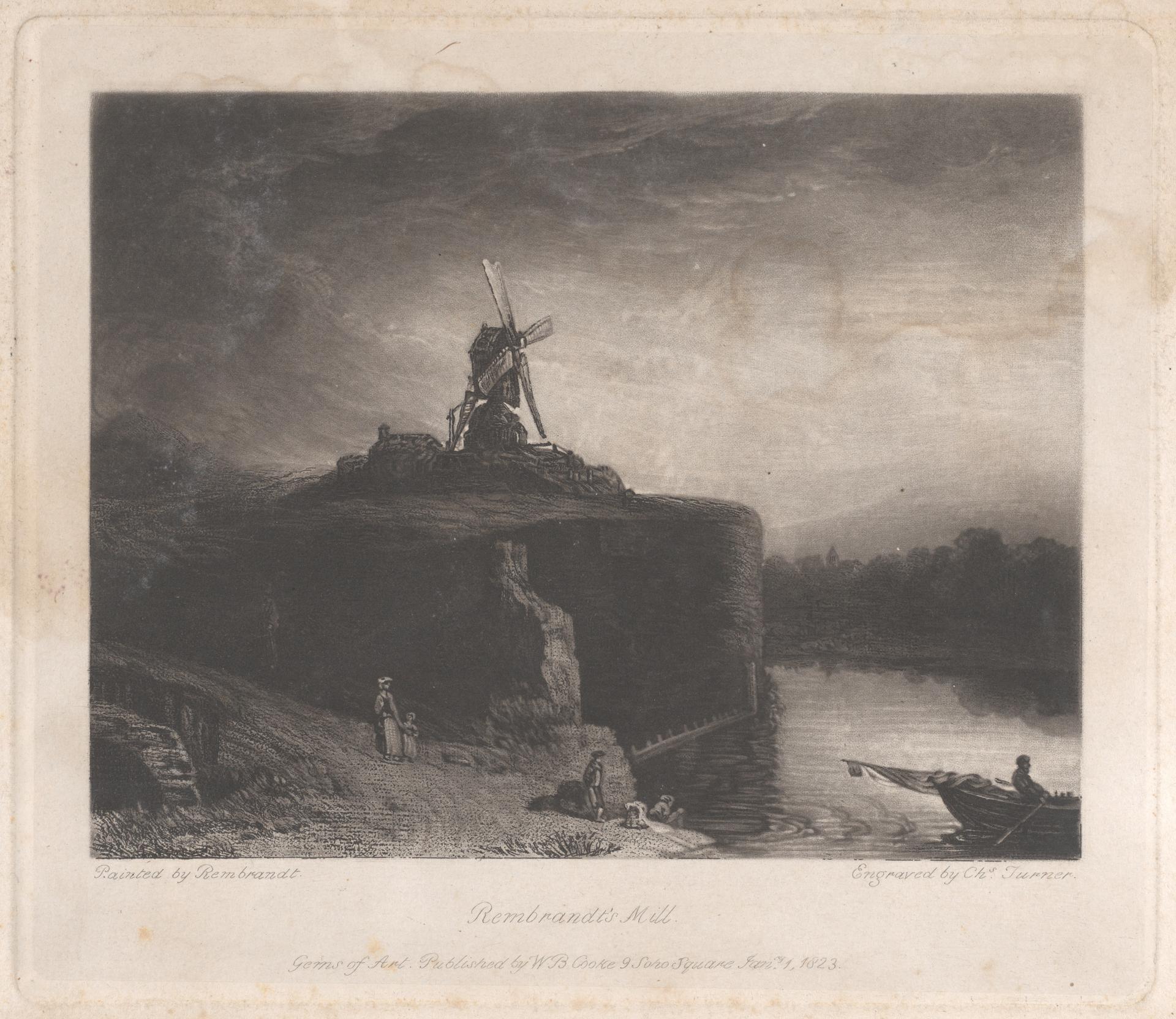
Charles Turner's 1823 mezzotint Rembrandt's Mill renders a windmill in a landscape in fine gradations of gray. The source is a painting by Rembrandt. The print is executed on chine collé and belongs to the collection of the Metropolitan Museum of Art.
Description
Your eye is first drawn to the raised, walled platform on which the windmill stands. In the foreground several figures enliven the bank: one person stands at the water's edge, another sits on a rock, a third is in a boat on the water. Trees and another building echo in the distance. A somber, monochrome gray dominates the image; the subdued light rests over the view and gives it a quiet, melancholic air.
Context
In 1823 Charles Turner made this reproductive print after a painting by Rembrandt then commonly known as The Mill. The original was on view in British collections in the nineteenth century and became widely known through prints such as this one. Turner specialized in mezzotint reproductions of old masters; in London he was among the leading engravers of his day.
Impact
Soft, velvety tonal transitions, such as the mezzotint technique produces, shape the light of the landscape with atmospheric modeling. The muted tonality and calm arrangement evoke a contemplative, almost elegiac effect. This makes clear how reproductive prints made the painterly quality of great works tangible even in small format.
Technique
The print was made in mezzotint on chine collé — fine Japanese paper glued to a support sheet. In this technique the surface of a roughened plate is gradually smoothed to gain light areas. This is the first of two states; the fine, dense grain characteristic of the process is clearly visible.
AI-generated description text
Source: Metropolitan Museum of Art · Public Domain (CC0 1.0)