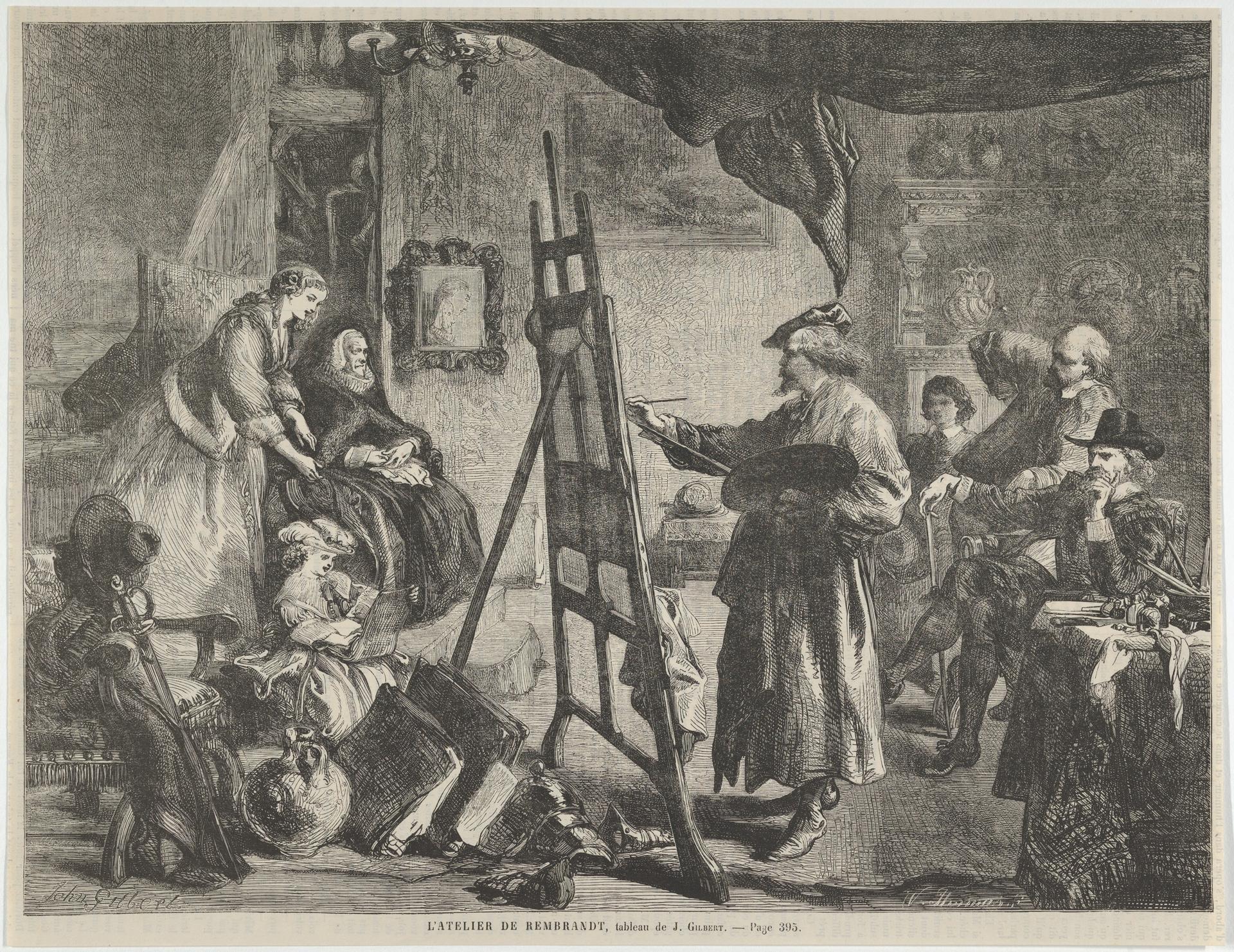
L'Atelier de Rembrandt, tableau de J. Gilbert
Original title: L'Atelier de Rembrandt, tableau de J. Gilbert (Rembrandt's Studio, a painting by J. Gilbert), from "L'Univers Illustré," p. 395
kurzbeschreibung
William Luson Thomas produced this wood engraving in 1861 after a painting by J. Gilbert. It appeared in the magazine L'Univers Illustré and presents an idealized workshop scene of Rembrandt: the painter stands at his easel, surrounded by figures and props.
Description
A painter works at an easel, palette in hand; a woman keeps him company while others sit or stand around him. Books, a chair, a table scattered with objects, and a picture frame on the wall fill the room. The arrangement feels lively, with figures turned in various directions. Light falls from above, emphasizing the texture of garments and surroundings. The style remains realistic, focused entirely on rendering the people.
Context
This wood engraving was made in 1861 for the French magazine L'Univers Illustré, which covered art and culture. It reproduces a painting by J. Gilbert that depicts Rembrandt's studio in an idealized form. Such scenes were highly popular in the 19th century, as they romanticized the artistic life of past eras. William Luson Thomas was among the well-known wood engravers who worked for illustrated journals.
Impact
The print conveys a transfigured image of Rembrandt's working environment; the atmosphere feels lively, almost like a stage. Through the lighting and rich furnishings, a familiar yet heightened mood emerges, immersing the viewer in the world of the Baroque painter.
Technique
Wood engraving requires cutting the design into a woodblock that then serves as a printing form. Gradations of light and dark arise from the varying depth of the cuts. This allowed fine details to be captured, which is why the technique was often used for book and magazine illustrations in the 19th century.
AI-generated description text
Source: Metropolitan Museum of Art · Public Domain (CC0 1.0)