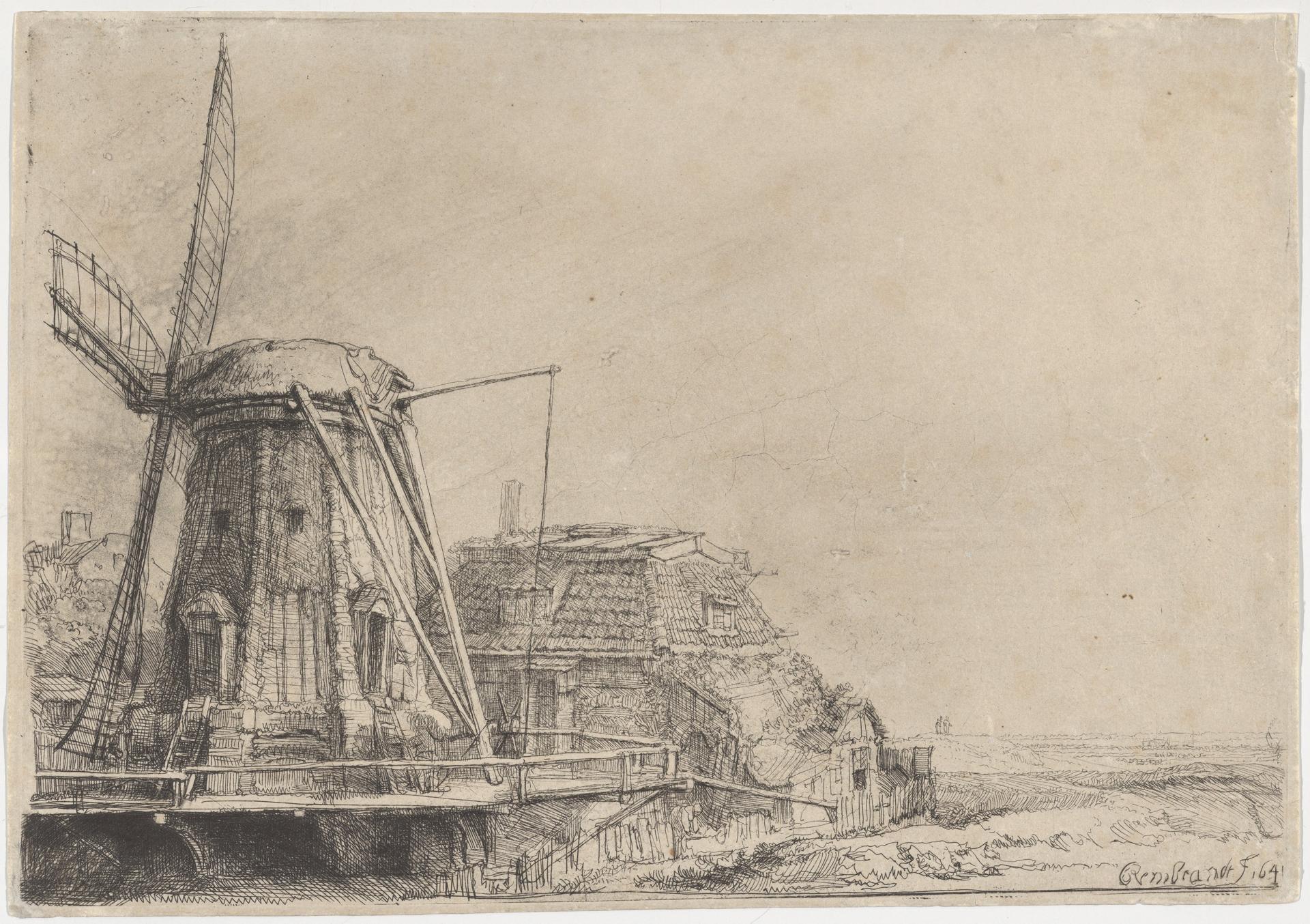
The Windmill (1641, Met-Objekt 5448)
Original title: The Windmill
kurzbeschreibung
A windmill stands in the foreground of this 1641 etching by Rembrandt van Rijn. Beside it rises a building with a chimney. Further structures and a distant horizon complete the rural view.
Description
The windmill rises on the left side of the sheet, worked out in detail with fine strokes. To its right stands a building with a roof and a chimney flue. Beyond them lie more structures and a flat stretch of land that ends at the horizon. The layout runs horizontally, and the light falls evenly, with no visible shadows, which suggests a daytime view.
Context
Rembrandt made this etching in 1641, during a period when he was deeply engaged with printmaking. Windmills were a common motif in seventeenth-century Dutch landscape art and stood for economic prosperity. The sheet was produced in Amsterdam, where the artist lived and worked.
Impact
The careful linework and the calm, level arrangement give the print balance and richness of detail. The even brightness creates a clear, matter-of-fact mood that draws the eye to the particulars of the landscape.
Technique
A plate was bitten with acid and pulled on paper to make this work: it is an etching. Rembrandt reworked the plate several times, as the chimney added later to the central building shows. The impressions were taken in black on light paper, which brings out the fine lines clearly.
AI-generated description text
Source: Metropolitan Museum of Art · Public Domain (CC0 1.0)