Two Cottages
Original title: Two Cottages
kurzbeschreibung
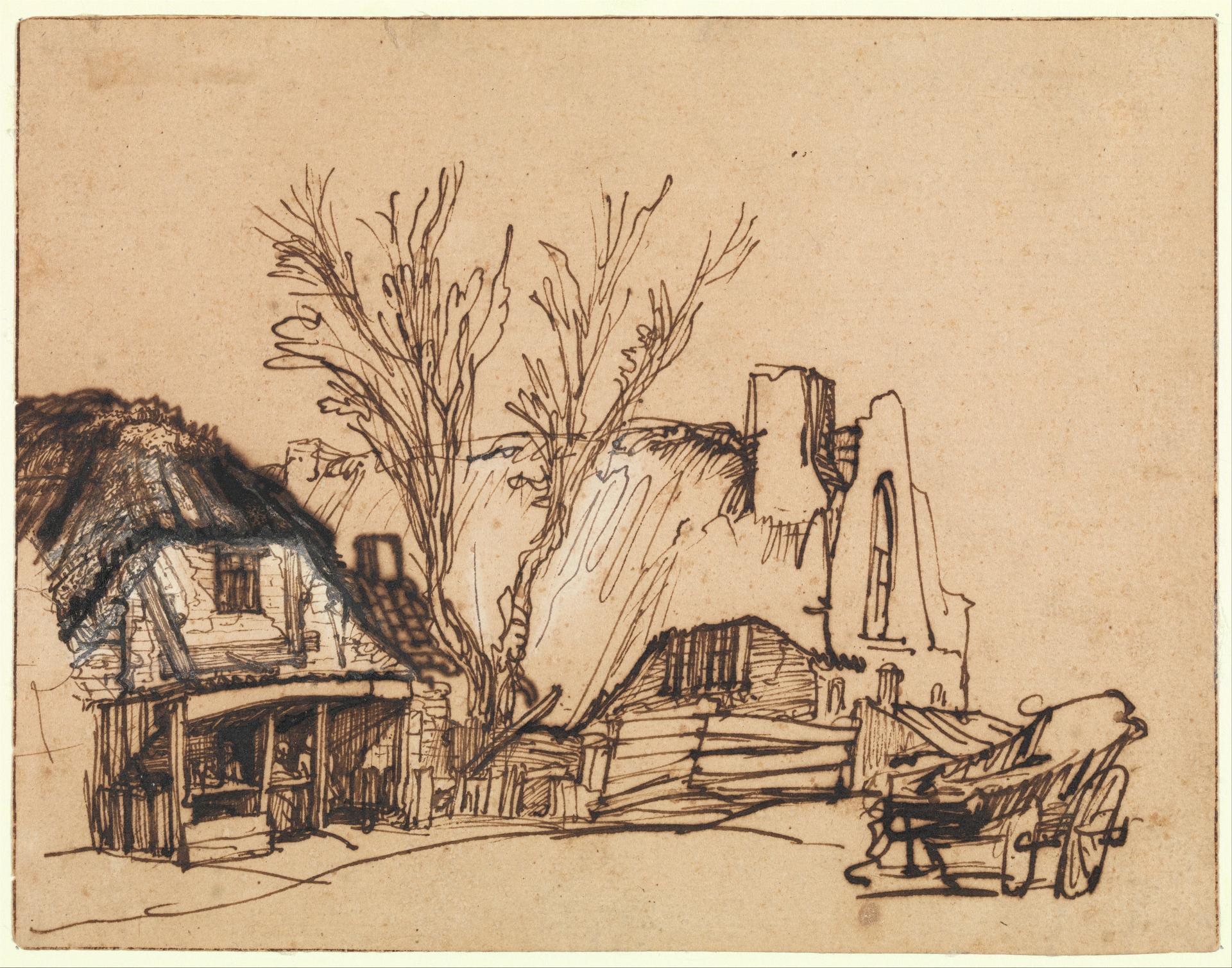
Around 1636 Rembrandt van Rijn drew two neighbouring rural houses with thatched roofs. He worked in pen and brown ink, probably gallnut ink, and reworked parts of the sheet with white chalk or body colour.
Description
On the left stands a plain house with a thatched roof, windows and a door; to its right a second thatched building follows, this one damaged, its facade worn and its roof partly destroyed. Trees with carefully drawn branches and twigs rise between the two structures. In front lie a fence and an overturned wagon with a horse. The background stays bare, without further incident.
Context
The drawing belongs to Rembrandt's Amsterdam years, when he gave close attention to landscape. It falls in a phase in which he turned more strongly toward nature and rural life, shaped by the Dutch landscape tradition. Gallnut ink was a common material in the seventeenth century; its unusual pairing with white corrections, however, is characteristic of how Rembrandt worked.
Impact
The shifting pen strokes and the single brown tone give the sheet a quiet, richly detailed presence. The contrast between the damaged and the intact building tightens the atmosphere and draws the eye out into the rural surroundings.
Technique
Pen and brown ink were used on paper, with the gallnut ink perhaps applied only in part. Corrections in white chalk or body colour point to a considered working process. Varying line weights attest to the artist's technical precision.
AI-generated description text
Source: Metropolitan Museum of Art · Public Domain (CC0 1.0)