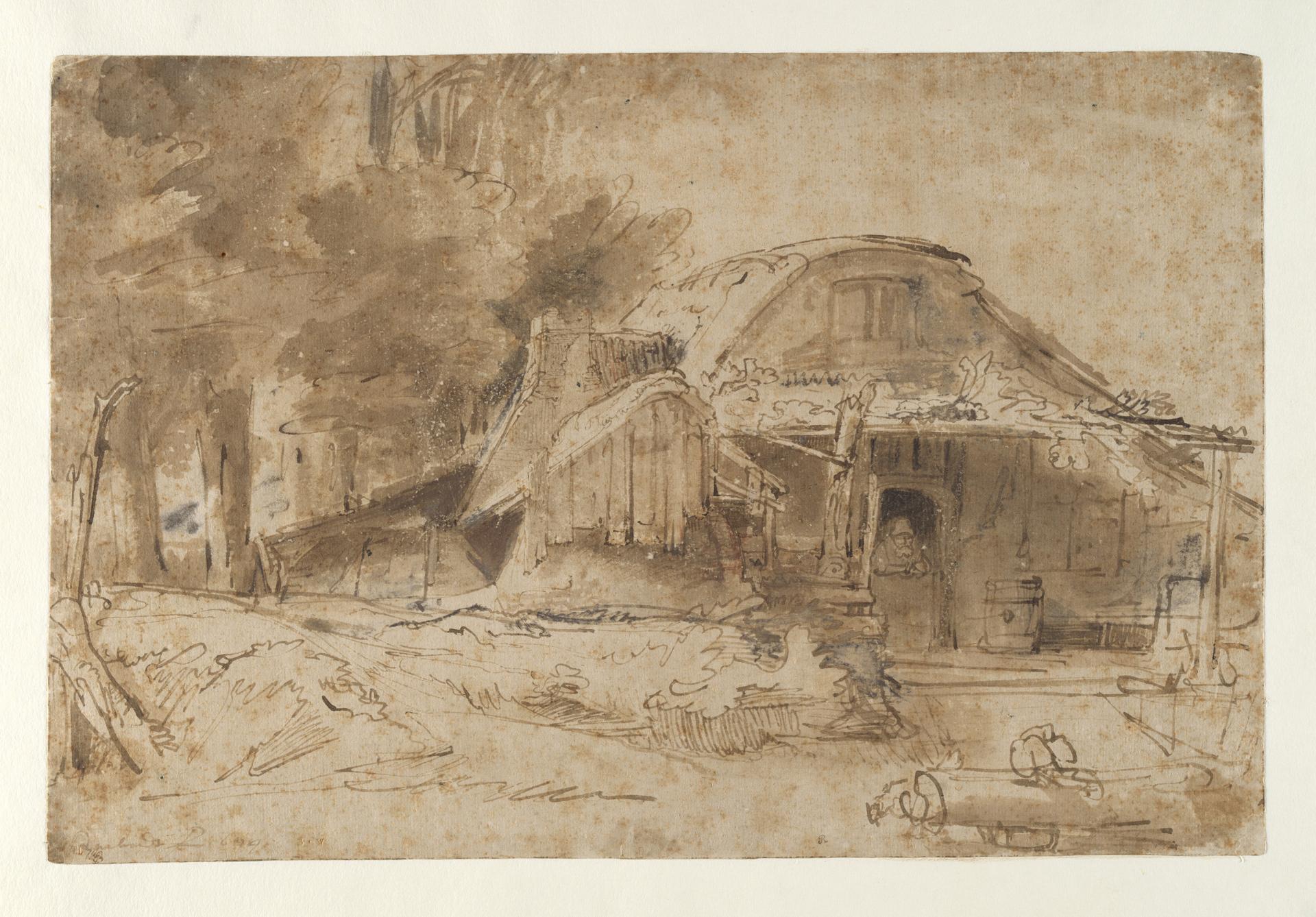
Cottage near the Entrance to a Wood
Original title: Cottage near the Entrance to a Wood
kurzbeschreibung
An open gate gives onto a wood: Rembrandt's drawing "Haus am Eingang eines Waldes" of 1644 places a rural cottage at the edge of the forest. Pen and ink in shades of brown, laid on with brown washes and white corrections, some of which have oxidized, carry the quiet rural subject. What holds the sheet together is that view through the gateway.
Description
The cottage stands at the front, and its open gate pulls the eye past the building into the trees behind it. Dense trees mark where the wood begins. Inks from pale to deep brown, brown washes and white corrections — partly oxidized, partly rubbed away — shape the sheet. To the left of the main cottage are added structures with traces of red chalk. Diffuse light settles over the view and gives it a peaceful mood.
Context
The drawing dates from 1644, a period when Rembrandt was working on landscapes with real intensity. His drawings, unlike his paintings, often take up ordinary subjects such as farmhouses and woodland edges. Pen drawing with washes was common in the seventeenth-century Netherlands and served both as study and as finished work in its own right. At this time Rembrandt was testing materials and methods of correction.
Impact
Earthy browns and soft, diffuse light produce a calm, almost meditative atmosphere. Looking through the open gate into the wood invites the viewer to step into the scene. Precise penwork and gentle washes give the sheet a lively texture.
Technique
Pen drawing in inks of several brown tones, rounded out with brown washes for broad areas of shadow. The white corrections have partly discolored through oxidation and partly worn away. Rembrandt used red chalk for the structures left of the main cottage, which adds touches of colour to the sheet.
AI-generated description text
Source: Metropolitan Museum of Art · Public Domain (CC0 1.0)