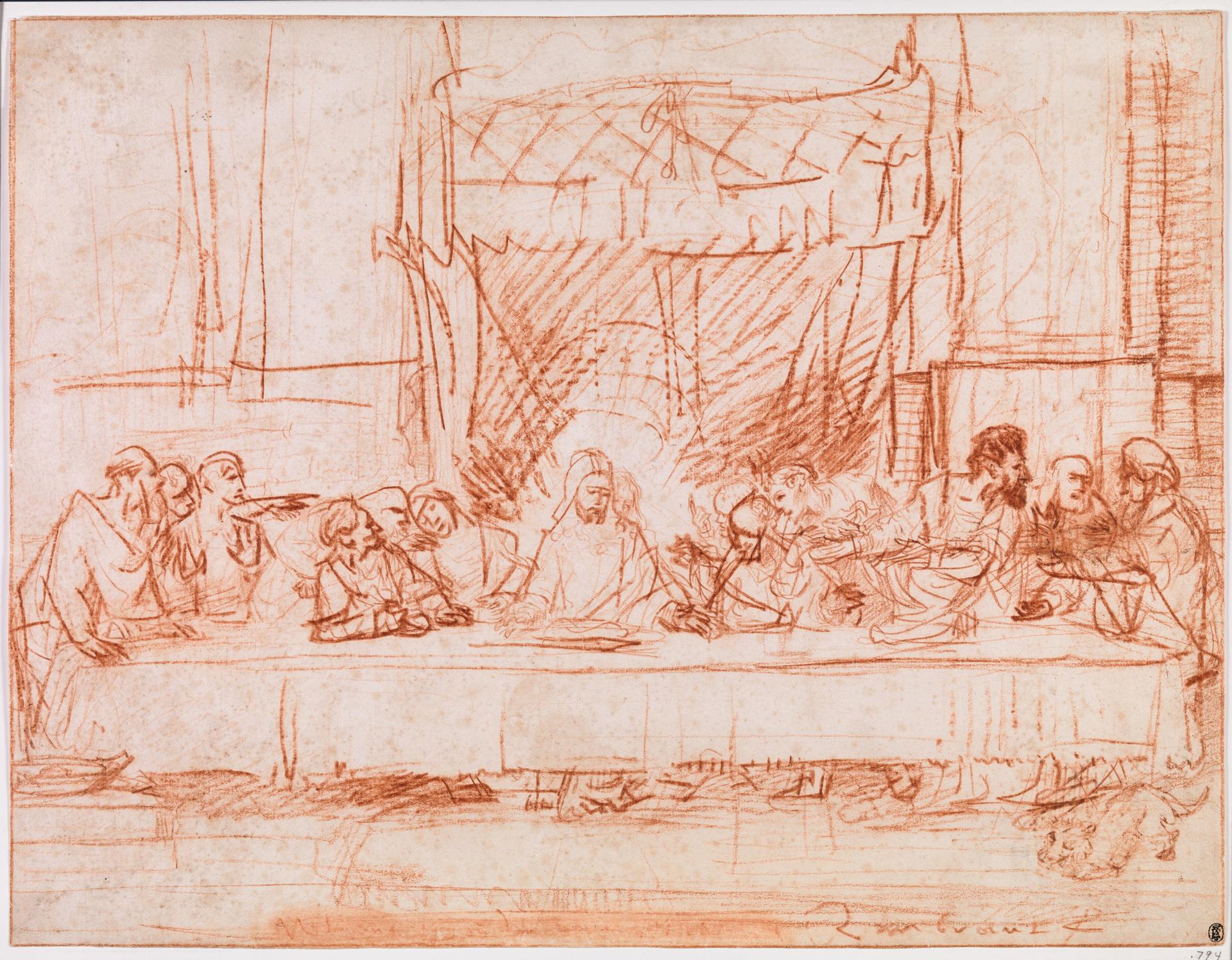
The Last Supper, after Leonardo da Vinci
Original title: The Last Supper, after Leonardo da Vinci
kurzbeschreibung
Between 1634 and 1635 Rembrandt van Rijn made a drawing after Leonardo da Vinci's Last Supper. Executed in red chalk on paper, the sheet takes up the biblical table scene with Christ and the disciples.
Description
Several figures are grouped around a table that fills the foreground; Christ is the focal point of the arrangement. Dressed in garments of older tradition, the participants adopt various poses. Hints of architecture in the rear recall the interior of a church or temple. The overall red tone comes from the drawing material; the contours are fluid and detailed, while the arrangement of the figures around the table remains clearly structured.
Context
Rembrandt's model was Leonardo's famous wall painting, which he likely knew through reproductions. In the 1630s he engaged intensively with biblical subjects and with the art of the Italian Renaissance. The sheet belongs to a series of studies in which he took up compositions by other masters and reshaped them for himself.
Impact
The red chalk lends a warm, intimate mood to the event, emphasizing the dramatic core of the moment. Flowing lines and the clear distribution of the figures create a calm yet animated image that draws the viewer into the biblical narrative.
Technique
Red chalk on paper, a common drawing medium in the seventeenth century, allows both delicate lines and broader hatching, and thus gradations of depth and shadow. The drawing reveals Rembrandt's sure hand as well as his ability to organize a multi-figure group with economical means.
AI-generated description text
Source: Metropolitan Museum of Art · Public Domain (CC0 1.0)