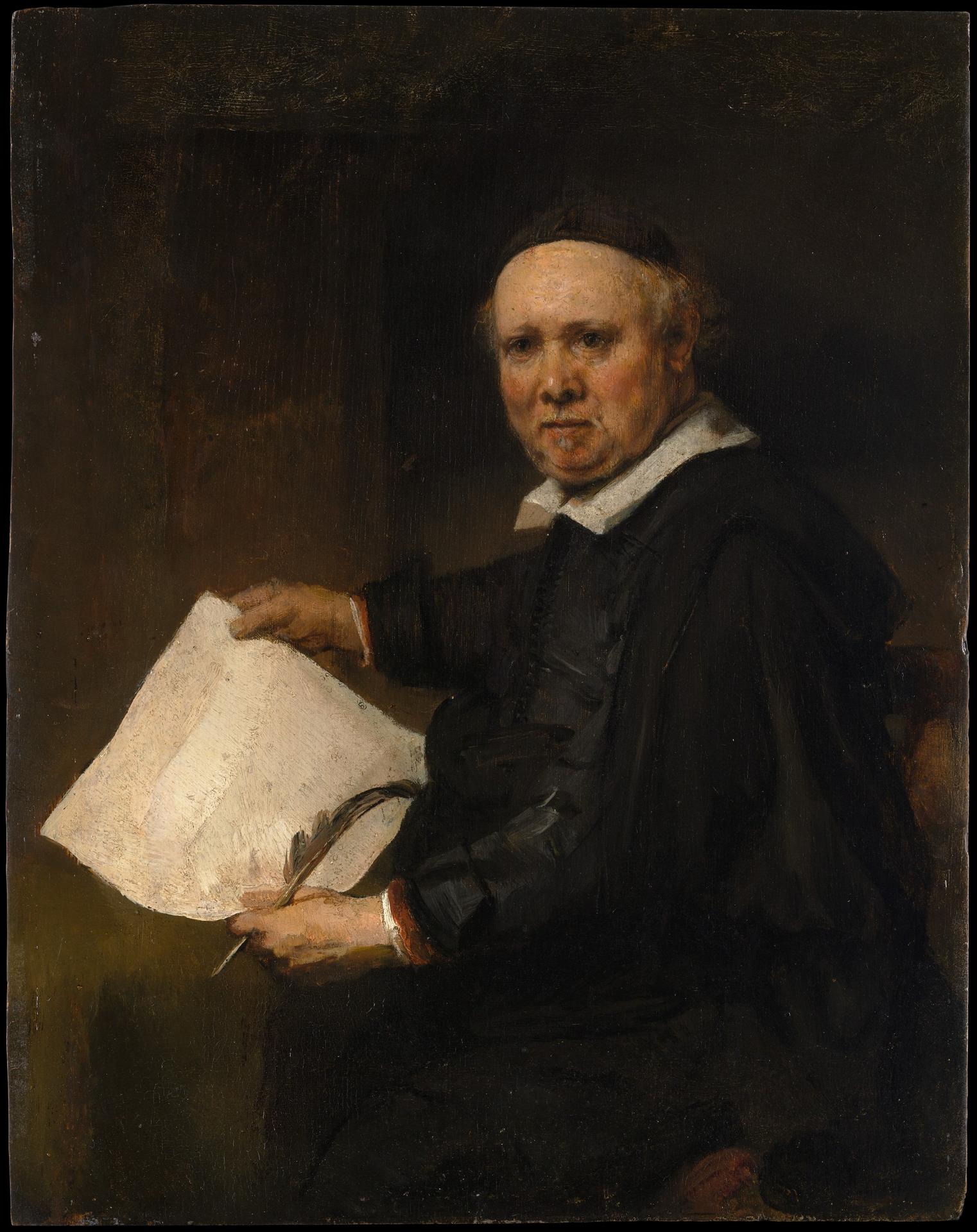
Portrait of Lieven Willemsz van Coppenol
Original title: Lieven Willemsz van Coppenol (born about 1599, died 1671 or later)
kurzbeschreibung
Unlike many other seventeenth-century likenesses, this painting by Rembrandt van Rijn presents the calligrapher Lieven Willemsz van Coppenol not as a representative figure but in the midst of his work. The undated piece is executed in oil on oak and measures 36.5 x 28.9 cm. It shows the writer at work and is a typical example of Rembrandt's approach to portraiture.
Description
A man in dark clothing with a white collar sits holding a document while writing with a quill. The background stays dark and undefined, making the figure stand out. Light falling from the side accents the contours of his face and hands. The palette is restrained, with a strong contrast between the bright paper and the dark fabric. Surfaces are rendered with care and attention to detail.
Context
Lieven Willemsz van Coppenol was a respected calligrapher in Amsterdam who also worked as a schoolmaster and customs collector. Rembrandt portrayed him several times, which may indicate a personal connection. The exact date of the painting is not recorded, but it likely comes from Rembrandt's later career. The portrait shows Coppenol as a writer, underscoring his profession and social standing.
Impact
A calm, collected mood emanates from the painting, drawing the viewer into the intimate moment of writing. The careful lighting and precise execution give the portrait an immediate presence. By linking the sitter's character with his profession, Rembrandt creates a compelling testament to his portraiture.
Technique
The portrait is painted in oil on oak, a standard method for seventeenth-century Dutch painting. With fine brushstrokes and careful layering, Rembrandt rendered textures such as fabric and paper realistically. The dark underpainting and side lighting are characteristic features of his technique.
AI-generated description text
Source: Metropolitan Museum of Art · Public Domain (CC0 1.0)