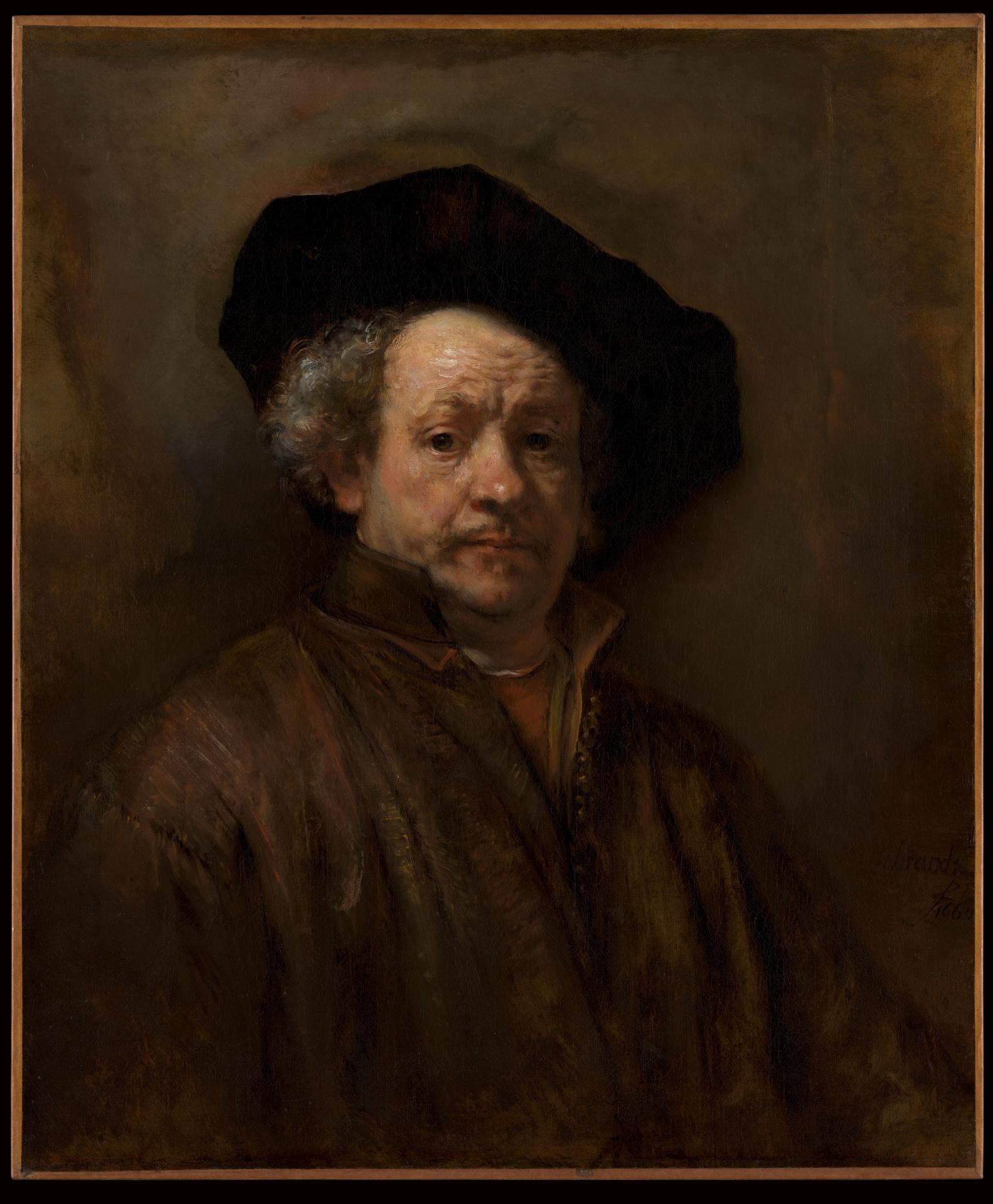
Self-Portrait (1660)
Original title: Self-Portrait
kurzbeschreibung
In 1660 Rembrandt van Rijn again took up brush and oil paint to capture himself on canvas. The painter appears in half-profile, wearing a dark cap and brown robe, his head turned slightly to the right. The picture belongs among his late self-portraits and shows how, even at this stage, he found a distinctive, concentrated form within the genre.
Description
A man with grey curly hair and a hint of stubble looks out from the canvas. A dark cap sits on his head, and a brown robe with a collar covers his shoulders. The ground stays dark and without discernible detail, so the face stands out against it. Light falls mainly on his features, bringing out wrinkles and the surface of the fabric. Brown and grey tones dominate the palette, held in an earthy, dark overall key.
Context
At fifty-four, Rembrandt painted this self-portrait in Amsterdam, during a period marked by financial worries and the loss of people close to him. Self-portraiture remained a central field for him, a way to track his own ageing and shifting moods. In his late work, the psychological penetration of the portrait comes forward more strongly than earlier representational ambitions.
Impact
The harsh contrast of light and dark gives the picture great immediacy. The painter's gaze meets the viewer only halfway, turned slightly aside, and leaves a pensive, inward-looking impression.
Technique
The picture is worked in oil on canvas, in a glazing manner characteristic of Rembrandt. By layering transparent and opaque paint, he created fine transitions between light and shadow; in this way a high degree of detail was preserved in the face.
AI-generated description text
Source: Metropolitan Museum of Art · Public Domain (CC0 1.0)