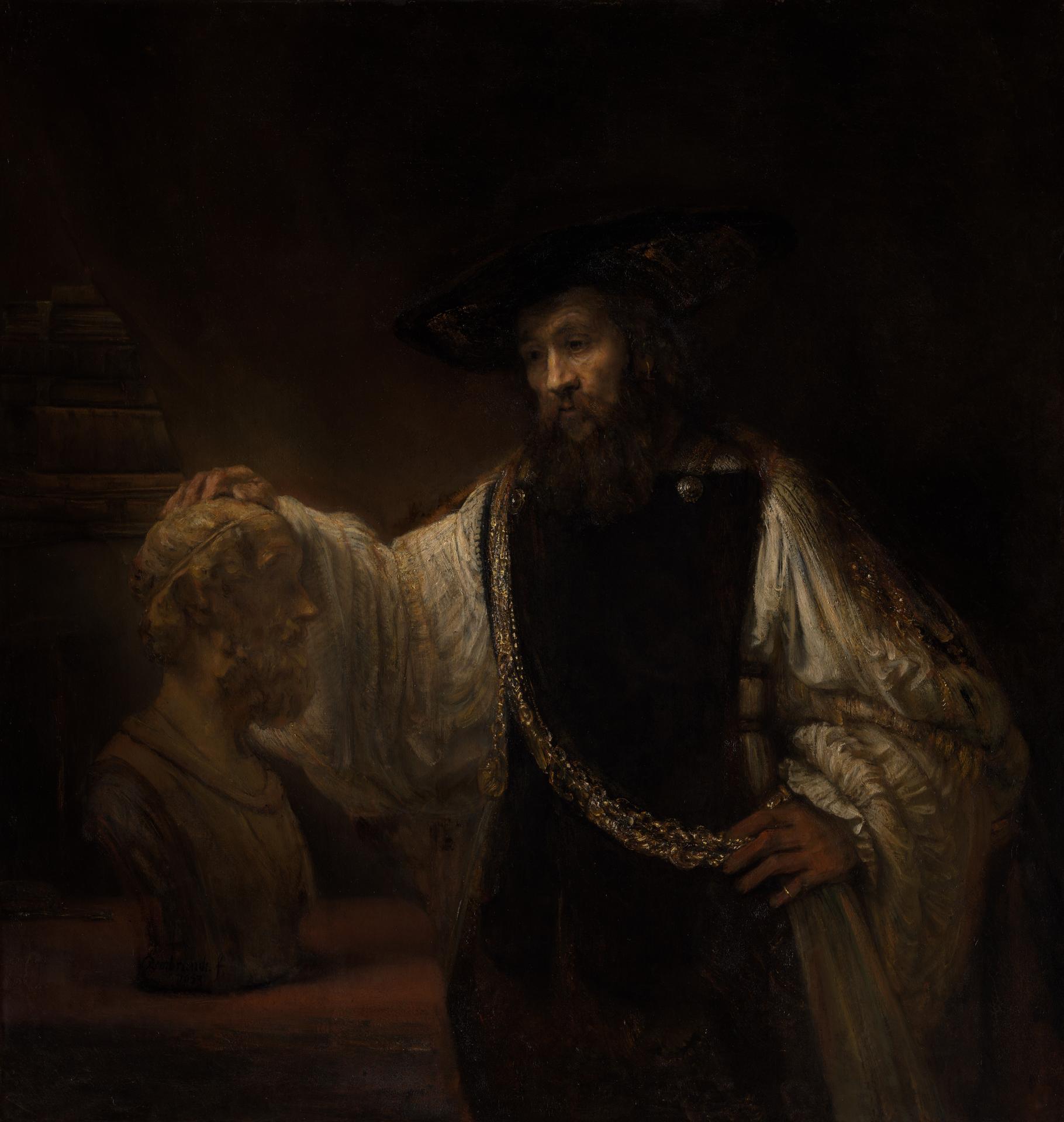
Aristotle with a Bust of Homer
Original title: Aristotle with a Bust of Homer
kurzbeschreibung
A philosopher from antiquity pauses over a poet's bust. Rembrandt van Rijn painted Aristotle contemplating the bust of Homer in 1653 in oil on canvas. The picture ranks among the major works of the Baroque and revolves around the relationship between knowledge and poetry.
Description
Aristotle stands as the central figure, wearing a dark, broad cap and an elaborately decorated robe with embroidery and gold bands. His hand rests gently on the Homer bust, which he holds before him. Stacks of books and another bust can be made out in the background. Subdued light falls specifically on the philosopher and the bust, creating an intimate, pensive mood. Gold and white accents stand out against the predominantly dark palette.
Context
The Sicilian nobleman Antonio Ruffo commissioned the painting, completed in 1653, as part of a series of philosopher portraits. Rembrandt was then at the height of his fame but also struggling with financial difficulties. The work reflects his engagement with ancient philosophy and poetry—a subject rarely taken up in seventeenth-century Dutch painting. Rembrandt combined the portrait of a thinker with a still life of books and sculptures, referring to his own collection of art objects.
Impact
The dramatic lighting and the philosopher's calm gesture create a thoughtful, almost melancholy atmosphere. The viewer feels drawn into the intimate scene and reflects on the relationship between poetry and philosophy. A timeless dignity emanates from the picture, heightened by the detailed rendering of the fabrics and the bust.
Technique
Rembrandt worked in oil on canvas measuring 143.5 x 136.5 cm. His characteristic use of light and shadow (chiaroscuro) makes the figures stand out in three dimensions. In the light areas the paint is applied impasto, while the dark areas show glazing layers—resulting in a particular depth to the picture.
AI-generated description text
Source: Metropolitan Museum of Art · Public Domain (CC0 1.0)