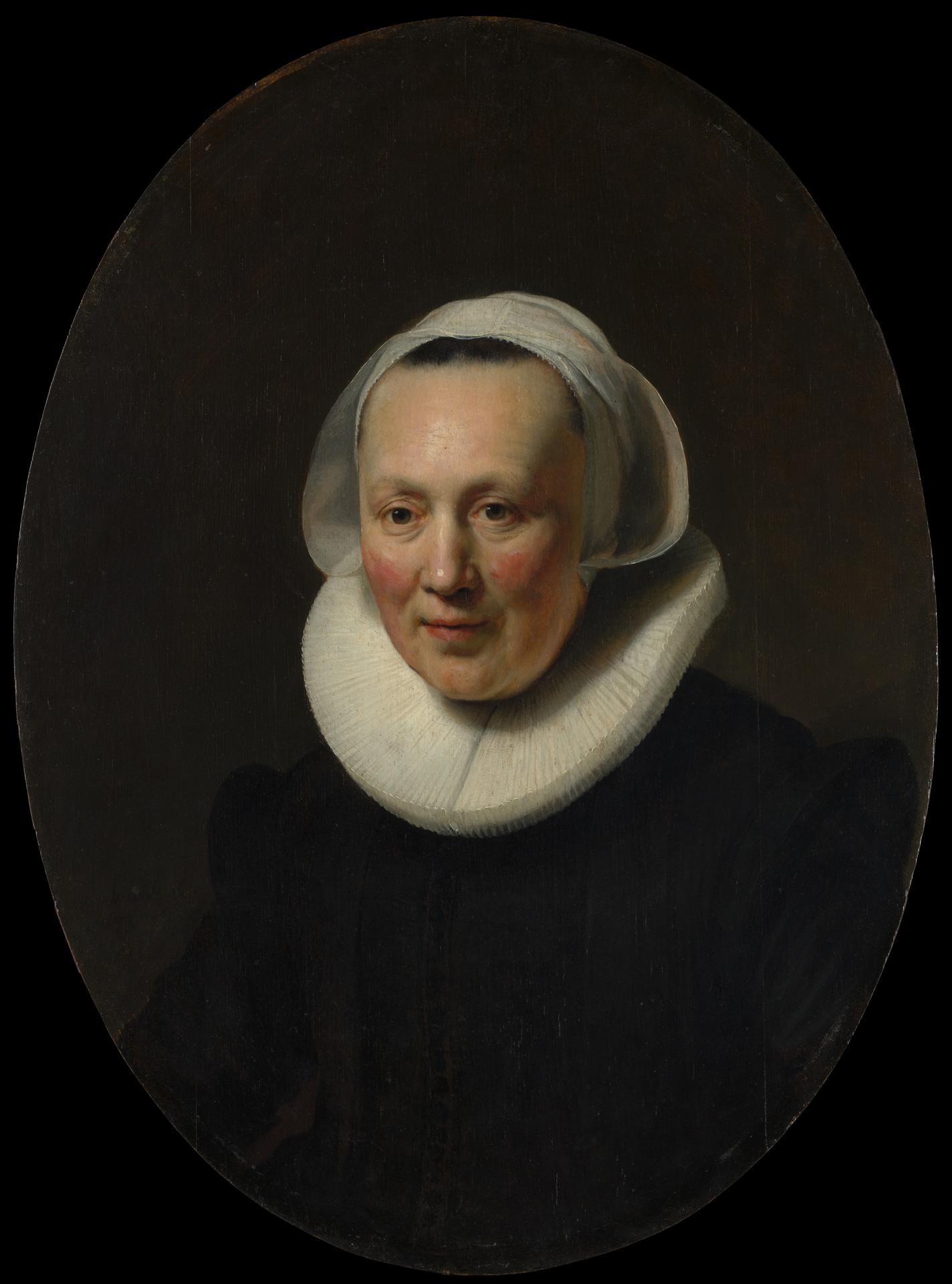
Portrait of a Woman (1633)
Original title: Portrait of a Woman
kurzbeschreibung
Rembrandt's portrait of a woman from 1633 presents an unknown sitter in seventeenth-century Dutch dress. Painted in oil on wood, the panel measures 67.9 by 50.2 centimetres. Its oval shape draws the eye straight to the woman and lets everything else fall away.
Description
A white cap covers her ears and the back of her head, and a white collar sits around her neck. A single button fastens the dark bodice at the front. The face is worked out with precision; wrinkles remain visible, and the expression is quiet and thoughtful. A plain dark ground lifts the figure forward. The muted, realistic colours belong to seventeenth-century painting.
Context
By 1633, working in Amsterdam, Rembrandt was already established as a portraitist, and a series of oval likenesses dates from these years. Nothing is recorded about this woman, which was common enough for bourgeois portraits of the period. Rembrandt was regarded as a master at bringing individual features and inner depth into view.
Impact
From the first glance the calm, pensive face holds the viewer, creating an intimacy that keeps its distance at the same time. Wrinkles and fabrics are rendered so exactly that the image feels almost physically present. The dark ground heightens the woman's presence and lends the portrait a dignity not bound to any era.
Technique
Oil on oak, as was customary in the seventeenth-century Netherlands. Rembrandt used fine brushwork for the facial features and thicker, pastose layers for the texture of the clothing. The oval panel was probably displayed in a frame with an oval opening, as was usual at the time.
AI-generated description text
Source: Metropolitan Museum of Art · Public Domain (CC0 1.0)