Portrait of a Man (1632)
Original title: Portrait of a Man
kurzbeschreibung
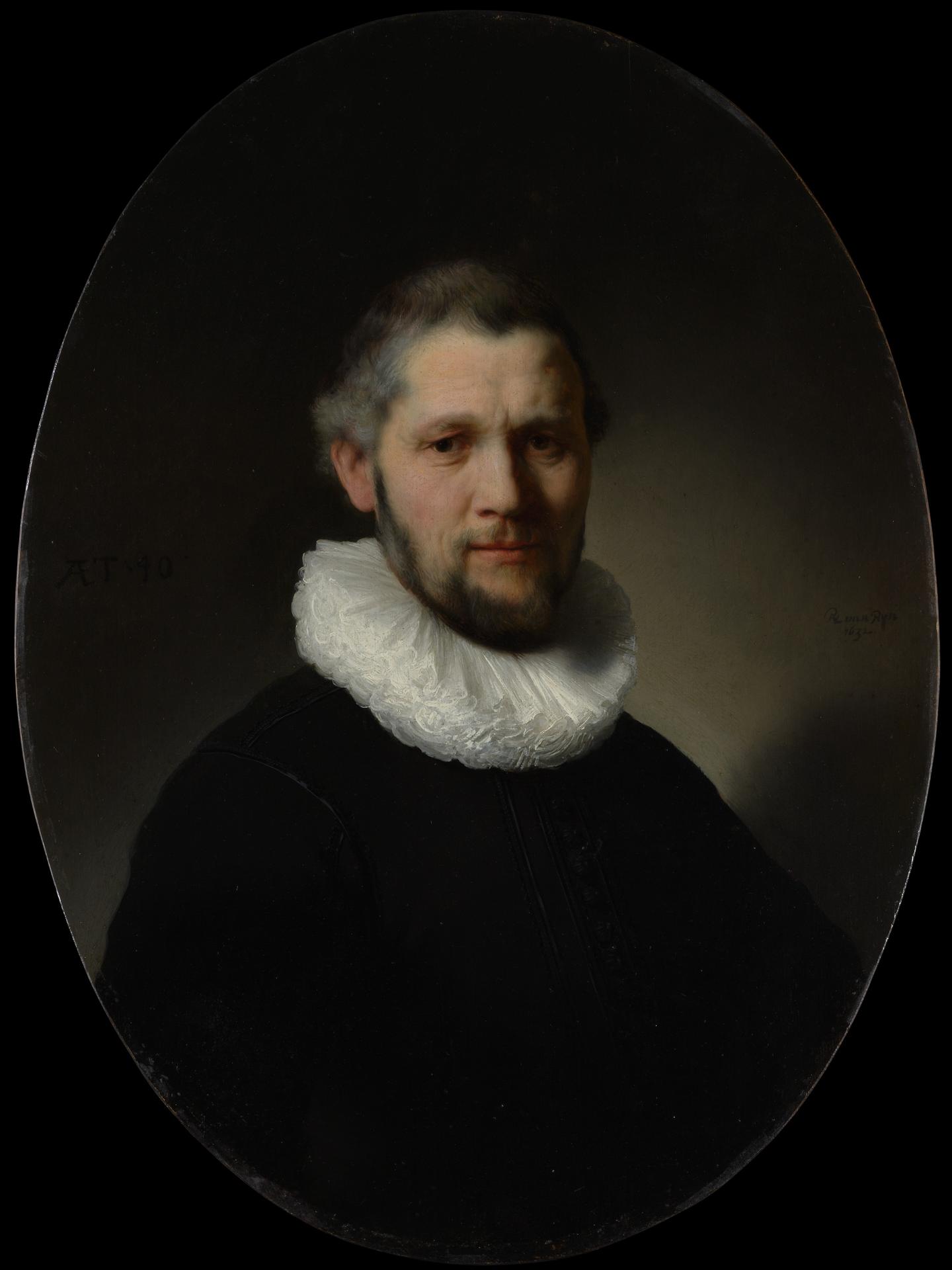
Unlike many contemporary portraits, this oval painting of 1632 relies on near-total darkness, with only the face and collar emerging. Rembrandt van Rijn painted the bust of an unknown man in oil on wood; the panel measures 75.6 x 52.1 cm. The subject fits the portrait type of the Dutch Golden Age, but the lighting gives it a distinctive note.
Description
A man in a dark coat and a broad, multi-layered white collar—typical of Baroque fashion—looks out from the picture. His face appears serious and introspective, the head slightly tilted to the right. Curly, almost black hair frames his face. In the upper left there is a monogram 'AT', and in the lower right the signature 'Rembrandt 1632'. The almost black background makes the figure stand out in relief.
Context
In 1632 Rembrandt was active in both Leiden and Amsterdam, building a career as a portrait painter. The identity of the sitter is not recorded—a circumstance that occurs more frequently in his portraits from this period. The monogram 'AT' might indicate an earlier owner or a later addition; this is not certain. The autograph signature with the year follows the practice of his portraits from the early 1630s.
Impact
The sharp contrast between the bright collar, the dark garment and the almost black ground draws the eye to the face. The serious expression gives the portrait a thoughtful, almost introspective mood. The oval format and precise execution lend the portrait a private, timeless aura.
Technique
Oil on wood was a common technique for this era. Rembrandt worked out the facial features with fine brushes, while he applied the collar with impasto to emphasize its materiality. A dark underpainting and glazes create the deep shadows and the subtle lighting effect.
AI-generated description text
Source: Metropolitan Museum of Art · Public Domain (CC0 1.0)