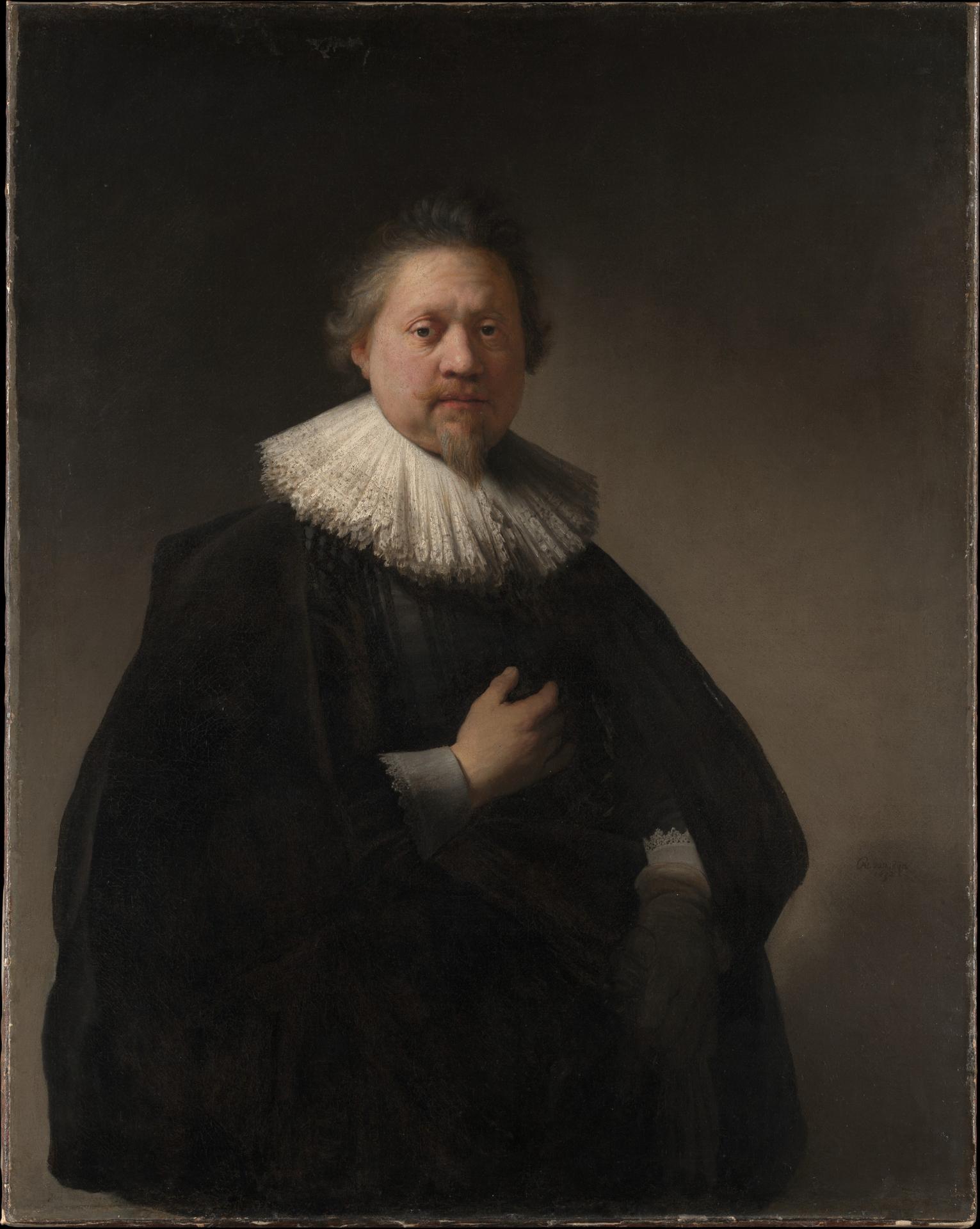
Portrait of a Man, probably a Member of the Van Beresteyn Family
Original title: Portrait of a Man, probably a Member of the Van Beresteyn Family
kurzbeschreibung
Rembrandt painted this portrait of a man in 1632 using oil on canvas. The person shown is presumably a member of the Van Beresteyn family. The picture is regarded as a typical example of 17th-century Dutch portraiture.
Description
A black garment and a large white ruff collar dominate the man's appearance. Seated upright, he directs his gaze straight at the viewer; his expression is serious and thoughtful. The plain dark background pushes the figure to the fore. Light falls from the upper left, emphasizing his face and shoulders. The palette remains restrained, mostly dark, with a strong contrast provided by the white collar.
Context
By 1632 Rembrandt was already established in Amsterdam as a sought-after portraitist. The sitter's identity cannot be confirmed, but the name Van Beresteyn points to a wealthy Amsterdam family. Commissions of this kind were often given by citizens to make their social rank visible. The simple design with a dark background matched the Protestant-influenced art of the Netherlands.
Impact
The direct gaze and serious expression give the sitter an immediate presence. Through the lighting and the contrast of black and white, the picture radiates a calm, dignified atmosphere characteristic of Rembrandt's portraits.
Technique
The work is executed in oil on canvas and measures 111.8 x 88.9 cm. Rembrandt used fine brushstrokes to capture the structure of the collar and the shadows precisely. The dark underpainting enhances the effects of light, which bring out the face in three dimensions.
AI-generated description text
Source: Metropolitan Museum of Art · Public Domain (CC0 1.0)