Man in a Turban
Original title: Man in a Turban
kurzbeschreibung
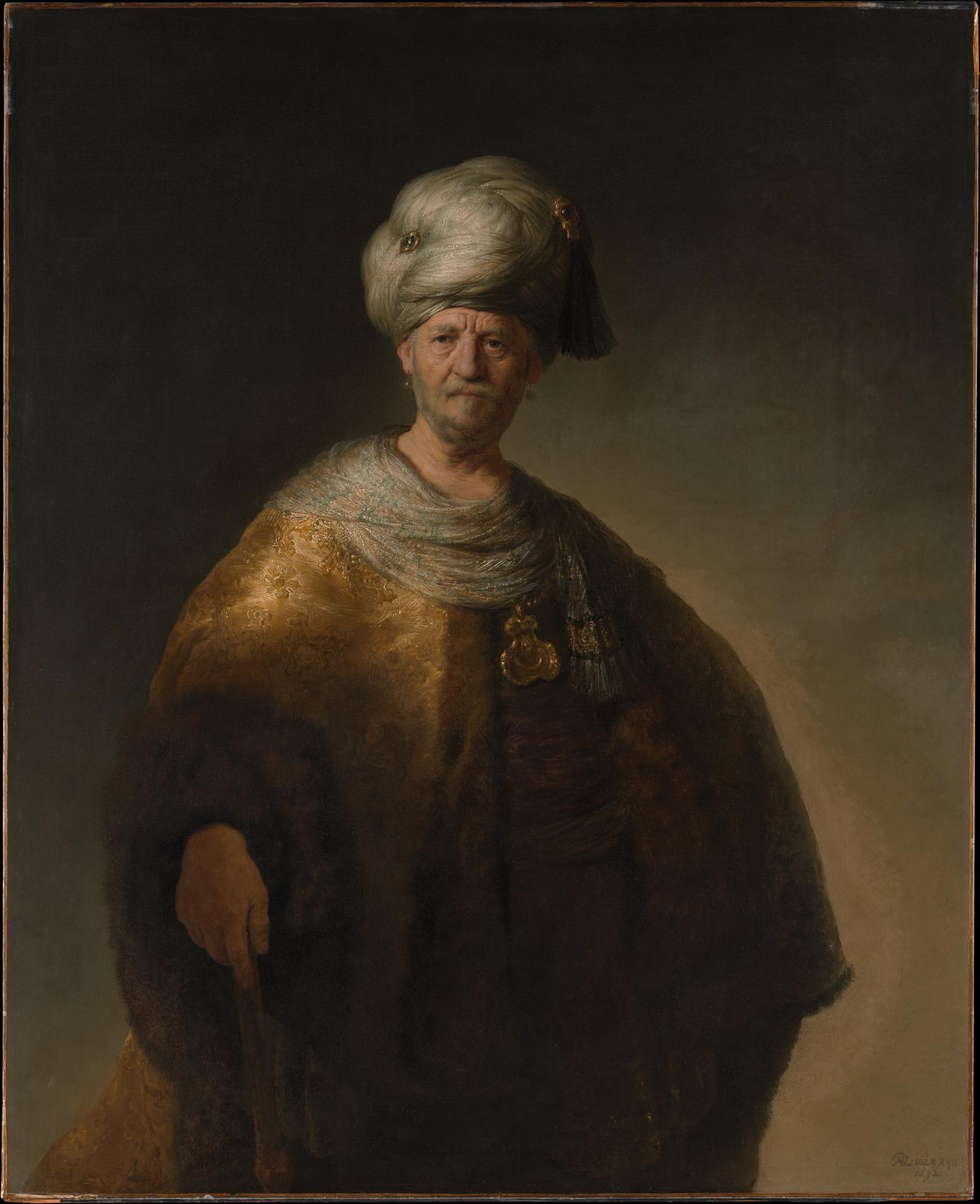
Rembrandt van Rijn painted this portrait of a man in 1632, dressed in garments that read as oriental, with a turban and a fur cloak. Worked in oil on canvas, the figure gains a strong presence from the darkened ground behind him.
Description
A turban rests on the man's head and a fur mantle wraps his shoulders; in his right hand he holds a staff. Behind him the ground stays dark and empty, so that face and clothing lead the eye. Muted tones govern the picture and add to its grave, dignified mood. The oil paint reveals a fine surface texture and a quiet sheen, characteristic of Rembrandt's handling.
Context
Rembrandt was in Leiden in 1632, working to establish himself as a portraitist, and this picture falls in those years. It should be understood as a tronie, a study of a distinctive head, not made to commission for a sitter but meant to display artistic virtuosity. Orientalising dress was common in seventeenth-century Dutch painting; trade contacts with the Near East, among other things, provided the stimulus.
Impact
The warm light on the face, set against the dark ground, makes the figure seem near and immediate. Strange-seeming clothing and realistic features of the face meet one another, and from this grows a tension between the exotic and the familiar that holds the gaze.
Technique
Oil on canvas, laid on in fine layers and glazes, producing depth and a sense of light. Visible brushwork and the lustre of the colours match Rembrandt's working method in the 1630s.
AI-generated description text
Source: Metropolitan Museum of Art · Public Domain (CC0 1.0)