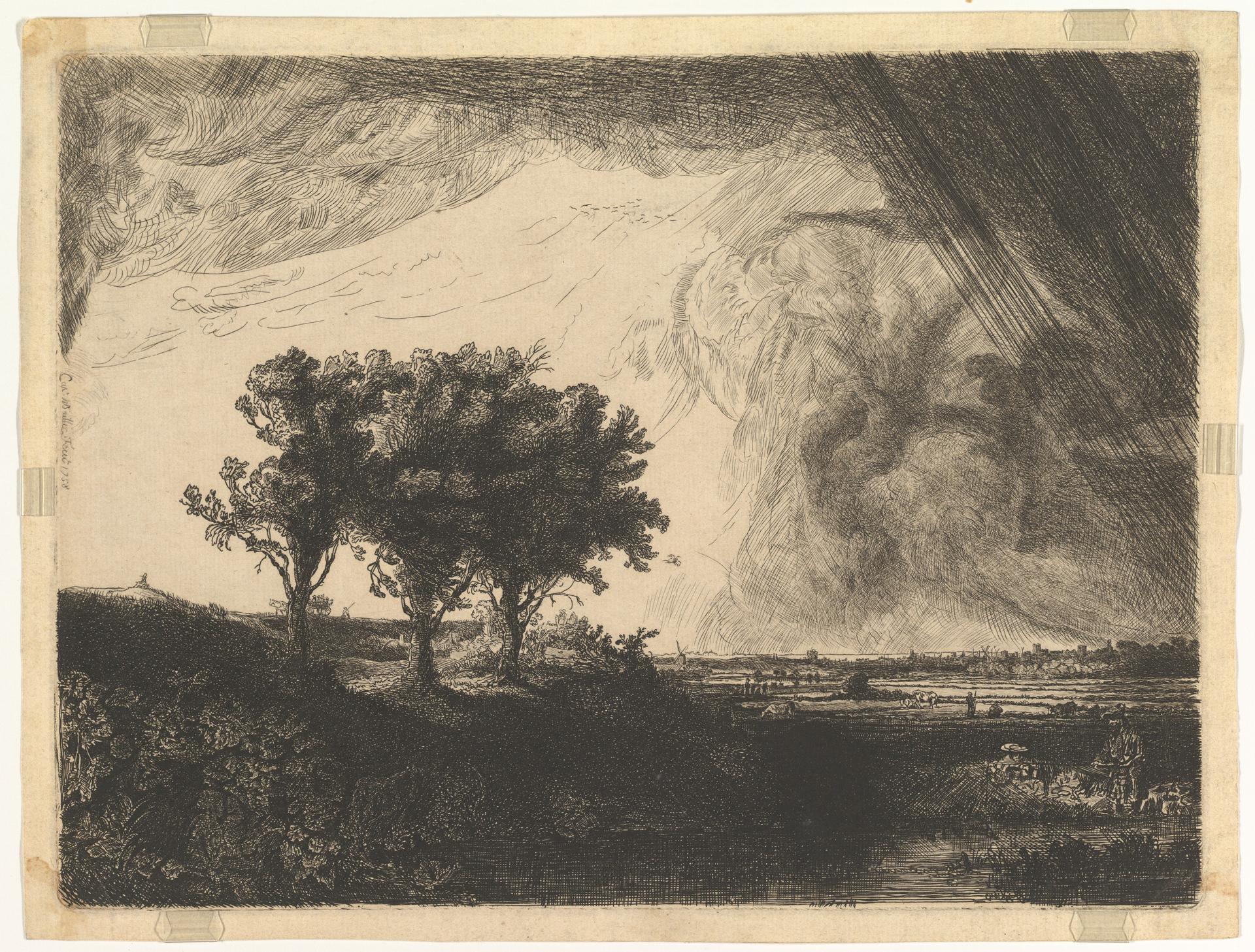
The Three Trees, after Rembrandt (1758, Met-Objekt 5406)
Original title: The Three Trees, after Rembrandt
kurzbeschreibung
Three heavily leafed trees stand at the edge of a rise and give their name to this landscape of 1758. Captain William E. Baillie made the etching after a model by Rembrandt, reworked it with drypoint and roulette, and left it as the fifth state of six.
Description
Along a ridge in the foreground rise three trees with dense foliage, and they carry the structure of the image. Beyond them lie further woods and an open field. Above, a restless sky arches with dark clouds and one bright patch, likely an opening for the light. Fine hatching and graded greys give the sheet a close texture. Light falls from the upper left and brings out clouds and sky.
Context
This etching was made in 1758 as a reproduction of a painting by Rembrandt, datable to around 1643. Baillie served as a British officer and also worked as an engraver; many prints after works by old masters come from him. The roulette allowed soft tonal values, as was usual for reproductive printmaking in the eighteenth century.
Impact
Dark clouds and bright light lend the view tension and mood. The carefully led lines and stepped greys produce a quiet yet dense atmosphere that draws the eye into the landscape.
Technique
Printing was done from an etching plate additionally worked with drypoint and roulette, which yields fine lines and soft tonal transitions. The plate measures 21 x 28 cm, the sheet 22.2 x 29.2 cm. In the fifth of six states one sees how the plate was progressively refined.
AI-generated description text
Source: Metropolitan Museum of Art · Public Domain (CC0 1.0)