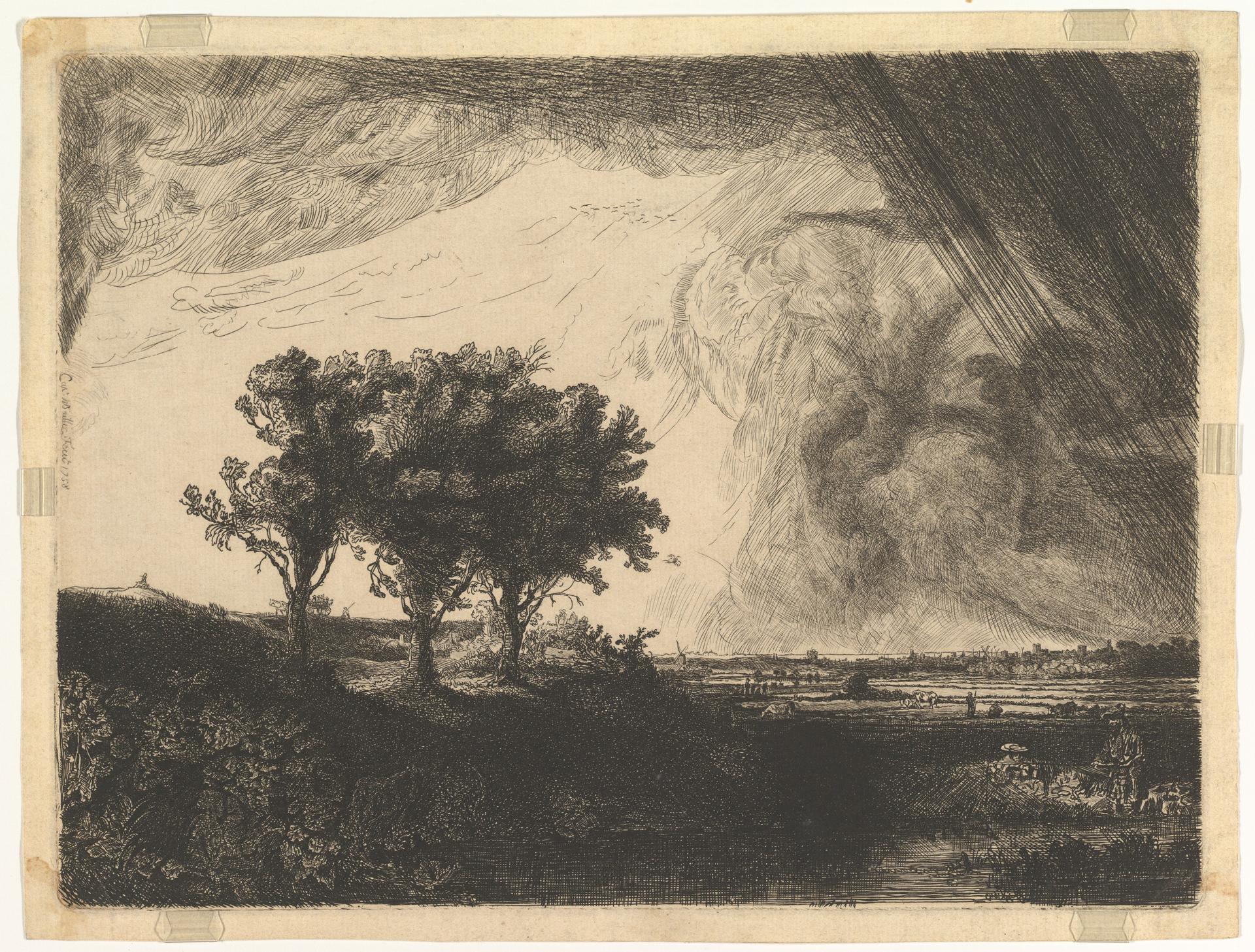
The Three Trees, after Rembrandt (1758, Met-Objekt 5404)
Original title: The Three Trees, after Rembrandt
kurzbeschreibung
Captain William E. Baillie's etching Die drei Bäume, nach Rembrandt, from 1758, offers an independent take on the famous motif. Three striking trees stand in the foreground before a turbulent landscape. The work is executed in etching, drypoint and roulette and is the fourth of six states.
Description
Three mighty trees dominate the foreground, outlined against a dark, stormy sky. Strong, densely set strokes run through the sky, hinting at rain and thunderclouds and creating a sense of movement. Behind them appear fields and small buildings, smaller and less detailed. Grey tones and the gloomy light heighten the dramatic impression. The layout is unevenly distributed, with the trees in front and the sky as the dominant element.
Context
About a century after Rembrandt's death, in 1758, this etching was made as an interpretive copy of his famous Die drei Bäume (1643). Baillie, an Irish officer and amateur artist, took up the motif and changed it in technique and execution to create his own version. The print belongs to a series of reproductions after Rembrandt with which Baillie helped spread his art in the 18th century.
Impact
The dense, powerful strokes and dark tonality create a threatening, restless mood that draws the viewer into the storm. Through their prominent position and the contrast with the sky, the trees appear monumental and give the scene a sublime, almost dramatic quality.
Technique
The print is an etching, reworked with drypoint and roulette to achieve fine tonal values and textures. The plate measures 21 x 28 cm, the sheet 22 x 28.9 cm. The four states show that Baillie revised the plate several times to achieve the desired effect.
AI-generated description text
Source: Metropolitan Museum of Art · Public Domain (CC0 1.0)