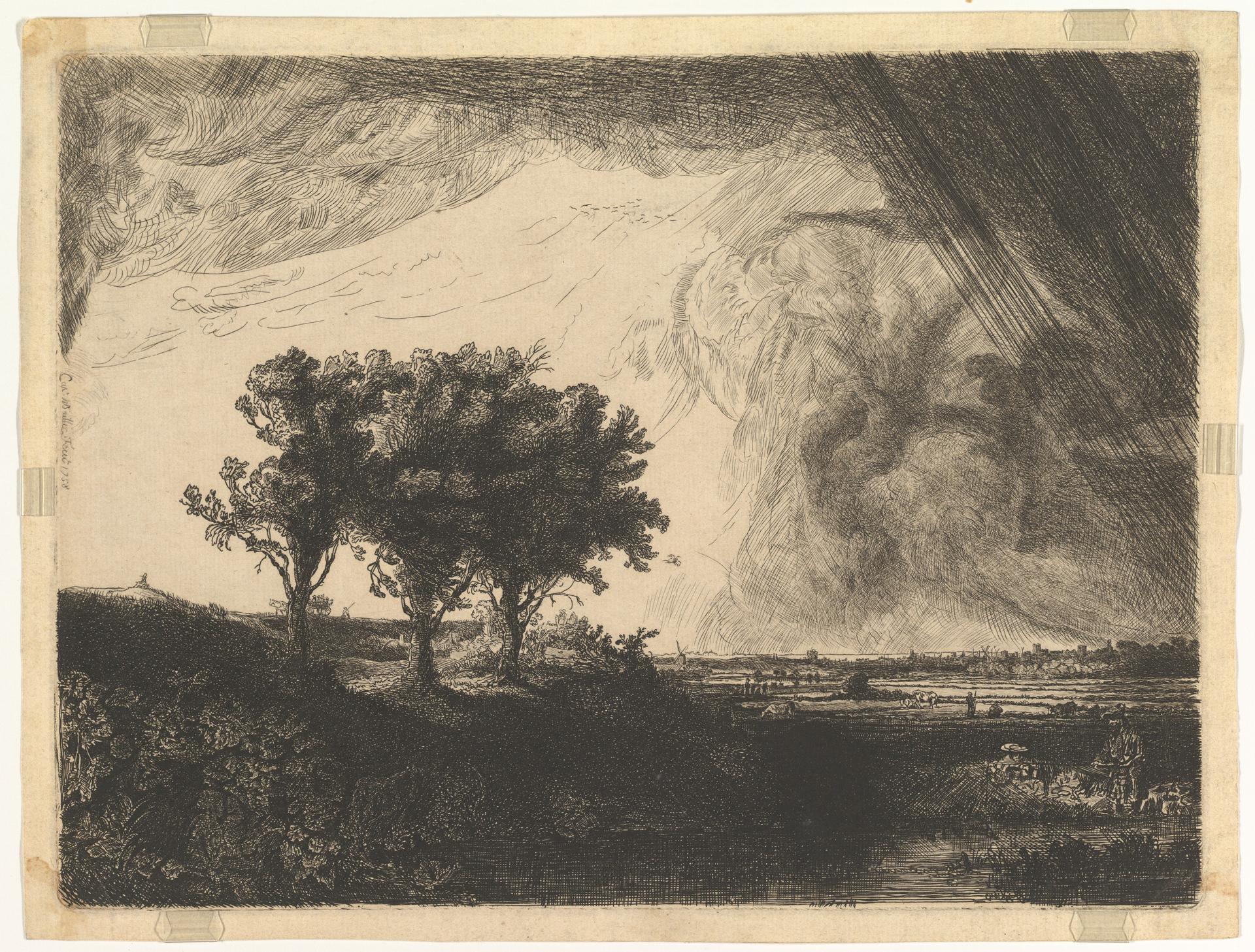
The Three Trees, after Rembrandt (1758, Met-Objekt 5403)
Original title: The Three Trees, after Rembrandt
kurzbeschreibung
Three massive trees anchor the foreground of this 1758 etching by Captain William E. Baillie. The print, which has plate tone, is based on Rembrandt's landscape etching 'The Three Trees' and presents an expansive scene beneath a restless sky.
Description
Densely leafy, three trees stand on a hilly, overgrown patch of ground. Above them arches a dramatic sky with dark, luminous clouds that create a sense of threat. In the lower right, a rural incident unfolds with people and a horse. The image is dominated by shades of gray, produced by the technique of etching with plate tone.
Context
Baillie, an Irish officer and amateur artist, was active as a printmaker in the 1750s. He copied works by old masters, including several etchings by Rembrandt, and published them in collected volumes. Rembrandt's original of 1643 is among his major landscape etchings. Baillie's copy attests to the esteem for Rembrandt's art in the eighteenth century.
Impact
Strong contrasts between light and shadow generate a dramatic mood. The dense foliage of the trees and the menacing clouds give the view something sublime, almost eerie. Fine linework and tonal gradation make the print both detailed and atmospheric.
Technique
This etching with plate tone is the third of six states. In plate tone, the printing plate is inked unevenly, creating soft tonal transitions and a painterly effect. It was printed on paper; the sheet measures approximately 21.5 x 28.5 cm.
AI-generated description text
Source: Metropolitan Museum of Art · Public Domain (CC0 1.0)