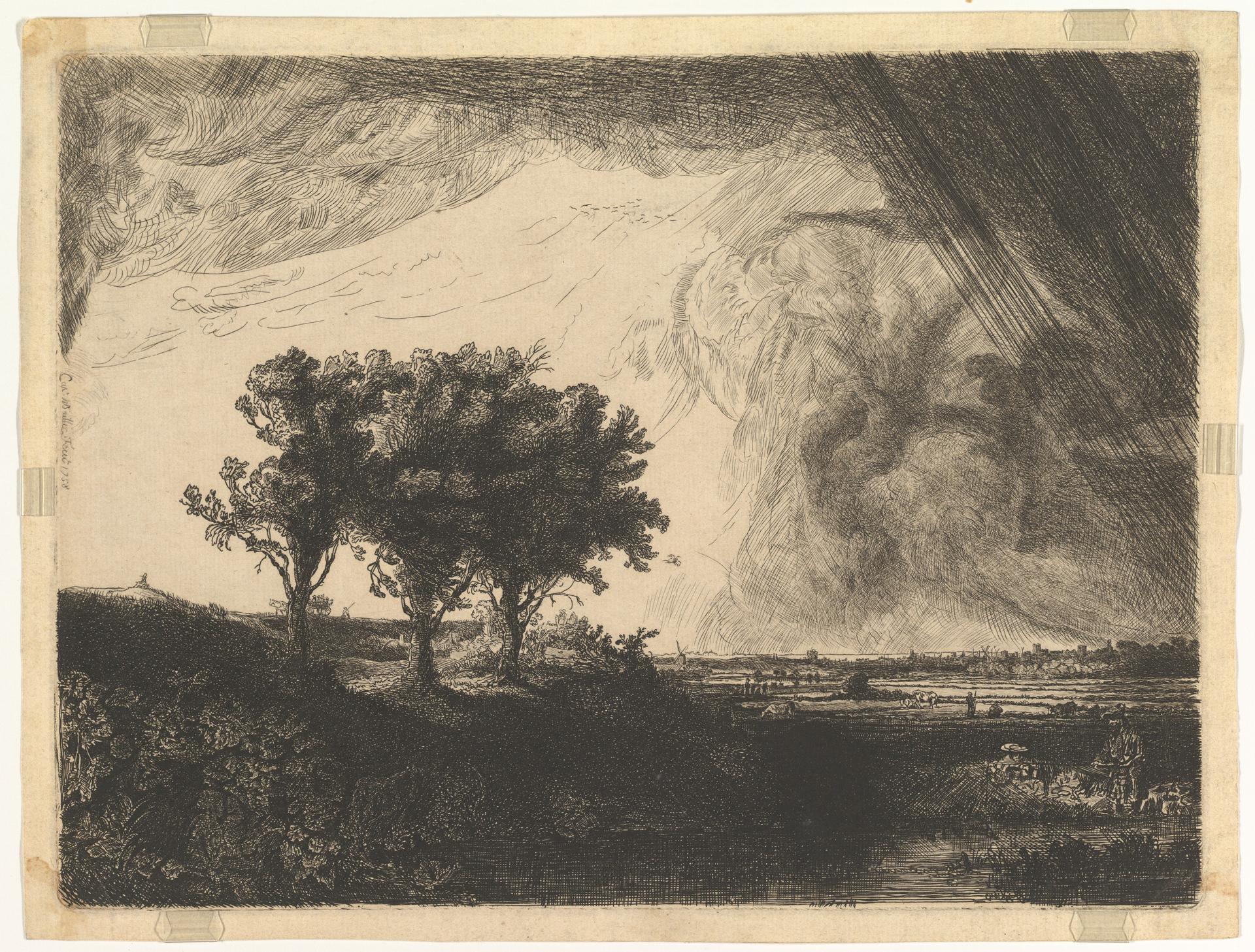
The Three Trees, after Rembrandt (1758, Met-Objekt 5402)
Original title: The Three Trees, after Rembrandt
kurzbeschreibung
Captain William E. Baillie made this etching in 1758 after Rembrandt's famous landscape. Three prominent trees dominate the foreground, and the print is in the second state of six, with the plate measuring 21 x 28 cm.
Description
Three densely leafy trees rise on a hill in the foreground. Above them, a dramatic formation of storm clouds seems to move through fine lines and hatching. Fields and vegetation in the foreground create depth; on the right, two figures stand by a river or body of water. Shades of gray with strong light-dark contrasts define the image and reinforce the ominous mood.
Context
William E. Baillie was an eighteenth-century British officer and amateur artist. His 1758 etching is a reproduction after Rembrandt's famous painting 'The Three Trees' of 1643, considered a masterpiece of landscape art. At the time, reproductions of famous artworks through printmaking were widespread. The sheet shows the influence of the Dutch Baroque on eighteenth-century British art.
Impact
Dark clouds and bright patches of light create an atmospheric tension that draws the viewer straight into the dramatic mood. The dynamic linework gives the scene movement and intensity. The layout feels balanced and classical, as is typical of eighteenth-century art.
Technique
In etching, the drawing is incised into a metal plate and bitten with acid. Baillie used fine hatching and lines to model textures and shadows. This technique allowed precise lines and a wide range of gray tones, which are crucial for rendering light and atmosphere.
AI-generated description text
Source: Metropolitan Museum of Art · Public Domain (CC0 1.0)