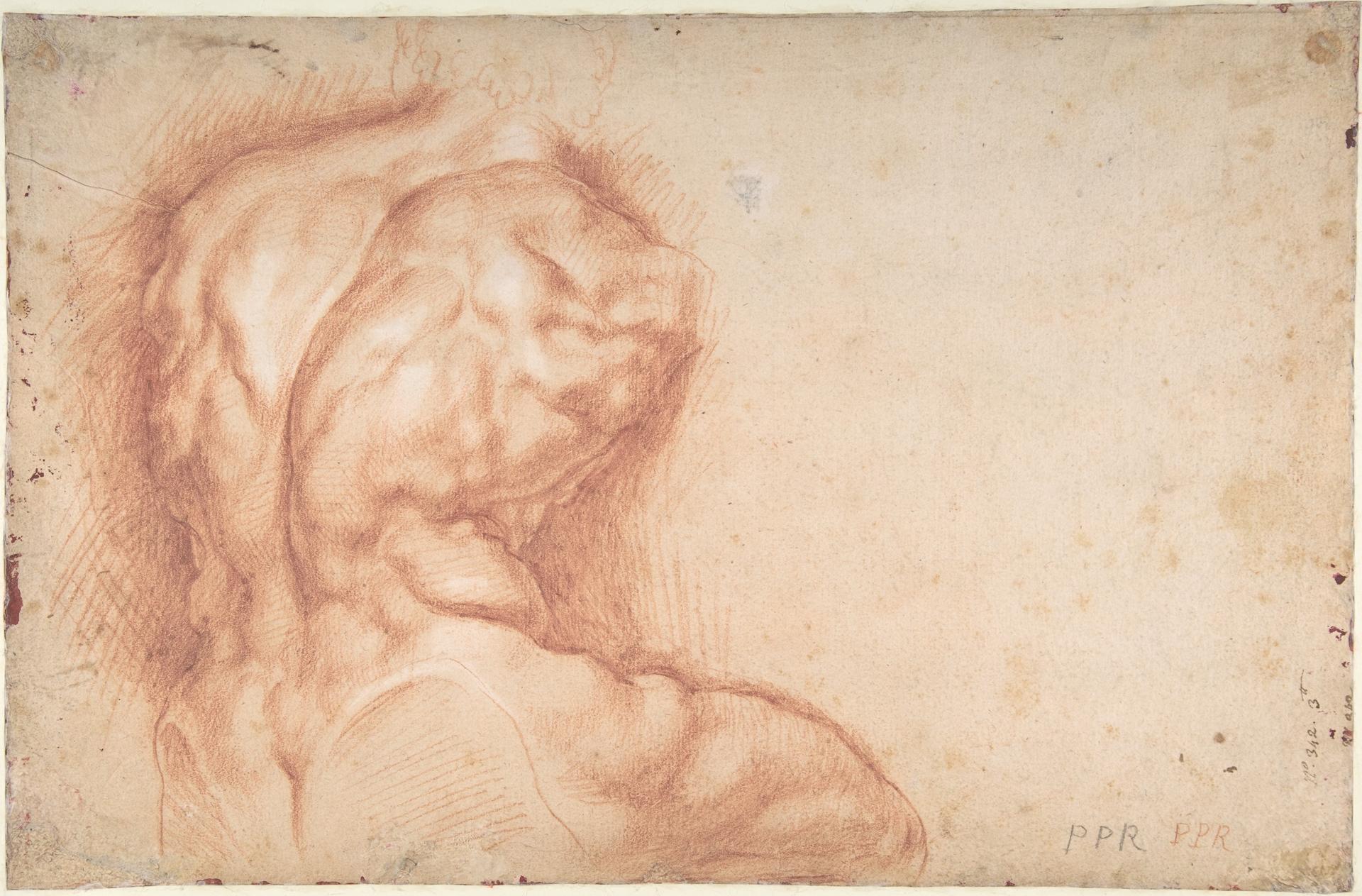
The Virgin Adored by Saints (recto); Study of the Torso Belvedere (verso)
Original title: The Virgin Adored by Saints (recto); Study of the Torso Belvedere (verso)
kurzbeschreibung
Peter Paul Rubens (1597–1640) combined two studies on this single sheet. On the recto, a pen-and-brown-ink drawing shows the Virgin adored by saints; on the verso, a red chalk study of the Belvedere Torso. Thus a religious invention and an engagement with an ancient model meet on one support.
Description
The recto presents a sketch in which the upper body of a figure is laid out; attention falls on the torso and head, whose gaze turns to the left. The lines flow freely and are rich in detail, suggesting a carefully prepared study. Around the figure the ground remains empty, with no further pictorial elements. The paper shows slight discoloration and stains, traces of time. At the lower right, the letters 'PPR' appear several times.
Context
The drawing dates from Rubens's Italian years (1600–1608), when he studied ancient works and made copies after classical sculptures. The red chalk study of the Belvedere Torso on the verso attests to this engagement with the famous sculpture. The Madonna with saints on the recto, in turn, shows how Rubens approached religious themes that played a central role in Catholic art of the Counter-Reformation.
Impact
Virtuosic lines define the sheet: both the pen drawing and the chalk study gain a lively movement from them. That religious devotion and ancient figure study come together here on one sheet reveals the breadth of Rubens's draftsmanship. The paper's signs of age surround the work with an aura of history.
Technique
Pen and brown ink govern the recto and allow fine, precise strokes. On the verso, red chalk is used, permitting softer tonal transitions. Both techniques are characteristic of Rubens's drawings and illustrate his handling of different materials.
AI-generated description text
Source: Metropolitan Museum of Art · Public Domain (CC0 1.0)